
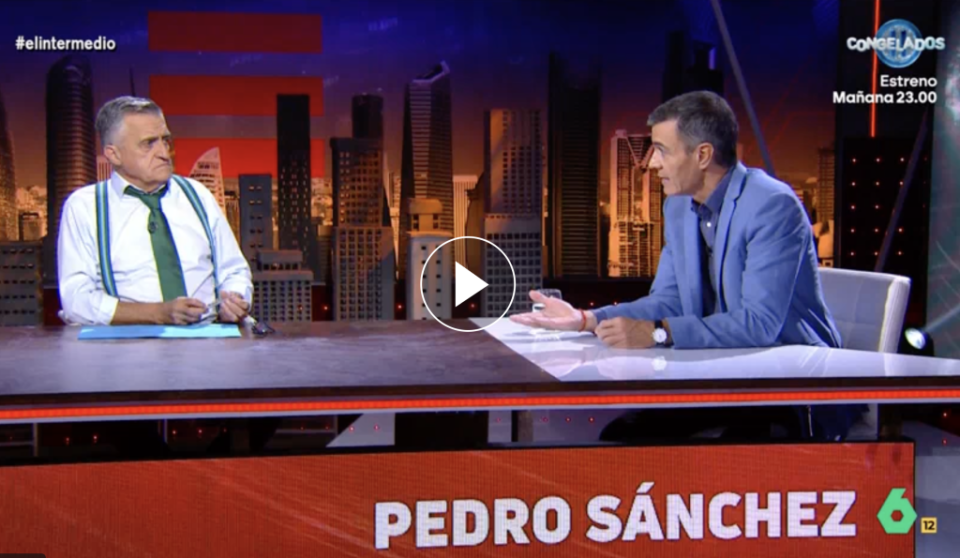
Spanish Prime Minister Pedro Sánchez has dismissed claims that his government is being blackmailed by Morocco as material better suited to ‘a Netflix series’, while saying the special command structure established to deal with the migration crisis in Ceuta could remain in place until the end of the year.
More than 70,000 migrants crossed into the Spanish North African city from Morocco on 30 and 31 July, overwhelming the authorities and leaving thousands of people still awaiting identification or decisions over deportation and international protection. ALSO READ: Spanish court to investigate deadly Ceuta migrant surge as possible ‘hybrid warfare’ operation.
Sánchez said on Monday that the government hoped to have the situation ‘stabilised’ by the end of the year, while increasing its capacity to accommodate migrants if necessary.
Speaking in an interview with La Sexta, he said the government was working to make 10,000 places available, with more than 6,000 expected to be operational by the end of this week.
The authorities are also seeking to speed up administrative procedures so that people who do not qualify for international protection can be returned to Morocco.
‘Nine out of ten people who entered have already returned to Morocco; and now 200 people a day are returning from Ceuta to Morocco,’ Sánchez said.
Several thousand migrants nevertheless remain in the city, where the authorities have faced the complex task of identifying those who arrived and determining whether they are entitled to asylum or other forms of protection. Unaccompanied minors cannot simply be deported.
The continuing pressure has contributed to growing tension in Ceuta, including demonstrations by local residents and episodes of violence. ALSO READ: Tensions erupt in Ceuta as protesters block food aid to migrants and government appeals for calm.
Sánchez appealed for ‘patience’ and ’empathy’ from the people of Ceuta, saying he hoped the situation could be resolved ‘sooner rather than later’. He also accused the right-wing People’s Party (PP) and far-right Vox group of exploiting the crisis to weaken the government rather than helping Ceuta. ALSO READ: Tens of thousands rally across Spain in support of Ceuta as crisis fuels anger at Sánchez government.
Sánchez rejects claims of Moroccan involvement
The prime minister also continued to defend Spain’s relationship with Morocco, insisting there was still no firm evidence that Rabat had deliberately orchestrated the mass crossings.
‘Relations with neighbours have to be based on respect and facts,’ Sánchez said.
He rejected suggestions that Moroccan authorities had deliberately stood aside as migrants approached Ceuta, arguing instead that they had also alerted Spain to movements towards the border. ALSO READ: Spanish PM backs Morocco over Ceuta migrant crisis as King Felipe visit is announced.
Sánchez described Morocco’s handling of the situation as an ‘intelligent way’ of managing the sudden influx and pointed instead to the consequences of a Supreme Court ruling and migrant networks as factors behind the events.
He also denied accusations that his government had played down warnings before the crossings. Referring to WhatsApp messages cited as evidence that alerts had been received, Sánchez said: ‘WhatsApps are not proof that there were warnings. In my view, it is rather the opposite.’ ALSO READ: Spain had warnings of mass migrant crossings into Ceuta, but not their scale, documents reveal.
Opposition figures have questioned why Sánchez has been reluctant to blame Morocco, with allegations circulating that Rabat could possess compromising information obtained from the hacking of one of the prime minister’s mobile phones. ALSO READ: Spain’s Ceuta crisis: Polls show widespread disapproval of Sánchez as PP and Vox pass 50%.
Sánchez categorically rejected suggestions that he was being blackmailed.
‘These false reports that are being spread, perhaps for a Netflix series, but reality has to be built on facts and not false reports,’ he said.
He added that his refusal to accuse Morocco without evidence should not be interpreted as ruling out action against Rabat if its involvement were eventually established. ALSO READ: Sánchez convenes National Security Council as government steps up response to Ceuta migrant crisis.
‘I have never said that we would not give a firm response to Morocco if it is proven that it is behind’ the events of 30 and 31 July, he said.
Sánchez maintained, however, that there was currently no solid information establishing Moroccan responsibility. ALSO READ: Spain’s police chief says Ceuta report does not attribute ‘planning or execution’ of migrant crisis to Morocco.
Ceuta president: ‘This was an invasion’
The prime minister’s assessment contrasted sharply with that of Ceuta president Juan Jesús Vivas, who said on Monday that he did not trust Sánchez to ‘protect Ceuta or Spain’.
Speaking separately to Antena 3, Vivas warned that the Spanish enclave had become ‘a pressure cooker that could explode at any moment’.
He argued that the mass crossings could have been prevented if the full resources of the Spanish state had been deployed beforehand and said the crisis went beyond the question of irregular migration.
‘What is at stake is the territorial integrity of Spain,’ Vivas said. ‘What Ceuta has experienced and what Ceuta is experiencing is not a migration crisis. It has been a full-scale invasion.’
Vivas said one of the principal lessons from the events was that control of the border could not depend on Morocco.
‘The border has to be in the hands of Spain and Europe,’ he said. ‘It is not a reliable country, and that is plain to see.’
Although Vivas stopped short of endorsing claims that Morocco possesses compromising information about Sánchez, saying he had no evidence to support such an allegation, he strongly criticised what he described as the Spanish government’s ‘extraordinary submission’ to Rabat.
He also questioned why Madrid had publicly thanked Morocco for its cooperation during the crisis, highlighting the increasingly stark divide between the Spanish government and the Ceuta authorities over both Morocco’s role and how the unprecedented events at the border should be interpreted. ALSO READ: Morocco stops new mass attempt to reach Ceuta as almost 300 migrants detained.
Enjoying the news from Spain in English? Add us as a preferred news source in Google.
Subscribe to the Weekly Newsletter from Spain in English.
Sánchez niega un chantaje de Marruecos y pide paciencia hasta “final de año” para “arreglar” la crisis de Ceuta https://t.co/ilF29aG4J2
— El Intermedio (@El_Intermedio) September 14, 2026
La entrevista completa a Pedro Sánchez en El Intermedio: de la crisis en Ceuta a la ‘ley de nietos’ y las causas judiciales que le rodean https://t.co/6hsJiw43RC
— El Intermedio (@El_Intermedio) September 15, 2026

Click here to get your business activity or services listed on our DIRECTORY.