
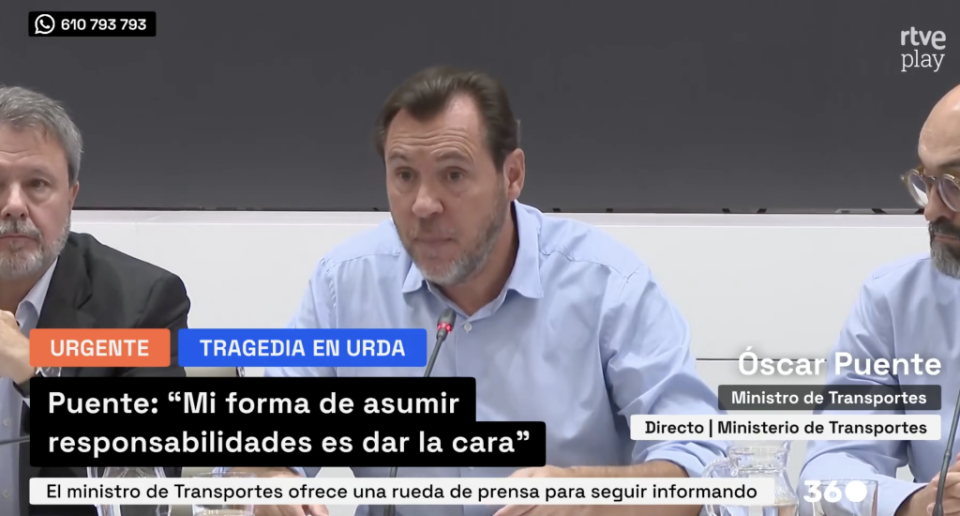
Spain’s Transport Minister Óscar Puente ruled out resigning on Friday as the investigation into the Urda rail disaster focused on a succession of technical failures and operating decisions that preceded the collision, which killed at least 69 people.
Speaking at his second press conference since Wednesday’s crash in the Toledo province (Castilla-La Mancha), Puente said his responsibility was to establish what happened, provide explanations and take measures to restore public confidence in the railway. ALSO READ: At least 69 dead and over 50 injured in high-speed train collision near Toledo.
‘My duty now is not to focus on discussing whether I will remain in office, but on solving the problem, determining exactly what happened and providing clear explanations,’ he said.
The minister faces mounting pressure from opposition parties and railway unions after Spain’s second major high-speed rail disaster in nine months. January’s collision at Adamuz, involving the same operators, Renfe and Iryo, killed 46 people, bringing the combined death toll to at least 115. ALSO READ: Families of Adamuz train crash victims to receive €216,000 under €20m compensation plan.
Puente acknowledged the pressure but said his way of accepting responsibility was to face questions publicly. He maintained that Spain’s railway remained safe, describing the circumstances of the latest disaster as ‘tremendously exceptional’.
Control-room instructions under scrutiny
The collision occurred after a computer-related failure disabled the LZB train protection system, automatically bringing several trains to a halt. Controllers at Adif’s Atocha control centre in Madrid then took over the task of authorising their movements under alternative operating procedures.
According to Puente’s account, a Renfe high-speed AVE train was allowed to resume its journey while an Iryo train remained stationary farther along the same track. The Iryo, being ahead, should have been authorised to move first. ALSO READ: Transport Minister says decision to let AVE proceed before fatal Toledo crash was ‘inexplicable’.
The AVE was also instructed to proceed at ‘normal speed’, rather than under restricted, sight-based running conditions. Puente said the applicable procedure required a maximum speed of 40 km/h, allowing the driver time to respond to an obstruction.
Recordings of communications between controllers and drivers document the instruction to resume normal running. The AVE was carrying 379 passengers and seven crew members; the Iryo had 147 passengers and five crew aboard. ALSO READ: Toledo crash recordings reveal restart orders as Iryo driver reported train still stopped.
Puente said a further problem arose when the Iryo was subsequently authorised to depart. Although it could not restart its system and remained stationary, a signal changed from red to green.
In the minister’s explanation, this meant the ASFA protection system did not warn the approaching AVE to stop at that signal.
‘It is impossible for the ASFA system to warn the AVE when it reaches the end of the block because the signal is green even though the Iryo has not resumed its journey,’ he said.
Puente said images corroborated his account and insisted that control-room displays continued to show the positions of the trains throughout the incident.
‘The system allows them to know where they are at all times. They could see what was happening,’ he said.
Although he repeated that he would not single out an individual employee, his explanation placed considerable emphasis on the sequence of decisions taken after the initial equipment failure.
Investigators examine why safeguards failed
The Independent Authority for the Technical Investigation of Accidents and Incidents (AITAT), estimated in its preliminary report that the AVE struck the stationary train at between 160 and 200 km/h.
Investigators said the precise impact speed would remain unconfirmed until information had been extracted from the train’s black box.
‘The sequence of malfunctions, instructions, and actions eventually led to the collision, in the absence of the necessary mitigating barriers,’ the authority said.
The preliminary findings leave investigators examining both the original technical malfunction and why subsequent safeguards failed to prevent a collision.
Railway unions have challenged the emphasis on controllers’ actions, arguing that working conditions and the failure of the protection system must also be investigated.
Raquel Ayllón, a union representative at infrastructure manager Adif, told state broadcaster TVE that staff were operating under difficult conditions.
‘Human error is being criticised and questioned very quickly, while people are not really focusing on the central issue: the failure of the safety system,’ she said.
On Friday, Puente disclosed that the LZB system had failed 170 times this year, describing that frequency as ‘within European norms’.
Questions over delayed signalling upgrade
The disaster has also renewed scrutiny of the delayed replacement of LZB on the Madrid–Seville high-speed line.
Public procurement documents cited by the Reuters news agency show that Adif awarded Thales España a €93.8 million contract in September 2021 to install the European Rail Traffic Management System, ERTMS, with completion scheduled for early 2026.
The contract subsequently passed to Hitachi Rail in 2024, according to Thales, which declined to comment on the rollout delay.
ERTMS is already installed across much of Spain’s high-speed network, but the Madrid–Seville route had fallen behind the timetable set out in the contract.
The delay has become a central issue in the political response, alongside questions about maintenance, operating procedures and the resilience of backup safety arrangements.
Families await identification of victims
At the crash site, large cranes continued removing wreckage while forensic teams worked to identify those killed.
Castilla-La Mancha government spokesperson Esther Padilla said on Friday that 49 autopsies had been completed and five victims formally identified: three women and two men. ALSO READ: King Felipe visits train crash survivors and urges action to prevent another tragedy.
‘Testing is proceeding slowly, although families will be contacted throughout the day so that they can come and collect their results,’ she told TVE.
The Guardia Civil had recorded 64 people as missing. It remained unclear how many were already included in the provisional death toll, meaning the two figures could not be added together.
Regional president Emiliano García-Page said no further bodies had been discovered when emergency teams overturned a carriage on Thursday. However, he warned that the death toll could still rise.
‘The truth is that we cannot rule out the possibility that there may be more fatalities,’ he said.
Identification was particularly difficult because some bodies had been fragmented. Rescue teams had collected partial human remains in 31 bags on Thursday; those bags did not represent a confirmed number of additional victims.
Resignation demands intensify before election
The disaster has brought railway safety to the forefront of the political debate ahead of the general election called by Prime Minister Pedro Sánchez for 29 November. ALSO READ: Spain’s latest rail tragedy puts safety and accountability at centre of election campaign.
Politicians across the parliamentary spectrum have criticised Puente’s response, while railway unions have demanded his dismissal.
On Friday, the right-wing opposition People’s Party (PP) explicitly called for his resignation. Its parliamentary spokesperson, Ester Muñoz, said he should leave office before his scheduled appearance in the Spanish Congress on Tuesday.
PP leader Alberto Núñez Feijóo accused the government of failing to replace an obsolete safety system and said political responsibility would ultimately be determined at the election. ALSO READ: Sánchez pledges firm action over Toledo train disaster as Feijóo demands answers.
‘If they do not resign, we will remove them at the ballot box,’ he said. ALSO READ: PP and Vox strike Senate election deal with judicial appointments in their sights.
Sánchez, meanwhile, acknowledged that public confidence in high-speed rail had been damaged and said the government must establish the causes and provide solutions to prevent another disaster.
‘It is unacceptable for a country like Spain, with such a strong high-speed rail system, to suffer two accidents of this nature and magnitude in a single year,’ he said.
Puente insisted he remained capable of leading that response and retained the prime minister’s confidence.
‘I believe it is safe and that the events that have occurred are tremendously exceptional,’ he said of the railway network.
Enjoying the news from Spain in English? Add us as a preferred news source in Google.
Subscribe to the Weekly Newsletter from Spain in English.
Óscar Puente: “Como ministro, asumo mi responsabilidad de garantizar que los procedimientos funcionen, que se investigue lo sucedido y que se adopten las medidas necesarias para evitar que vuelva a ocurrir. Respecto a las peticiones de dimisión, respeto todas pero creo que las decisiones de esta naturaleza deben valorarse a partir de los hechos, de las responsabilidades que se determinen y de las respuestas que demos a la ciudadanía. Y no a la presión del momento que, evidentemente, es muy grande” https://t.co/aDLeVPNBAb
— RTVE Noticias (@rtvenoticias) October 30, 2026
⭕️ Óscar Puente: “No voy a utilizar a ningún trabajador como escudo ni a prejuzgar responsabilidades antes de que concluya esa investigación”. “Mi forma de asumir responsabilidades es dar la cara”. ➡️ “Mi confianza en Adif y en su personal es inequívoca”. ▶️ “Siento un dolor inmenso y una enorme tristeza. Las víctimas siempre estarán en mi memoria”. #Mañaneros30O
— Mañaneros 360 (@MananerosTVE) October 30, 2026
Esta es la rueda de prensa que, por espacio de casi dos horas y sin límite de preguntas he ofrecido hoy. https://t.co/z5E4R3DVWi
— Óscar Puente (@oscar_puente_) October 30, 2026

Click here to get your business activity or services listed on our DIRECTORY.