
Spain’s National Police director has told Interior Minister Fernando Grande-Marlaska that a controversial intelligence report submitted to the National Court does not attribute the ‘planning or execution’ of July’s mass migrant entry into Ceuta to the Moroccan security forces.
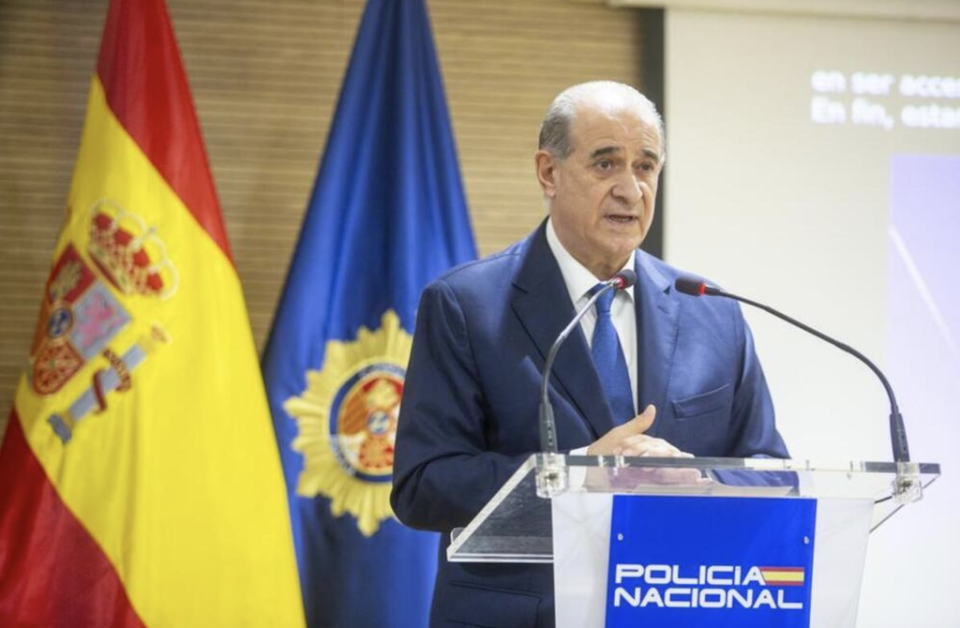
Francisco Pardo Piqueras (main image, from archive) gave the assurance on Wednesday after being granted access to the report for the first time, amid growing controversy over its findings. According to the Interior Ministry, Pardo told Marlaska that ‘there is no police report whatsoever that attributes to the Moroccan security forces the planning or execution of what happened on 30 and 31 July in Ceuta’.
The document, prepared by the National Centre for Immigration and Borders (CENIF), was submitted to National Court judge María Tardón as part of a preliminary judicial investigation into the events of late July, when approximately 72,000 people crossed from Morocco into Ceuta in an unprecedented mass movement across the border.
Despite Pardo’s assertion, Spanish media including RTVE and El Español have reported that the CENIF analysis contains photographs, video footage and other material indicating that uniformed Moroccan gendarmes actively directed migrants towards particular crossing points, while individuals in plain clothes – suspected of being Moroccan intelligence personnel – allegedly issued instructions on the ground near the El Tarajal breakwater.
The document reportedly concludes that the objective went beyond migration itself and included overwhelming Spain’s border-control system and reducing the authorities’ ability to respond effectively. It also examines the incident in the context of Morocco’s longstanding territorial claims over the Spanish cities of Ceuta and Melilla.
RTVE reported on Wednesday that legal sources had confirmed that the police analysis indicated Moroccan gendarmes and plainclothes agents had guided the mass movement towards Ceuta. The broadcaster also reported that the incident was characterised in the analysis as an offensive counter-intelligence operation intended, among other objectives, to undermine the credibility of Spain’s security and intelligence apparatus, including the National Intelligence Centre (CNI).
The controversy therefore hinges on a crucial distinction between what the report is said to document about the actions of Moroccan personnel on the ground and Pardo’s insistence that it does not attribute the overall ‘planning or execution’ of the mass entry to Morocco.
Marlaska demands to know why he was not informed
The revelation has caused considerable alarm inside the Spanish government, which had apparently been unaware that such an assessment had been sent to the National Court.
Grande-Marlaska responded in the early hours of Wednesday by sending an unusually direct letter to Pardo demanding clarification.
‘If what this digital publication reports is true, I need to know since when the National Police had this information, which is absolutely essential so that, irrespective of any judicial proceedings that may be carried out, I, as Interior Minister, can exercise my responsibility,’ Marlaska wrote, according to the Spanish reports.
Marlaska said the information was also necessary so that the government could ‘adopt the appropriate decisions’ concerning the Ceuta crisis as part of its constitutional responsibility for domestic and foreign policy and the defence of the state.
His concern is particularly acute because Spain declared the Ceuta emergency a situation of interest to national security under the 2015 National Security Law. ALSO READ: Sánchez convenes National Security Council as government steps up response to Ceuta migrant crisis.
Marlaska argued that information of this significance should therefore have been made immediately available to the National Security Council and other authorities responsible for managing the crisis.
Judicial proceedings, he added, should not prevent the state security forces from immediately informing the Interior Ministry, who holds ultimate responsibility for domestic security.
On Wednesday morning, according to Spanish media, the judge lifted restrictions on the investigation sufficiently to allow senior police officials to see the document.
Pardo subsequently summoned senior officials responsible for immigration and police intelligence before reporting back to Marlaska.
Dispute over warning issued before mass crossing
Another potentially important issue concerns what the Spanish police knew before the border was overwhelmed.
CENIF sent an alert to border posts on 29 July, the day before the mass influx began. Earlier reports suggested that the warning referred to an ‘extreme risk of mass entry’ into Ceuta.
Pardo has now given Marlaska a different account of its significance.
According to the police director, the 29 July communication was one of the risk alerts routinely circulated to border posts and contained no reference to the possibility of a mass entry occurring the following day.
Police sources quoted by El País, however, said that material subsequently used to compile the CENIF report had been discussed with Spain’s Secretary of State for Security during various meetings and warnings in the weeks following the crisis.
Precisely who knew what – and when – has consequently become almost as politically sensitive as the report’s conclusions about Morocco.
Findings clash with government’s public position
The controversy is particularly damaging because it follows repeated statements by Prime Minister Pedro Sánchez and his ministers rejecting suggestions that the Moroccan authorities organised the influx. ALSO READ: Spanish PM backs Morocco over Ceuta migrant crisis as King Felipe visit is announced.
In an interview with Cadena SER on Monday, Sánchez said there was no information from intelligence agencies normally working with Spain suggesting Moroccan involvement. Instead, he praised Morocco for providing ‘instantaneous, immediate’ cooperation following the crisis, including assistance with returning migrants.
The Spanish government has also claimed to have evidence of a disinformation campaign involving Russia, Israel and the international far right which helped provoke the crisis.
That account is now being subjected to much greater scrutiny following the disclosure of the CENIF material.
On Wednesday, the government urged ‘maximum caution’ while the contents and status of the police document are established.
Sources at Moncloa told RTVE that the government itself still did not possess the report and expressed surprise that information potentially affecting national security had apparently not been passed upwards. ‘The Police will have to give explanations,’ the sources said.
Presidency Minister Félix Bolaños similarly said it was necessary to know the report ‘in detail’ before drawing conclusions or deciding whether Spain should demand explanations from Rabat.
Territorial Policy Minister Ángel Víctor Torres, who has been placed in overall charge of the government’s response to the Ceuta crisis, said Madrid would not rule out seeking explanations from Morocco if direct responsibility were ultimately established.
Culture Minister Ernest Urtasun, from the government’s left-wing Sumar coalition partner, has gone further, arguing that Morocco must bear some degree of responsibility, whether through action or omission, for an influx on such an extraordinary scale.
National Court awaits prosecutors’ assessment
Behind the political confrontation lies a potentially significant judicial investigation.
Judge María Tardón began preliminary proceedings following a complaint filed by the political party Iustitia Europa after the July crossings. ALSO READ: Spanish court opens security inquiry into Ceuta mass crossing as Morocco cites trafficking networks and false rumours.
Rather than immediately opening a full criminal case, Tardón requested reports from both the National Police and Guardia Civil to establish whether the mass movement had been a spontaneous migration event or an ‘action concerted or directed’ by a criminal organisation or another actor. ALSO READ: Sánchez condemns mass Ceuta crossing as ‘violation of Spain’s territorial integrity’.
She also sought to establish whether the Spanish government or security authorities possessed advance intelligence about what was going to happen.
The complaint argued that the simultaneous mobilisation of thousands of migrants from Morocco could not be regarded as an ordinary or spontaneous migration phenomenon. It alleged that migration flows had instead been instrumentalised on a scale capable of overwhelming Spain’s security forces and reception services and potentially threatening public security and territorial integrity on an external frontier of the European Union.
The CENIF report was produced as part of that process and sent to Tardón at the National Court.
The judge has now forwarded the material to prosecutors, who must give their opinion on whether there are sufficient grounds for a criminal investigation and, crucially, whether any potential offences fall within the jurisdiction of the National Court because they concern the security or independence of the Spanish state.
Depending on the prosecution service’s response, Tardón will decide whether to open a formal investigation at the National Court or send the case to an ordinary court in Ceuta.
Political pressure intensifies
The disclosure has meanwhile opened another major political front for Sánchez’s government.
The right-wing opposition People’s Party (PP) has accused the government of concealing Morocco’s alleged ‘active role’ in the crisis and demanded urgent explanations. PP leader Alberto Núñez Feijóo has called for the Moroccan ambassador to be summoned and for Spain’s ambassador in Rabat to be called back for consultations.
Pressure is also emerging from within the governing coalition. Sumar figures have demanded greater transparency, while Izquierda Unida has called for political resignations if it emerges that crucial information was withheld.
The central question therefore remains unresolved.
CENIF’s analysis reportedly contains evidence that Moroccan security personnel actively guided migrants during the extraordinary movement of tens of thousands of people into Spanish territory and examines the incident as something more than a conventional migration crisis.
Yet Spain’s most senior police official insists that the report itself does not formally attribute the planning or execution of the operation to the Moroccan security forces.
The distinction between those two claims – and what the evidence contained in the confidential report ultimately demonstrates – is now likely to determine not only the course of the National Court proceedings, but also whether Spain’s government faces a serious diplomatic confrontation with Morocco and a deepening political crisis at home.
Enjoying the news from Spain in English? Add us as a preferred news source in Google.
Subscribe to the Weekly Newsletter from Spain in English.
#ÚLTIMAHORA | El director general de la Policía comunica a Marlaska que no existe ningún informe policial que señale a Marruecos en la crisis de Ceuta. pic.twitter.com/7502DzsOkA
— EFE Noticias (@EFEnoticias) September 2, 2026
🔴El director de la Policía asegura al ministro del Interior que el informe policial, encargado por la Audiencia Nacional, no atribuye a Marruecos la entrada masiva de migrantes en Ceuta.
— RTVE Noticias (@rtvenoticias) September 2, 2026
🎙️ @DanielLuisMar10#Canal24Horas pic.twitter.com/Hr3KHLDJt4

Click here to get your business activity or services listed on our DIRECTORY.