
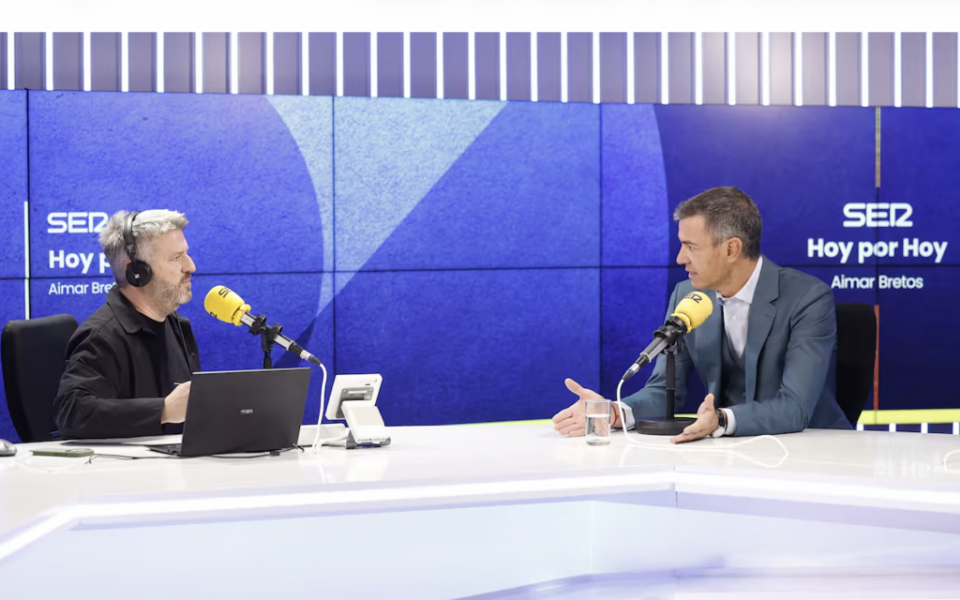
Spanish Prime Minister Pedro Sánchez has rejected suggestions that Morocco was behind the unprecedented migrant influx into Ceuta, insisting that cooperation with Rabat is essential to resolving the crisis, as he also announced that King Felipe VI will visit the Spanish enclave when circumstances allow.
Speaking on the Radio SER on Monday in his first media interview since the mass arrivals at the end of July, Sánchez said investigations were continuing into how more than 70,000 people crossed into Ceuta from neighbouring Morocco over a short period, many swimming around the border barriers or entering on foot.
The overwhelming majority returned to Morocco within hours, but Sánchez said around 5,000 migrants remain in Ceuta, including approximately 1,200 minors.
The influx placed enormous pressure on the Spanish territory, which covers just 18 square kilometres and has a resident population of around 80,000. Thousands of migrants have been left awaiting decisions over their status, while residents have staged demonstrations over security, overcrowding and sanitation concerns. ALSO READ: Tensions erupt in Ceuta as protesters block food aid to migrants and government appeals for calm.
Sánchez nevertheless strongly defended Morocco’s response to the emergency and dismissed speculation that the authorities in Rabat had deliberately facilitated the crossings.
‘There is no information from any intelligence centre that casts any doubt on the involvement of the Moroccan authorities,’ he said.
‘This crisis can only be resolved through cooperation and not through distrust toward Morocco, which would make the situation worse.’
Morocco praised for response
Questions over Morocco’s role emerged after some analysts suggested the sudden influx could have been intended as a political warning to Madrid following Sánchez’s visit to Algeria in July.
Relations involving Spain, Morocco and Algeria remain particularly sensitive because of the unresolved dispute over Western Sahara, the former Spanish colony largely controlled by Morocco but also claimed by the Algerian-backed Polisario Front.
Sánchez, however, said no intelligence service normally working with the Spanish government had provided evidence implicating the Moroccan authorities.
Instead, he described cooperation between the two countries as ‘frankly positive’ and said Moroccan officials responded rapidly once the scale of the emergency became clear.
Spanish authorities were in constant contact with their Moroccan counterparts during the mass crossings, he said, with a major security deployment visible the following day around Castillejos, on the Moroccan side of the border.
Morocco has also agreed to accelerate the return of Moroccan nationals in Ceuta who are not entitled to asylum and to assist with the family reunification of unaccompanied minors. ALSO READ: Morocco stops new mass attempt to reach Ceuta as almost 300 migrants detained.
Sánchez stressed that children could only be returned in accordance with Spanish law and where the appropriate request had been made by their parents or guardians.
He also rejected, for now, transferring migrants from Ceuta to mainland Spain, saying the government was preparing sufficient accommodation in the enclave itself.
Up to 6,000 reception places are expected to become available shortly, while Sánchez also pledged an additional €168 million in financial assistance for Ceuta to deal with the consequences of the crisis.
He said most of those who remain in the city appeared to have entered for economic reasons and would therefore probably be returned to Morocco once their cases had been processed. At least 100 people have already been deported after committing criminal offences, according to the prime minister. ALSO READ: Ceuta police clear migrants from Trampolín beach and move them to temporary shelters.
Disinformation investigated
Sánchez said investigators were also examining the role played by online misinformation in encouraging thousands of people to attempt the crossing.
He linked the surge partly to false claims surrounding a Spanish Supreme Court ruling on 8 July, which was subsequently misrepresented online as meaning that migrants who reached Ceuta by swimming could not be returned to Morocco.
According to Sánchez, misleading versions of the ruling were circulated not only by people-trafficking networks but through social media networks associated with Russia, Israel and what he described as an international far right.
‘After 30-31 July, rumours and disinformation spread on social networks linked to Russia and Israel, and to an ultra-right international that always uses migration to attack both Spain and Europe and divide it,’ he said.
Sánchez said the European External Action Service had identified Russian and Israeli-linked networks involved in spreading false information.
However, the precise combination of events that triggered such an extraordinary number of people to head for the border remains under investigation.
Government had warnings of increased crossings
Sánchez also addressed controversy over whether his government had received advance warnings that a major migration emergency was developing.
He acknowledged that both Spain’s National Intelligence Centre (CNI) and National Police had produced situation reports indicating an increase in irregular migration flows ahead of 30 July.
However, he insisted there had been nothing to suggest that an influx on anything approaching the eventual scale was imminent.
‘I can assure you that no information made it possible to gauge the scale, the seriousness of the crisis we were going to experience on 30 & 31 July,’ Sánchez said. ‘Nobody predicted that we were going to have an influx of those characteristics.’
Between 26-29 July, authorities in Ceuta and central government officials had held several meetings after detecting an increase in migrants attempting to reach the territory by swimming.
Sánchez said those movements initially appeared comparable with seasonal increases experienced during previous summers.
Measures were nevertheless taken, including reinforcing border controls and increasing capacity at Ceuta’s temporary migrant reception centre, although preparations were nowhere near the level ultimately required.
The government has also faced criticism for waiting 25 days before establishing a single command structure to coordinate its response. ALSO READ: Sánchez convenes National Security Council as government steps up response to Ceuta migrant crisis.
Sánchez said such an arrangement had not initially been considered necessary because Spain already had experience of handling previous migration emergencies in Ceuta and the Canary Islands. It was subsequently introduced at the request of Ceuta president Juan Jesús Vivas and because the nature of the crisis had evolved.
With the immediate border emergency largely brought under control, Sánchez said the focus was now shifting towards speeding up the processing of the thousands of outstanding immigration cases and developing a longer-term social, economic and security response for Ceuta.
King Felipe to visit Ceuta
The prime minister also announced that King Felipe VI is expected to visit Ceuta, although no date has yet been fixed.
Sánchez said the visit would take place ‘when the conditions are right’, adding that ‘there are reasons and arguments for it’.
Any trip would be coordinated between the government and the royal household.
Felipe has never visited Ceuta as king or during his years as Prince of Asturias.
The last Spanish monarch to make an official visit was his father, Juan Carlos I, who travelled with Queen Sofía to Ceuta and Melilla in November 2007. It was the first official visit to the two Spanish territories by a head of state in more than 70 years.
The proposed royal visit comes as Madrid attempts to demonstrate its support for Ceuta while simultaneously preserving cooperation with Morocco, which Sánchez made clear he regards as indispensable to preventing another migration emergency on the same scale.
Enjoying the news from Spain in English? Add us as a preferred news source in Google.
Subscribe to the Weekly Newsletter from Spain in English.
🗣️ @sanchezcastejon: “No hay ninguna información por parte de ningún centro de Inteligencia que alumbre duda sobre la participación de las autoridades marroquíes. La relación bilateral tiene muchas aristas”
— Hoy por Hoy (@HoyPorHoy) August 31, 2026
“La cooperación con Marruecos está siendo francamente positiva” pic.twitter.com/CyyzjSC2hv
Ceuta saldrá reforzada.
— Pedro Sánchez (@sanchezcastejon) August 31, 2026
Me hago cargo del estado de ánimo de la ciudad autónoma.
Soy muy consciente de que todos los recursos son insuficientes hasta que no se recuperen la normalidad y la tranquilidad.
El Gobierno aprobará una ampliación extraordinaria del plan especial para… pic.twitter.com/fuhUufvRl6

Click here to get your business activity or services listed on our DIRECTORY.