
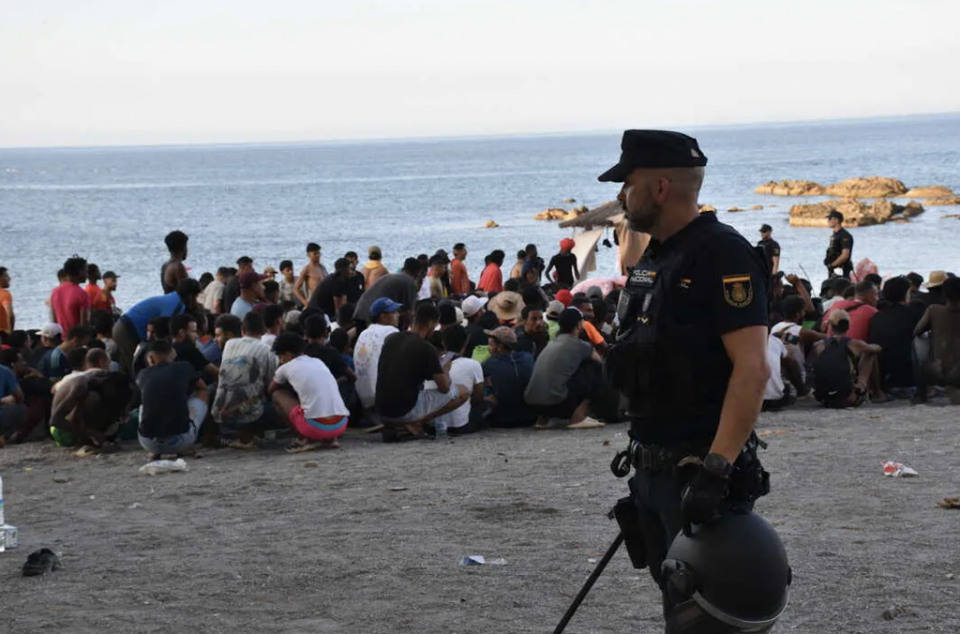
Spanish Prime Minister Pedro Sánchez convened the National Security Council on Tuesday morning to coordinate the government’s response to the continuing migrant crisis in Ceuta, almost four weeks after tens of thousands of people crossed into the Spanish enclave from neighbouring Morocco.
The meeting at Madrid’s Moncloa Palace took place ahead of the first Cabinet meeting following the summer break and marked a significant escalation in the central government’s response to a crisis that has placed Ceuta’s public services, security forces and local economy under severe pressure.
The government is also set to approve a Royal Decree declaring the situation in Ceuta to be of interest to national security, allowing greater coordination of state resources as authorities attempt to restore normality in the autonomous city.
Sánchez’s government has already announced a series of measures, including the creation of a single command structure headed by Territorial Policy Minister Ángel Víctor Torres, additional health resources and vaccines, reinforcement of the courts and an immediate expansion of Ceuta’s existing socioeconomic development plan.
Spain has also requested emergency financial assistance from the European Commission.
The development plan, introduced in 2022 and so far backed by more than €180 million, is expected to be expanded with measures aimed at strengthening security, accelerating the processing of migrant returns and helping Ceuta’s economy recover from the impact of the crisis. ALSO READ: Five arrests as police bust migrant smuggling ring charging €9,000 from Ceuta to mainland Spain.
Conflicting figures over scale of arrivals
The unprecedented influx began on 30 and 31 July, when huge numbers of migrants entered Ceuta from Morocco.
Spain’s Interior Ministry has previously estimated that approximately 72,000 people entered during the two days, although other officials have put the total considerably higher.
The Spanish government’s representative in Ceuta, Miguel Ángel Pérez Triano, said on Monday that more than 80,000 people had crossed through the Tarajal border, while Ceuta’s president, Juan Jesús Vivas, has said that more than 8,000 migrants remain in the city. ALSO READ: Ceuta police clear migrants from Trampolín beach and move them to temporary shelters.
The differences underline the difficulty authorities have faced in establishing precise numbers following such a large and sudden movement of people.
Pérez Triano acknowledged on Monday that Ceuta remained ‘very far’ from returning to normal, 25 days after the crisis began. ALSO READ: Thousands remain in Ceuta as Spain moves to expand emergency accommodation.
Following a meeting with officials from the National Police Immigration and Borders Brigade, he said additional facilities had been opened but that there were still insufficient places to accommodate everybody requiring assistance.
He also rejected demands for his resignation over the handling of the crisis, saying that leaving his post while the emergency continued would be ‘an absolute act of irresponsibility and cowardice’.
Humanitarian, health and security pressures
The consequences of the mass arrivals have extended far beyond the immediate challenge of controlling Spain’s border with Morocco.
More than 100 people are reported to have died by drowning during the crisis, while thousands of migrants were initially left without adequate shelter or reliable access to food and water. Emergency tented accommodation was subsequently established as authorities struggled to cope with the numbers. ALSO READ: Spain installs sea barrier as Ceuta slowly returns to normality and death toll rises to 72.
The large migrant population remaining in Ceuta has also placed increasing pressure on the city’s health services. Cases of contagious illnesses, including tuberculosis and scabies, have prompted additional public-health measures, with up to 25,000 vaccine doses reportedly being mobilised for the city following an agreement by Spain’s Public Health Commission.
Authorities have meanwhile been attempting to register and protect unaccompanied minors, considered among the most vulnerable people caught up in the crisis. Additional personnel have been required to deal with the registration process amid overcrowding and occasional disturbances outside police facilities.
There have also been concerns about public safety following reports of robberies, fights and sexual offences, many involving migrants themselves.
The prolonged disruption has had an increasingly serious effect on everyday life in Ceuta, with reduced commercial and social activity raising fears of substantial losses for local businesses. ALSO READ: Morocco stops new mass attempt to reach Ceuta as almost 300 migrants detained.
Opposition demands faster returns
Spain’s main opposition party, the right-wing People’s Party (PP), has increased pressure on the Sánchez government to accelerate the processing and return of migrants who remain in Ceuta.
PP spokesperson Borja Sémper called on the government to deploy ‘all the immigration units that are needed’ and for officials to work three shifts each day while the emergency continues.
‘It is unacceptable that returns are being processed as if this were a normal situation, because it is extraordinary,’ Sémper said.
‘As many civil servants as necessary must be mobilised for as long as necessary. They must all be returned, and as soon as possible,’ he added.
The government, however, must also deal separately with minors, people entitled to international protection and others whose individual circumstances prevent an immediate return.
Borrell attacks EU response
The crisis has also triggered a wider dispute within the European Union over migration policy and solidarity with Spain.
Former Spanish foreign minister and former EU foreign policy chief Josep Borrell has described the European reaction to events in Ceuta as ‘hysterical, disproportionate and absurd’, accusing most member states of failing to support Spain. ALSO READ: Spain imposes reciprocal border checks on Italy as Schengen dispute escalates.
Twenty-two EU countries have criticised aspects of Spanish migration policy, arguing that measures including the regularisation of undocumented migrants have helped create a so-called ‘pull factor’.
Borrell rejected that argument and said European countries needed to show greater solidarity while applying existing laws.
‘Several countries, all except France, Portugal, Luxembourg and Ireland, have gone into panic. European solidarity has disappeared. The laws must be applied,’ he said.
While acknowledging the need for Europe to strengthen control of its external borders, Borrell defended Spain’s position towards children and people potentially entitled to asylum.
‘The Spanish government is right to emphasise that minors have rights: the laws must be applied,’ he said.
What does the National Security Council do?
The National Security Council is the government body responsible for assisting the prime minister in directing Spain’s national security policy and coordinating the state’s response when a major crisis affects the country.
Chaired by Sánchez, it brings together senior ministers and officials responsible for areas including defence, foreign affairs, the interior, health, transport, territorial policy, migration and intelligence.
Other national, regional and local authorities can also be called to participate when a crisis directly affects their responsibilities.
The council normally meets at least once every two months, although the prime minister can convene it whenever circumstances affecting national security require a coordinated response. Its previous meeting was held on 21 April and focused principally on cybersecurity in the context of current international crises.
In the case of Ceuta, its role is to bring together the different arms of government and coordinate resources across areas including border security, policing, migration, healthcare, humanitarian assistance and economic recovery.
Its involvement also allows greater cooperation between central government ministries and the authorities in Ceuta, as well as other public administrations and, where necessary, the private sector and civil society.
The immediate priority has shifted from preventing the original mass crossing – which has already taken place – to ensuring that Ceuta can withstand its consequences and return to normality as quickly as possible.
Tuesday’s meeting therefore represented an attempt to move the response onto a broader national footing, almost a month after the crisis began, as the government faces the simultaneous challenges of caring for those who remain, processing returns, protecting vulnerable migrants and minors, restoring security and public services, and limiting the longer-term economic damage to the city.
Enjoying the news from Spain in English? Add us as a preferred news source in Google.
Subscribe to the Weekly Newsletter from Spain in English.

Click here to get your business activity or services listed on our DIRECTORY.