
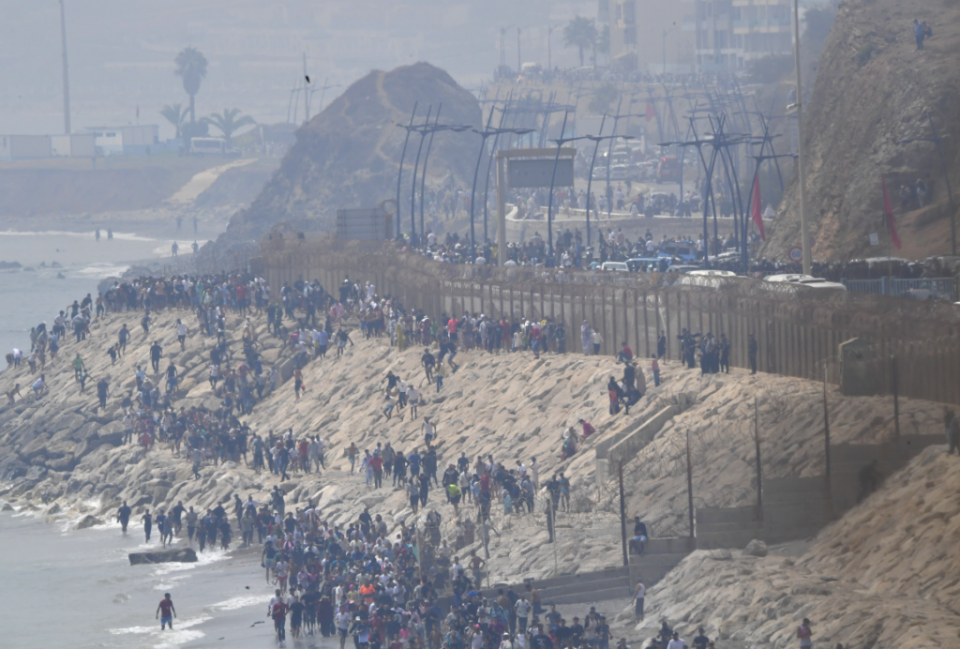
Spain’s intelligence and security services had detected mounting migration pressure and received warnings of possible coordinated mass crossings into Ceuta before more than 70,000 people entered the Spanish enclave from Morocco at the end of July, according to newly declassified government documents.
However, the material also indicates that the clearest intelligence about plans to enter Ceuta simultaneously by sea and across the land border emerged only on 29 July, around a day before the unprecedented influx began.
The Spanish government has published 40 intelligence reports, security assessments, alerts and communications covering the period from 1-31 July, following Prime Minister Pedro Sánchez’s pledge to declassify information surrounding the crisis. ALSO READ: Sánchez convenes National Security Council as government steps up response to Ceuta migrant crisis.
The documents provide the most detailed picture yet of what Spanish authorities knew before the events of 30 and 31 July, while also fuelling a political dispute over whether the government could have done more to prepare for the mass arrivals.
They show that warnings intensified dramatically during the final days of July, progressing from concerns over growing numbers of people swimming into Ceuta to assessments of a possible coordinated attempt to enter by both sea and land.
Intelligence warning on 29 July
One of the most significant alerts came from Spain’s National Intelligence Centre (CNI) on the afternoon of 29 July.
At 1.52pm, the CNI sent a WhatsApp message to the Spanish government’s delegation in Ceuta warning that social media was being used to call on people to enter the enclave the following afternoon, both by swimming and by crossing the border fence.
The proposed timing was significant because 30 July was Morocco’s Throne Day, a major national holiday, and those organising the attempts apparently believed Moroccan security forces would be distracted by the celebrations.
The CNI said the calls were circulating through two WhatsApp groups with a combined 180,000 followers.
‘There are two different groups with a total of 180,000 followers. Just to give you an idea of the scale,’ the intelligence service said.
One minute later, at 1.53pm, the CNI telephoned Spain’s Guardia Civil.
‘We have information about an attempted entry by swimming and jumping the fence for tomorrow, Throne Day,’ the CNI said, according to a transcript included in the released documents. ‘We have several groups on Fb and WhatsApp encouraging these entries.’
Spanish intelligence also sent an urgent warning that day to Morocco’s domestic and foreign intelligence agencies, the DGST and DGED.
That communication referred to the ‘planning of several calls’ to organise crossings into Ceuta and identified particularly active WhatsApp groups, including one called ‘Assault on the Ceuta fence’.
It also referred to Facebook groups containing approximately 160,000 and 22,000 participants, where Morocco’s Throne Day was reportedly being described as a ‘last opportunity’ to reach Ceuta. Spanish intelligence supplied Moroccan authorities with names and telephone numbers connected to the activity.
Later that evening, at 9.34pm, the Spanish government’s delegation in Ceuta held an 11-minute telephone conversation with the CNI. The declassified documentation does not reveal what was discussed.
Risk assessments had already been rising
The newly released material nevertheless shows that concern about irregular crossings had been building before the CNI’s warnings on 29 July.
Spain’s National Centre for Immigration and Borders (CENIF), part of the National Police, produced assessments on 28 and 29 July warning of possible irregular entries on 30 July.
On 28 July, it identified swimming into Ceuta as the form of irregular entry presenting the greatest immediate risk and said that ‘early signs on social media’ had been detected.
At that stage, however, officials said they had not identified evidence of an organised mass or violent assault on the land border. They recommended continued monitoring as online activity increased, including offers of wetsuits to people planning to make the crossing.
By the following day, the assessment had become considerably more serious.
CENIF warned of a ‘VERY HIGH RISK’ of arrivals by sea, noting that 921 people had swum into Ceuta during the month and that hundreds of others had been intercepted or rescued by Moroccan and Spanish authorities.
It also issued an ‘early warning’ over possible coordinated entries by land during the night of 29 July.
Another information note sent to border posts in Ceuta and Melilla that day assessed the potential impact of combined land and sea entries as ‘extreme’, although it placed the probability of such an event at ‘medium-low’.
For sea crossings alone, officials considered the probability ‘high’, but assessed the associated risk as ‘medium-low’.
‘It cannot be guaranteed that this will happen, but when this type of activity has been detected on social media and other forums, it has sometimes materialised,’ the report said.
By 30 July, CENIF was warning of an imminent ‘extreme risk of collapse’ caused by attempted entries into Ceuta and Melilla.
Migration pressure had been increasing throughout July
The documents also reveal a broader pattern of increasing migration pressure during the weeks before the crisis.
On 27 July, the CNI sent an assessment to relevant authorities in Madrid and Ceuta analysing irregular entries into both Ceuta and Melilla, the nationalities of those arriving and the reasons behind the increase.
It warned that pressure on the two Spanish enclaves from Morocco was likely to remain ‘high’, although it also expected Moroccan authorities’ controls on irregular migration to continue acting as a restraining factor.
An earlier Guardia Civil report, dated 10 July, had raised concerns about a possible increase in irregular sea crossings following a Spanish Supreme Court ruling concerning the immediate return of migrants entering by swimming.
The report warned that the ruling ‘could generate a pull effect’ and proposed reinforcing the Guardia Civil’s maritime service in Ceuta, increasing specialist underwater personnel in Melilla and strengthening technological systems used for early detection and coastal surveillance.
Official figures subsequently showed how rapidly the situation was deteriorating.
Before the mass arrivals of 30 and 31 July were included, 1,272 migrants had already entered Ceuta during July — an increase of 168% compared with the same period in 2025.
The Interior Ministry’s published figures stop at 2pm on 30 July, meaning the tens of thousands who subsequently crossed during the crisis are not included in that total.
No warning of the eventual scale, government insists
The central political argument now concerns the difference between warnings that mass or coordinated entries might be attempted and whether anyone could reasonably have anticipated their extraordinary eventual scale.
More than 70,000 people are estimated to have entered Ceuta during the crisis.
The CNI has stressed since the documents were released that, although it had detected and reported the online campaign encouraging crossings, it ‘did not anticipate the magnitude and nature of what ended up happening on the 30th, as it was an unusual phenomenon that does not correspond to the migration crises known to date’.
Spain’s Foreign Minister José Manuel Albares has made a similar argument.
‘I am speaking as Spain’s foreign minister, within my remit and based on what I experienced that day. I was not aware of any information of any kind pointing to the magnitude of the avalanche,’ he said on Wednesday.
Sánchez also defended the government’s response following publication of the documents.
‘With the information available at the time, no one could have foreseen the migration crisis that unfolded on the 30th and 31st. No competent body did so. Neither in Spain nor in the EU,’ he said.
The prime minister has also insisted that he received no intelligence containing ‘solid evidence that Morocco planned or carried out the incident’. ALSO READ: Spanish PM backs Morocco over Ceuta migrant crisis as King Felipe visit is announced.
Questions remain over Morocco’s response
The documents have nevertheless added to scrutiny of Morocco’s actions during the crisis. ALSO READ: Spanish court to investigate deadly Ceuta migrant surge as possible ‘hybrid warfare’ operation.
A previously leaked Spanish police report had pointed to what it described as the ‘permissiveness’ of Moroccan security forces, while some of the newly declassified material also questions the effectiveness of Morocco’s response. ALSO READ: Spain’s police chief says Ceuta report does not attribute ‘planning or execution’ of migrant crisis to Morocco.
An assessment by Spanish military intelligence on 30 July concluded that it was ‘highly likely that the Moroccan authorities are not actively encouraging the migratory wave, but have so far acted in a negligent and passive manner’.
Another Spanish assessment said that, at an operational level, there had been no effective proactive response from Moroccan authorities as control of the situation deteriorated, beyond the deployment of some riot police.
Spanish reports also state that large numbers of people had gathered on the Moroccan side of the border during the night of 29 July waiting to enter the water.
Although additional Moroccan police and gendarmes were deployed, Spanish intelligence concluded that their presence was insufficient to control the crowds, with several hundred people already managing to swim into Ceuta during the night.
Political pressure grows over handling of crisis
Spain’s opposition has seized on the declassified material as evidence that the government had sufficient warning to take stronger preventive action.
‘The government knew everything that was happening … They had the information. They are directly responsible for the invasion of Ceuta,’ the People’s Party (PP) parliamentary spokeswoman Ester Muñoz said. ALSO READ: Tens of thousands rally across Spain in support of Ceuta as crisis fuels anger at Sánchez government.
The government rejects that interpretation, arguing that the reports warned of heightened migration pressure and possible mass attempts to cross the border, but did not predict anything approaching the extraordinary number of people who eventually arrived.
The distinction is likely to remain at the centre of the political controversy: the documents demonstrate that Spanish authorities were increasingly aware of preparations for coordinated crossings, particularly during the final 24 hours, but they also show that the security services themselves did not anticipate an influx on the scale that subsequently overwhelmed Ceuta. ALSO READ: Spain’s Ceuta crisis: Polls show widespread disapproval of Sánchez as PP and Vox pass 50%.
Six weeks after the crisis, its consequences are still being felt in the enclave. ALSO READ: Morocco stops new mass attempt to reach Ceuta as almost 300 migrants detained.
More than 10,000 migrants, including unaccompanied minors, reportedly remain in Ceuta, many living in makeshift accommodation or on streets and beaches. NGOs estimate that around 140 people died during the mass crossing.
The continuing presence of thousands of migrants has also fuelled protests by residents over the Spanish government’s handling of the crisis, ensuring that questions about what Madrid knew – and whether more could have been done before 30 July – are unlikely to disappear with the publication of the intelligence files.
Enjoying the news from Spain in English? Add us as a preferred news source in Google.
Subscribe to the Weekly Newsletter from Spain in English.
El CNI alertó el 29 de julio al delegado del Gobierno de un “asalto” a Ceuta https://t.co/H5d5Dg5vUG pic.twitter.com/Ft31u3mMSK
— RTVE Noticias (@rtvenoticias) September 10, 2026

Click here to get your business activity or services listed on our DIRECTORY.