
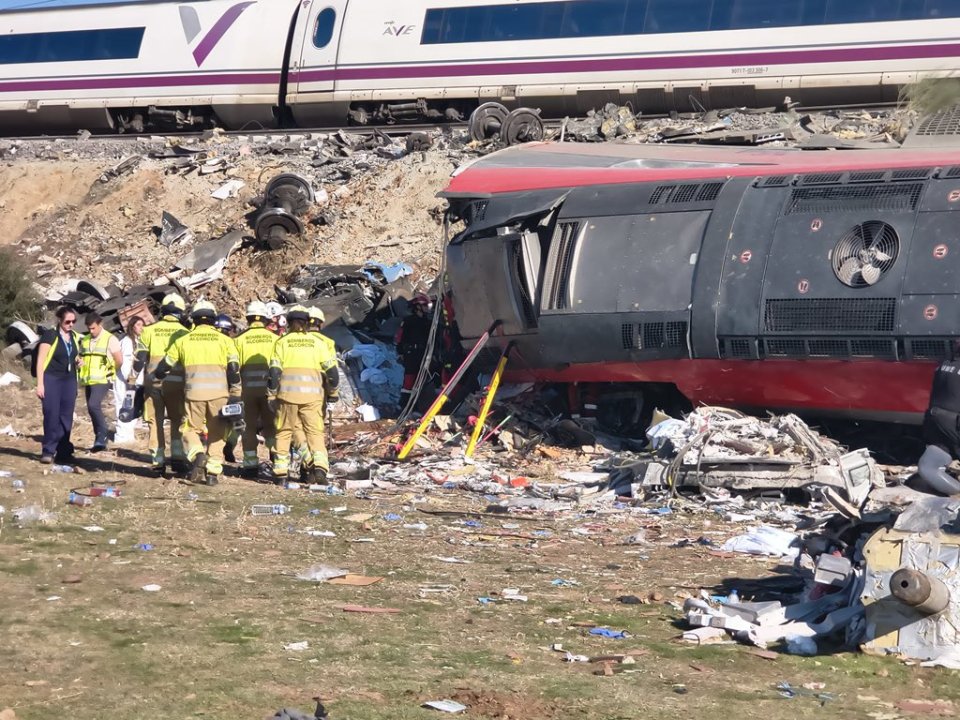
Recordings of communications before the deadly train collision near Urda in the province of Toledo reveal that Adif’s Atocha control centre instructed both drivers to restart their trains and resume normal running – but the Iryo remained stationary while the RENFE AVE approached from behind. ALSO READ: At least 68 dead and over 50 injured in high-speed train collision near Toledo.
The three recordings, reported by Spanish media, include a subsequent warning from the Iryo driver that she could not restart the train’s LZB protection system and was still stopped at the station’s entrance signal. ALSO READ: Transport Minister says decision to let AVE proceed before fatal Toledo crash was ‘inexplicable’.
The exchanges raise questions about the instructions issued after the safety system failed, whether controllers established that the route ahead was clear and whether the approaching AVE was warned in time. However, the published recordings may not represent all communications between the parties, and conflicting accounts of the timings remain unresolved.
At least 68 people died in Wednesday’s collision on the Madrid–Seville high-speed line in the Toledo province. ALSO READ: Sánchez pledges firm action over Toledo train disaster as Feijóo demands answers.
8.36am: AVE instructed to resume normal running
The first exchange concerns RENFE AVE 02080, which was initially around 25 kilometres behind the Iryo.
Following the loss of the LZB system, the AVE driver reported a transmission failure. During a conversation lasting more than five minutes, a controller referred to the failure at Urda and discussed disconnecting the equipment before issuing a formal instruction.
‘Train driver 2080. Disconnect and reconnect the LZB. Resume running. And then resume running under BSL with normal running,’ the controller said, according to the transcript published by El País.
‘With normal running?’ the driver asked.
‘Yes,’ the controller replied.
The instruction was recorded at 8.36am. Normal running could permit speeds of up to 200km/h on the section, although that does not establish the AVE’s actual speed before impact.
According to the government’s interpretation, reported by El País, the train should instead have been instructed to proceed on sight, subject to a 40km/h limit and prepared to stop for an obstruction. The newspaper also reported that controllers had not first established sufficient separation from the train ahead.
8.41am: Iryo driver reports she is stopped
In the next published exchange, timed at 8.41am, the driver of Iryo 6076 told Atocha that her train was stationary at Urda’s entrance signal following a loss of transmission.
‘I have had a loss of transmission and I am stopped at the Urda entrance signal,’ she said, according to Spanish state broadcaster RTVE’s transcript.
Controllers initially told her they were not authorising her to pass the signal and instructed her to watch its indications. Later in the exchange, she too was told to disconnect and reconnect the LZB equipment and resume normal running under BSL.
By then, the following AVE had already been authorised to move for several minutes.
The distinction between an instruction to restart and confirmation that a train has actually moved is central to the sequence: despite receiving the instruction, the Iryo did not resume its journey.
A further call: ‘I am still stopped’
The Iryo driver subsequently contacted the control centre again to explain that the restart had not worked.
‘The train is not allowing me to restart the LZB system. And that is why I am still stopped before the entrance signal,’ she said.
The controller replied: ‘OK. Understood? Well then, as soon as you can. And if you have a problem, call us.’
‘OK, perfect. I’ll let you know,’ the driver answered.
El País placed this conversation at 8.48am, five minutes before the government’s stated collision time. RTVE said it could not establish the time of this third recording.
The audio then captured an internal discussion among control-centre staff about a train experiencing equipment problems and how to handle the situation at Urda.
According to El País, the available recordings contain no apparent warning to the AVE to stop after the Iryo driver confirmed that she remained stationary. Whether additional communications took place has not been established from the published extracts.
Conflicting accounts of the final minutes
The government’s reconstruction places the collision at 8.53am, approximately 17 minutes after the AVE received its restart instruction.
However, RTVE reported a different account from sources close to Iryo. Those sources said the driver was already communicating with the control centre at 8.38am and placed the impact at 8.48am. They also maintained that the Iryo had not received authorisation to resume running before the collision.
That version conflicts with the chronology attached to the published recordings and with the government’s account. Establishing the precise times, the full sequence of instructions and what each participant knew will be essential to resolving those discrepancies.
Safety procedures at the centre of the inquiry
The communications followed a failure of LZB, the system used to supervise and protect train movements on the Madrid–Seville line. Services were subsequently managed under an alternative signalling arrangement known as BSL, or Bloqueo de Señalización Lateral.
The key question is not simply why the main system failed, but how trains were authorised to move afterwards – and what safeguards should have applied while it remained unavailable.
The government has pointed to possible human error in traffic management. El País identified the instruction to resume normal running, the failure to verify the situation ahead and the apparent absence of a subsequent stop warning as critical issues.
Those interpretations must still be tested against the complete communications record and other evidence. The published recordings so far provide a partial account of the decisions preceding the collision, rather than a final determination of its causes or responsibility.
Enjoying the news from Spain in English? Add us as a preferred news source in Google.
Subscribe to the Weekly Newsletter from Spain in English.
Según los audios a los que ha tenido acceso RTVE, Atocha le pide a la maquinista del tren Iryo que reanude la marcha. Posteriormente, la maquinista del tren se puso en contacto con Atocha y le informó de que no podía arrancar. https://t.co/Bq83SUVsLr
— RTVE Noticias (@rtvenoticias) October 28, 2026
RTVE ha tenido acceso a algunos de los audios de las conversaciones entre Adif y los conductores de los trenes. En este, el centro de control de Atocha pide al maquinista del AVE que “reanude con marcha normal”. https://t.co/yvfQXEXvvB
— RTVE Noticias (@rtvenoticias) October 28, 2026
Los audios del accidente | El controlador de Atocha, al maquinista del AVE: “Desconecte y vuelva a conectar. Reanude con marcha normal” https://t.co/pHPN68sf08 https://t.co/Wpmbem8Hmo
— EL PAÍS (@el_pais) October 28, 2026

Click here to get your business activity or services listed on our DIRECTORY.