
Nearly nine in 10 Spaniards hold Morocco responsible for the mass migrant crossings into Ceuta, while almost two-thirds rate socialist (PSOE) Prime Minister Pedro Sánchez’s handling of the crisis negatively, according to a new opinion poll.
A separate voting-intention survey by the same polling company also puts the main right-wing opposition People’s Party (PP) and the far-right Vox group above 50% combined – for the first time during the current legislature.
The findings, published on Monday by El País and Cadena SER, underline the political pressure facing Sánchez following the deadly border surge into Spain’s North African enclave in late July. They also suggest that the government’s attempts to play down Moroccan responsibility have failed to convince much of the Spanish public. ALSO READ: Tens of thousands rally across Spain in support of Ceuta as crisis fuels anger at Sánchez government.
Both surveys were conducted by 40dB through 2,000 online interviews between Monday and Wednesday of last week. The fieldwork took place before the publication of a police report pointing to possible collaboration by Moroccan agents in the mass crossings, a development that could potentially affect public perceptions of responsibility. ALSO READ: Spain’s police chief says Ceuta report does not attribute ‘planning or execution’ of migrant crisis to Morocco.
The results come as the Ceuta crisis remains unresolved and immigration continues to dominate Spain’s political debate. ALSO READ: Trump warns Spain ‘will be a ruined country’ as Ceuta crisis takes international turn.
Nearly 90% hold Morocco responsible
The special survey on Ceuta found that almost 90% of respondents attributed ‘a lot’ or ‘quite a lot’ of responsibility to the Moroccan government for the mass arrival of migrants during the final two days of July.
According to the figures, 89% identified Morocco as bearing responsibility, followed by human-trafficking organisations at 75%, the spread of disinformation on social media at 74%, the migrants who chose to cross at 73%, and the Spanish government at 72%.
The findings contrast sharply with the position adopted by Sánchez’s government, which has maintained that there is insufficient solid evidence to establish that Morocco orchestrated the border surge. The prime minister said last week that Spain would act if evidence against Morocco existed, but that no such firm evidence had been established. ALSO READ: Spanish PM backs Morocco over Ceuta migrant crisis as King Felipe visit is announced.
The subsequent emergence of a police report suggesting possible involvement by Moroccan agents has added to the controversy. The survey was completed before that report became public.
Sánchez’s handling receives a clear public rejection
The government’s management of the crisis received a strongly negative assessment. A total of 62.7% of respondents rated Sánchez’s performance as either ‘very bad’ (49.9%) or ‘bad’ (12.8%). Only 14.2% considered his handling ‘good’ or ‘very good’.
The prime minister’s personal rating was even worse than the assessment of his government as a whole, which also attracted widespread criticism.
Negative views extended across all four aspects of the response examined by the poll: cohesion, transparency, effectiveness and speed. In each category, those who judged the government’s performance negatively substantially outnumbered those who gave it a positive assessment.
The question of cohesion has been particularly sensitive following public disagreements between Interior Minister Fernando Grande-Marlaska and Defence Minister Margarita Robles over what the authorities knew before the crossings. The government has also faced criticism over the timing of its response, including Sánchez’s decision to convene the National Security Council 26 days after the crisis began. ALSO READ: Sánchez convenes National Security Council as government steps up response to Ceuta migrant crisis.
Two-thirds of respondents said the government had reacted too slowly. The administration has since announced a €309 million emergency assistance plan for Ceuta and said it would publish a dossier containing the reports produced before the mass crossings.
Immigration attitudes harden, with Vox seen as most capable
The survey also reveals a marked preference for tougher immigration and border policies. Seven in 10 respondents favoured stricter border controls over prioritising the protection of vulnerable migrants, while 82% supported increasing border fencing and surveillance.
Vox emerged as the party most frequently considered capable of managing immigration, selected by approximately 27% of respondents. The PSOE followed on 18.4%, with the PP on 13.9%.
The figures indicate that the debate is taking place on terrain particularly favourable to Vox, whose political platform has long placed immigration and border enforcement at its centre. They also show that dissatisfaction with the government’s handling of Ceuta extends beyond the question of whether Morocco was responsible for the initial crossings.
PP and Vox cross the 50% threshold
The separate 40dB voting-intention barometer shows a further strengthening of Spain’s right-wing and far-right parties, although the changes since July are relatively modest rather than evidence of a dramatic electoral upheaval.
The PP remains the leading party, rising four-tenths of a percentage point to 32.4%. Vox records the largest increase among the three principal parties, climbing from 17.2% to 17.8%.
Together, the two parties reach 50.2% of estimated voting intentions, the first time they have crossed the 50% threshold in the 40dB series during the current legislature. The centre-left bloc, meanwhile, falls to 36.1%.
The PSOE slips from 28% in July to 27.6%, widening the gap between the socialists and the PP to 4.8 percentage points. The difference has increased by eight-tenths since the previous survey.
The results therefore point to a gradual consolidation of the right’s advantage rather than a sudden transformation of the electoral landscape. All the parties on the left have lost ground, while those on the right have advanced. ALSO READ: Andalusia leaves Sánchez politically weakened as Spain edges further towards a PP-Vox era.
Feijóo’s advantage rests increasingly on the wider right
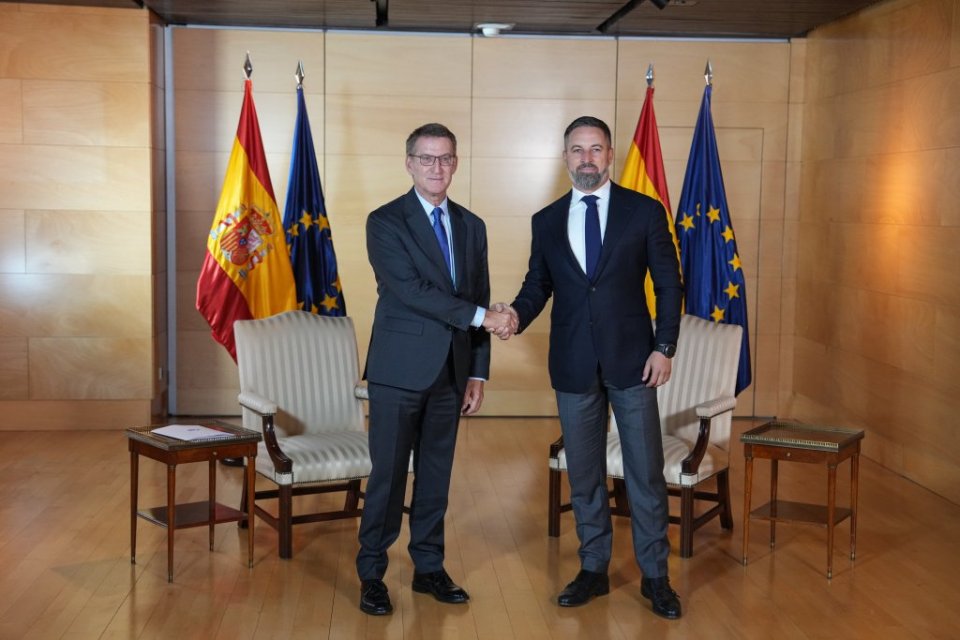
For PP leader Alberto Núñez Feijóo (left in main image with Vox leader Santiago Abascal in sept 2023), the latest result matches his party’s best figure of 2026, previously recorded in June. It nevertheless remains below the 33.9% reached in spring 2025 and is seven-tenths of a point lower than the PP’s result in the 2023 general election.
The PSOE’s 27.6% is its second-worst reading of the year, after January’s 27.1%, and more than four points below its 2023 election result. Although the current gap between the two main parties is substantial, it remains smaller than the 6.3-point lead recorded in July 2025, during the controversy surrounding the Cerdán case. ALSO READ: Spanish PM denies any knowledge of suspected scheme targeting corruption probes.
The more significant development for Feijóo’s prospects of reaching La Moncloa is therefore the combined strength of the right-wing bloc. Vox’s 17.8% is 5.4 points above its result in the 2023 general election, making it the only one of the three largest parties currently polling above its performance at that election. ALSO READ: Pedro Sánchez re-elected as Spanish Prime Minister.
The figures reinforce the importance of Vox to any potential future PP-led government. They also suggest that the party is entering the final stretch of the legislature with its principal issue, immigration, occupying a central position in the national debate. ALSO READ: PP-Vox agreement sees Juanma Moreno secure a third term as Andalusian leader.
A political warning, but not yet an electoral earthquake
Taken together, the two surveys present a difficult picture for Sánchez: widespread public criticism of his government’s response to Ceuta, strong support for tougher border measures, and a right-wing opposition bloc that has reached a new polling milestone.
The results do not establish that the Ceuta crisis alone is responsible for the changes in voting intentions. The movements since July remain limited, and the PP-Vox combined figure is an estimate of national vote share rather than a projection of parliamentary seats or a guarantee of a future governing majority.
Nevertheless, the polling suggests that the crisis has intensified existing political pressures on the government and strengthened an opposition bloc already ahead in voting intentions. With the situation in Ceuta still unresolved and questions continuing over the circumstances of the July crossings, the issue is likely to remain a major test for Sánchez and his administration.
Enjoying the news from Spain in English? Add us as a preferred news source in Google.
Subscribe to the Weekly Newsletter from Spain in English.
El maremoto político y social que ha supuesto la crisis con epicentro en Ceuta no se ha traducido por ahora en un tsunami electoral. El barómetro de 40dB. muestra un panorama sin cambios drásticos, aunque PP y Vox superan por primera vez el 50% del voto https://t.co/nkc7Ert1cR
— EL PAÍS (@el_pais) September 7, 2026
Casi un 90% de la sociedad atribuye al Gobierno de Marruecos “mucha” o “bastante” responsabilidad de la entrada masiva de inmigrantes, según el 40dB para EL PAÍS y la Cadena SER. Y cerca de un 72% cree que el Gabinete de Sánchez también tuvo responsabilidad en los hechos…
— EL PAÍS (@el_pais) September 7, 2026

Click here to get your business activity or services listed on our DIRECTORY.