
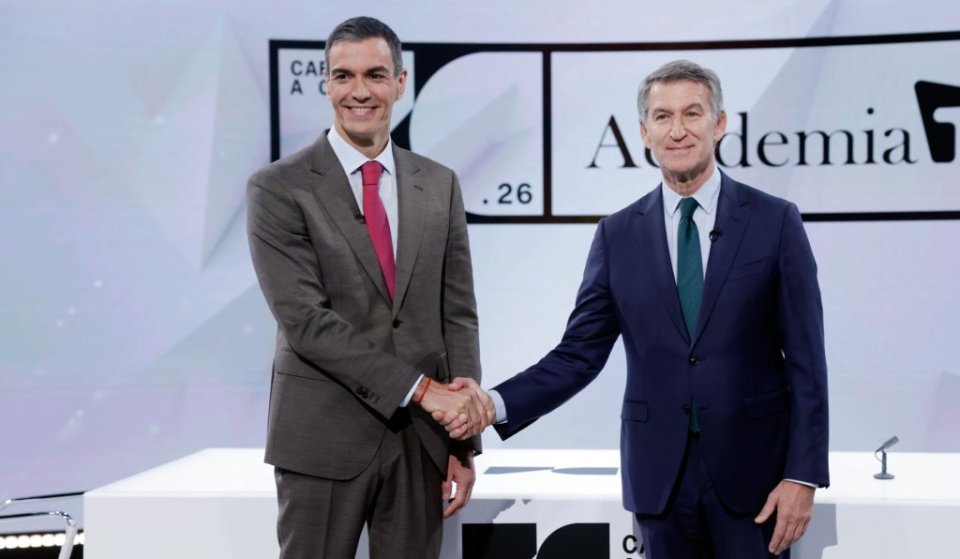
Pedro Sánchez acknowledged mistakes and defended his eight years in office, while Alberto Núñez Feijóo challenged the prime minister over living costs, corruption cases and two deadly rail crashes in their only head-to-head before Spain votes in the 29 November general election.
Spain’s two leading candidates for prime minister agreed that the country needs to build more homes, but offered sharply different plans for making housing more affordable in Thursday night’s televised debate.
Socialist (PSOE) Prime Minister Pedro Sánchez argued for stronger regulation and more protected housing, while Alberto Núñez Feijóo, leader of the right-wing People’s Party (PP), pledged one million new homes and used the housing shortage to question what the government had achieved since taking office in 2018. ALSO READ: Sánchez takes his re-election campaign to the cover of ‘Lecturas’.
The exchange set the pattern for the evening. Feijóo repeatedly pressed Sánchez on his record and his integrity, while the prime minister generally kept his tone measured and pointed to gains in employment, wages and economic growth. ALSO READ: Spain’s general election campaign opens with rallies across the country ahead of 29 November vote.
‘My government has not been perfect, I have made mistakes,’ Sánchez said in his opening remarks. He acknowledged that he had placed his trust in the wrong people and that his government had yet to solve the housing problem.
An analysis by public broadcaster RTVE found that Feijóo spent about 29 of his 38 minutes criticising Sánchez or his government. Sánchez used 11 of his 37 minutes to highlight his government’s achievements.
Housing led the discussion at roughly 14 minutes, followed by corruption at just over 12 minutes, then immigration and taxation. Together, those four subjects accounted for just over half the candidates’ speaking time. Feijóo also put forward more policy proposals, with RTVE’s detailed tally recording 28 from the PP leader and 16 from Sánchez. ALSO READ: Tens of thousands march for affordable housing and higher wages in Spain’s first general strike in 14 years.
Housing and the cost of living
Housing opened the debate and resurfaced throughout the evening. Both candidates referred to Maricarmen Abascal, whose eviction became a rallying point for housing campaigners. The crisis helped bring forward an election originally due in 2027 after the government’s measures for tenants were voted down. ALSO READ: Vigils and protests in Madrid after death of housing campaign symbol Maricarmen.
Sánchez accused PP-led administrations of failing to apply the national housing law and called for more protected housing, the renovation of existing homes and higher taxes on investment funds and large property owners. Feijóo said the government had had eight years to act. Alongside his construction pledge, he proposed a 48-hour deadline for removing illegal occupants. ALSO READ: Spanish Congress extends eviction protections after general strike but rejects indefinite rental renewals.
Feijóo argued that Spain’s economic growth had done little for families struggling to pay for groceries or find a home. He said food prices had risen by around 43% since Sánchez took office.
RTVE’s fact-checkers put the rise in food and non-alcoholic drink prices at 42.8% between June 2018 and October 2026, compared with 28.6% for consumer prices overall.
The PP leader proposed zero VAT on a basket of food staples while Spanish inflation remains above the eurozone rate, as well as a zero social security contribution for self-employed workers. ALSO READ: Spain’s inflation holds at 4.9% as lower motor fuel prices offset pressure from gas and heating costs.
Sánchez cited the European Commission’s improved growth forecast for Spain, job creation and recently approved increases in the minimum wage and public-sector pay. ALSO READ: Bank of Spain lifts growth forecast to 2.6% but warns of housing shortfall and higher energy bills.
Pressed on whether he would raise the minimum wage, Feijóo said he would, while stressing that his priority was to raise average pay and cut taxes. ALSO READ: Spain raises minimum wage to €1,286 and approves 4.5% public-sector pay rise.
He also challenged Sánchez over the government’s failure to pass a budget during the legislature. The two used different measures to describe public debt, with Sánchez pointing to its decline as a share of GDP and Feijóo pointing to the rise in the total amount owed.
Corruption cases and the rail crashes
Feijóo brought up corruption from his opening statement and returned to it across the debate, citing cases involving former transport minister José Luis Ábalos, former senior PSOE official Santos Cerdán and former ministerial adviser Koldo García.
He also raised legal proceedings involving Sánchez’s brother, David Sánchez, and wife, Begoña Gómez, and accused the prime minister of calling the election early to escape the political fallout. RTVE’s fact-checkers found that one of Feijóo’s claims, that the PSOE faced two cases over illegal party financing, was false. ALSO READ: Spanish PM’s wife to stand trial as court upholds influence-peddling and embezzlement case.
Sánchez apologised over corruption cases, defended his government’s record and pointed to the PP’s own history of scandals. ALSO READ: Spanish PM denies any knowledge of suspected scheme targeting corruption probes.
The opposition leader also challenged Sánchez over the government’s handling of the rail crashes at Adamuz (Andalusia) and Urda (Castilla-La Mancha), which together killed 115 people. ALSO READ: Spain’s latest rail tragedy puts safety and accountability at centre of election campaign.
Feijóo criticised Sánchez for dancing at a campaign rally two days after the funeral for the Urda victims. The prime minister apologised to those affected by the two crashes and described their loss as ‘a pain I will carry with me’.
Feijóo also raised the nationwide blackout in April 2025. ALSO READ: Reasons for Spain’s April power blackout: ‘overvoltage’ & ‘poor planning’.
Pensions, social rights and immigration
Sánchez took a more combative line on social policy. He warned that a government involving the PP and the far-right Vox party could weaken public services, and argued that raising defence spending to 5% of GDP would put further pressure on them. ALSO READ: From trade threats to praise: Trump changes tune as NATO agrees new defence commitments.
He pledged to protect pensions in the Constitution, while Feijóo said he had no intention of cutting them. Sánchez also pressed the PP leader on abortion rights and the euthanasia law. Feijóo said he would amend the euthanasia law, having previously raised the possibility of repealing it. ALSO READ: Feijóo leaves door open to governing with Vox and sets out plans to revisit abortion and euthanasia laws.
On immigration, Feijóo said the July surge in arrivals in Ceuta, Spain’s enclave on the North African coast, would be his first priority at a cabinet meeting. ALSO READ: Spain’s Ceuta crisis: Polls show widespread disapproval of Sánchez as PP and Vox pass 50%.
He proposed a points-based visa and the expulsion of migrants convicted of serious crimes. Sánchez defended the government’s approach, which includes an April plan to grant legal status to hundreds of thousands of undocumented residents who meet eligibility requirements, and challenged Feijóo over his support for deportation centres backed by some EU countries. ALSO READ: Spain will not ‘turn migrants into the enemy’, Sánchez tells UN as he highlights Ceuta crisis.
Ceuta also shaped the foreign policy exchange. Sánchez defended Spain’s positions on Ukraine, Gaza and Iran. ALSO READ: Pedro Sánchez responds to Donald Trump: ‘No to war’.
Feijóo focused on relations with Morocco and questioned Sánchez’s dealings with Rabat. Spain’s intelligence service said in a report submitted to the National Court that it had found no evidence linking the July crossings to a coordinated action by the Moroccan state. ALSO READ: Spain’s intelligence service finds no evidence Morocco organised July’s mass crossings into Ceuta.
Vox’s role and a near-record TV audience
Most published polls place the PP first but short of a parliamentary majority, giving Vox a potential role in determining who governs. ALSO READ: PP and Vox strike Senate election deal with judicial appointments in their sights.
The state pollster CIS has projected a socialist lead. The PP also won the most seats in 2023, but Sánchez stayed in office with backing from parties on the left and regional groups. With some of his former left-wing allies polling poorly, his route to another term could be harder this time. ALSO READ: Spain’s left heads into election divided as unity talks collapse.
Vox leader Santiago Abascal, whose party has governed with the PP at regional level, argued before the debate that his absence deprived viewers of a clear choice. In his closing appeal, Sánchez urged participation with the words, ‘Anyone who can vote, should vote.’ ALSO READ: Spain’s PSOE moves to block ‘national priority’ policy, warning of ‘first- and second-class citizens’.
María Casado, president of Spain’s Television Academy, moderated the debate and had to remind Feijóo that he had used up his allotted time during the economy discussion.
Across the channels carrying the broadcast, consultancy Dos30’ reported an average of 9,985,000 viewers and a 69.7% audience share. A separate tally reported by Vertele put the figures at 10.2 million and 71.1%. The debate ranked sixth by total viewers and second by audience share, behind the 75.3% recorded by Felipe González and José María Aznar in 1993. ALSO READ: Spain’s right retains clear majority in poll as Socialists close gap on PP.
Enjoying the news from Spain in English? Add us as a preferred news source in Google.
Subscribe to the Weekly Newsletter from Spain in English.
#CaraACaraRTVE | Corrupción, vivienda, pensiones y las tragedias ferroviarias protagonizan un sobrio debate entre Sánchez y Feijóo 🖊Mª Carmen Cruz Martín https://t.co/f6WLk3nprh
— RTVE Noticias (@rtvenoticias) November 20, 2026

Click here to get your business activity or services listed on our DIRECTORY.