
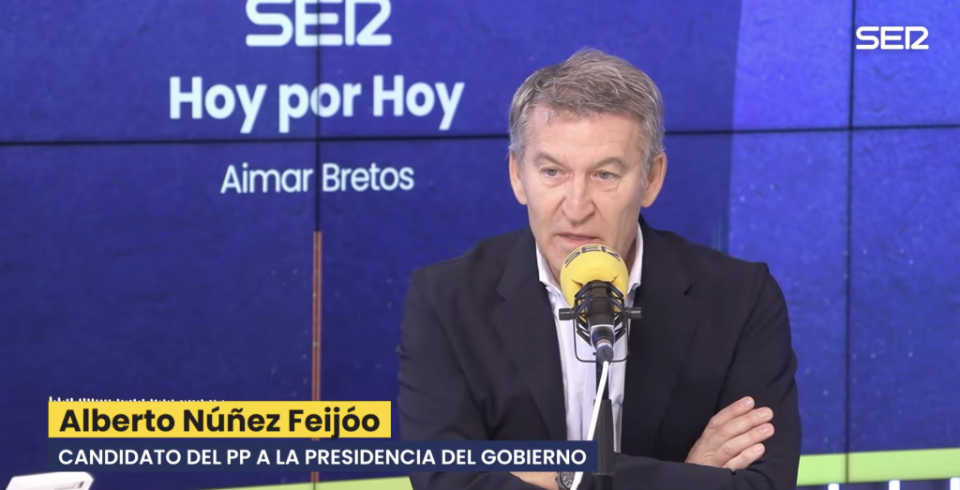
Alberto Núñez Feijóo, the leader of the right-wing opposition People’s Party (PP), has refused to rule out bringing the far-right Vox party into a future Spanish government, saying his overriding ambition in the general election on 29 November is to remove Pedro Sánchez from office.
In a wide-ranging interview with Cadena SER on Friday, the opposition leader outlined economic and social priorities for a possible PP administration, including annual pension increases linked to inflation, a million-home building programme and changes to legislation governing abortion and euthanasia.
‘My first objective is for Sánchez to leave government,’ he said, describing the prime minister as ‘a toxic and confrontational figure’. ALSO READ: PP, Vox and Junts attack Sánchez’s record as Spain heads for November election.
Feijóo said he expected the PP to emerge as the largest party, but left open the possibility of governing with Santiago Abascal’s far-right Vox group if parliamentary arithmetic required it. He presented such an agreement as a response to voters’ decisions, while insisting that no deal had been finalised. ALSO READ: Spain’s main opposition party, the PP, open to working with far-right Vox if elected.
Talks with Vox include possible Senate arrangements
According to RTVE’s report of the interview, contacts between the two parties extend to possible cooperation in Senate elections. Feijóo said he had spoken to Abascal two days earlier about Vox potentially standing aside in provinces where it had little prospect of winning a senator. ALSO READ: Abascal offers Senate deal with PP as left unites to challenge its majority.
‘It would be logical for Vox to consider not standing in those provinces where it is not going to win a senator. And for the PP to reciprocate that gesture,’ he said.
He did not explain what the PP might offer in return, stressing that discussions had yet to produce a completed agreement.
The PP leader also rejected the idea of rushing into a post-election pact and denied that negotiations had involved allocating government positions.
‘I have never spoken to them about sharing anything out, nor has Vox ever raised it with me,’ he said.
Abortion debate would focus on parental involvement
On abortion, Feijóo indicated that he would retain the existing framework of legal time limits but reopen discussion about the position of 16- and 17-year-olds, particularly whether parents should be informed or required to give permission. ALSO READ: Spanish government proposes including the right to abortion in the constitution.
Feijóo described an abortion as ‘a vital, consequential and irreversible decision’ and argued that a 16-year-old should share it with her parents.
‘Do you think that a 16-year-old girl needs her parents’ permission to get a tattoo but doesn’t need it to have an abortion? Do you think that a 16-year-old girl cannot drive a car in my country, yet she can have an abortion?’ he asked.
He acknowledged that any debate would also have to address what happens when a teenager wants to end a pregnancy and her parents object.
‘We will see during the parliamentary term, if I have responsibility for government, how we approach it,’ he said.
Feijóo argued that parental support could lead some teenagers to decide against an abortion. He also promised assistance for women who wanted to continue a pregnancy but faced financial difficulties.
His message, he said, was that no woman should have an abortion because of an economic problem: ‘If she wants to have a child and has a financial problem, I will look for a solution.’
He reiterated that women choosing an abortion should have access to appropriate doctors and healthcare in both the public and private sectors, while recognising doctors’ objections to carrying out the procedure.
Changes promised to euthanasia legislation
Feijóo also committed to reforming Spain’s euthanasia law, arguing that specialist doctors currently play too limited a role. ALSO READ: Spain confronts euthanasia law fallout after landmark case divides nation.
‘A dignified death is a concept I agree with,’ he said. However, he added: ‘Before reaching a dignified death, we have to guarantee a dignified life.’
He argued that euthanasia should come only at the end of a process establishing that a person’s life could no longer be maintained at minimum levels of dignity.
Pension pledge, but no equivalent promise on minimum wage
On the economy, Feijóo made annual pension increases in line with the consumer price index a personal priority, alongside ensuring that the system remains sustainable for younger generations.
Rather than proceeding by decree, he said he would revive negotiations through the Toledo Pact, the cross-party framework for pension policy, bringing together government, political parties, employers and trade unions.
He did not make an equivalent commitment to automatic increases in the statutory minimum wage, known in Spain as the SMI. Instead, he said future decisions would be negotiated with unions and other social partners.
Feijóo accused the government of increasing labour costs without sufficient agreement from economic representatives and argued that its approach had damaged productivity.
He also claimed that the state had benefited financially from minimum-wage increases through higher social security contributions and, in some cases, income tax.
When the interviewer pointed out that minimum-wage earners were exempt from personal income tax, Feijóo acknowledged the exemption but said it had followed a parliamentary dispute. He questioned whether it would remain in place and argued that the left-wing Sumar party had pushed the government to concede. ALSO READ: Spain’s left heads into election divided as unity talks collapse.
Labour Minister Yolanda Díaz responded on social media, rejecting his account.
‘Feijóo is lying or does not know what he is talking about. Anyone earning the minimum wage does not pay personal income tax. Since 2018 it has gone from 736 to 1,221 euros. And we are going to raise it further,’ she wrote.
A million homes to stimulate growth
Housing construction would be central to Feijóo’s economic programme, he said. He proposed building one million homes, claiming this would create 500,000 jobs while helping to reduce both purchase prices and rents.
He argued that expanding supply would make it easier for young people to obtain a home and generate wider economic activity. ALSO READ: Spain’s housing crisis prompts general strike on 11 November, ahead of election.
The aim, he said, was healthy growth rather than relying on public borrowing: ‘Not doping the economy with debt.’
‘My objective is not only for the minimum wage to rise, but for the average wage to rise. And for people to improve their purchasing power,’ he added.
Equality responsibilities would move to other ministries
Feijóo confirmed that a government led by him would have no separate Equality Ministry. Its responsibilities would instead be incorporated into other departments, with the minister responsible also handling additional areas.
He nevertheless described himself as a feminist, referring to having grown up surrounded by women.
He declined to identify prospective ministers or discuss the membership of a future cabinet, saying the immediate task was to win the election.
Film funding and Milei’s visit
Asked about Vox’s efforts in Castilla y León to block subsidies for films it considers ideological, Feijóo said he did not know the full details of the regional agreement but insisted that scripts would not be vetted. ALSO READ: PP and Vox strike third regional ‘national priority’ pact to form government in Castilla y León.
‘Culture does not admit censorship and must be challenging; it is another matter for it to be partisan and sectarian,’ he said.
He supported making funding criteria transparent and questioned the use of public money for what he described as sectarian cultural activity, arguing that the money was needed for pensions.
The interview also covered Argentine President Javier Milei’s recent visit and his meeting with Madrid regional president Isabel Díaz Ayuso, during which Milei called Sánchez a dictator. ALSO READ: Milei calls Sánchez a ‘disgraceful dictator’ and urges Spaniards to oust PSOE.
Feijóo defended Ayuso’s decision to receive an elected president, while distancing himself from Milei’s rhetoric.
‘I do not share the language,’ he said, although he suggested that such language appeared less striking in Argentine politics than in Spain.
He nevertheless praised Milei’s economic approach as more sensible than that of the Kirchners and Peronism. In a further attack, he described the Kirchners as corrupt and linked them politically to Sánchez.
Enjoying the news from Spain in English? Add us as a preferred news source in Google.
Subscribe to the Weekly Newsletter from Spain in English.
📻 Alberto Núñez Feijóo, sobre el feminismo: “¿Cómo no voy a ser feminista si me he criado con muchas más mujeres que hombres?” https://t.co/IUsqvgnn2e
— Cadena SER (@La_SER) October 23, 2026
Feijóo se compromete a actualizar las pensiones conforme al IPC y buscar “un sistema de viabilidad” que no concreta https://t.co/vfZuj2IUXh
— Cadena SER (@La_SER) October 23, 2026

Click here to get your business activity or services listed on our DIRECTORY.