
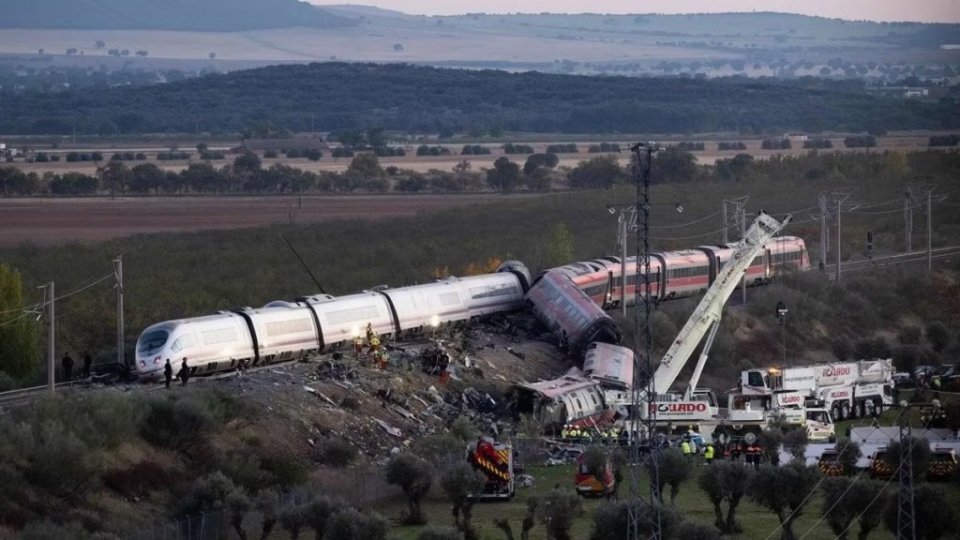
Adif must give the court a full account of the damage and every repair at the site of the 28 October collision, which killed 69 people. The government plans to run fewer trains when services resume.
A judge in Toledo (Castilla-La Mancha) has given Spain’s rail infrastructure manager Adif permission to rebuild the stretch of the Madrid–Seville high-speed line where a Renfe AVE struck an Iryo train three weeks ago. ALSO READ: Spain’s latest rail tragedy puts safety and accountability at centre of election campaign.
The order, issued on Thursday by the court in Orgaz, allows Adif to bring machinery onto the site near Urda, at kilometre 118 of the line. Dates for the start of work and the resumption of services through the damaged section have yet to be confirmed. ALSO READ: Spain to reduce Madrid-Seville train services and tighten safety procedures after recent disaster.
Adif must document the track before and after repairs
The judge attached two conditions to the authorisation. At the request of prosecutors, Adif must draw up a complete inventory of the components affected by the crash once it has finished inspecting and surveying the site. After the work, the company must submit a list of ‘each and every component that has been modified, repaired and/or replaced, specifying in every case the exact location of the repair and/or modification’, according to the order summarised by the High Court of Justice of Castilla-La Mancha. ALSO READ: EU prosecutors open second fraud inquiry into Madrid–Seville rail line after deadly crashes.
Both records will go into the court file, allowing investigators to compare the original damage with the work carried out. The judge had already restricted access to the site while Guardia Civil forensic and judicial police teams examined the wreckage, recorded the damage and recovered material for the investigation. The criminal proceedings remain under seal. ALSO READ: Sánchez pledges urgent support for train tragedy victims and vows to restore trust in high-speed rail.
Urda was the second fatal crash on the Madrid–Seville line in ten months. The first, at Adamuz in the Córdoba province on 18 January, killed 46 people. In that case, the judge investigating the crash in Montoro ordered sections of track returned after Adif removed them without express judicial authorisation. The court subsequently tightened controls on access to the wreckage. ALSO READ: Families of Adamuz train crash victims to receive €216,000 under €20m compensation plan.
Fewer trains planned when services resume
On 3 November, then transport minister Óscar Puente said the work ‘would not exceed ten calendar days from the date of said authorisation’. The court granted permission 16 days after he made that statement. As of Thursday, there was still no confirmed reopening date. ALSO READ: Spain’s transport minister Óscar Puente resigns after latest deadly high-speed rail crash.
The Transport Ministry plans to reduce the number of services initially so trains can run farther apart. Adif is discussing the timetable with Renfe, Iryo and Ouigo and has asked the operators to run two trainsets coupled together where possible to limit the loss of seats.
The reduced timetable is expected to stay in place until the line switches from its LZB train protection system to Level 2 of the European Rail Traffic Management System (ERTMS), scheduled for early 2027. The new equipment was installed in July and has since been undergoing tests during overnight maintenance slots at weekends. LZB has been in use on the route since Spain launched high-speed services in 1992. ERTMS, adopted on the country’s later high-speed lines, is the European standard designed to allow trains to operate across national networks.
The ministry has also pledged to review how the entire Madrid–Seville line operates, upgrade technology at Adif’s traffic control centres and require a second check on instructions issued to drivers when LZB is unavailable. It has also committed to improving working conditions for traffic controllers and train drivers.
Investigators examine signalling failure and control room instructions
The collision occurred at 8.53am on 28 October. Iryo service 6076 was stopped at a signal on the approach to Urda when Renfe’s AVE service 2080 struck it from behind on the same track. The Transport Ministry says 397 passengers were aboard the Renfe train and 147 were travelling on the Iryo service. ALSO READ: Fifteen foreign nationals confirmed among 69 killed in Spain’s latest train tragedy.
The independent rail accident investigation authority, Aitat, is examining the failure of the LZB system, the instructions issued by the Atocha control centre and the conditions under which trains resumed running using the backup system. ALSO READ: Toledo crash recordings reveal restart orders as Iryo driver reported train still stopped.
In remarks to Congress, Puente said the control centre had authorised the AVE to proceed at ‘normal speed’ while the Iryo train ahead remained stationary. Investigators are still working to establish what role technical failures, individual decisions and operating procedures played in the collision. ALSO READ: Transport Minister says decision to let AVE proceed before fatal Toledo crash was ‘inexplicable’.
Enjoying the news from Spain in English? Add us as a preferred news source in Google.
Subscribe to the Weekly Newsletter from Spain in English.
La jueza del accidente de Urda autoriza a ADIF a las labores de reparación https://t.co/vguEr0N5hT https://t.co/LyZfuOQTbE
— Europa Press TV (@europapress_tv) November 19, 2026
La jueza que investiga el accidente de Urda autoriza a ADIF a reparar la vía donde se produjo el siniestro.
— RTVE Noticias (@rtvenoticias) November 19, 2026

Click here to get your business activity or services listed on our DIRECTORY.