
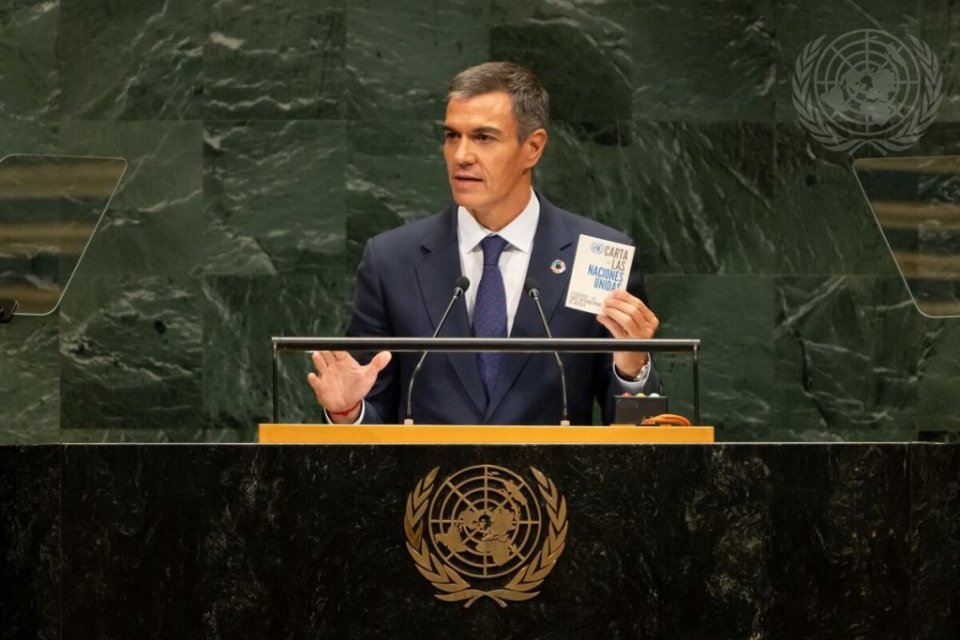
Spanish Prime Minister Pedro Sánchez used an address to the United Nations in New York on Wednesday night to defend Spain’s handling of the migration crisis in Ceuta, insisting that the country will not respond to the emergency by ‘turning migrants into the enemy’ or abandoning international law and human rights.
Speaking before the 81st session of the UN General Assembly, Sánchez singled out the situation in the Spanish North African city as an example of the wider choices facing governments at a time when, he argued, international cooperation and the founding principles of the United Nations are increasingly under pressure.
His comments came after more than 70,000 migrants crossed into Ceuta from neighbouring Morocco on 30-31 July, overwhelming the small city and triggering one of Spain’s most serious migration emergencies in recent years. Most subsequently returned to Morocco, but thousands remained as the authorities struggled to provide accommodation and other essential services. ALSO READ: Thousands of migrants return to Ceuta beaches after port reception camps reach capacity.
The crisis has also placed renewed scrutiny on relations between Madrid and Rabat. A day before his UN speech, Sánchez acknowledged that Morocco’s border-control system had ‘failed’ during the July influx and said Spain had sought ‘explanations and changes’ from its neighbour. ALSO READ: Spanish court to investigate deadly Ceuta migrant surge as possible ‘hybrid warfare’ operation.
However, his government has maintained that there is no solid evidence that the Moroccan authorities deliberately organised the mass crossing. ALSO READ: Spanish PM backs Morocco over Ceuta migrant crisis as King Felipe visit is announced.
Fresh calls circulating on social media for migrants to attempt another entry into Ceuta and Melilla had prompted increased security on both borders this week. Sánchez said in New York that there had been ‘a very large police deployment, at the Ceuta border as well as at the Melilla border’ by the Moroccan authorities, an effort which he said should also be acknowledged. ALSO READ: Morocco stops new mass attempt to reach Ceuta as almost 300 migrants detained.
‘Spain is not going to do it’
Turning to the humanitarian response in Ceuta during his UN address, Sánchez said that ‘inequality, desperation and disinformation’ had contributed to one of the most significant irregular migration crises Spain had faced in recent years.
‘I know that, at times like these, the temptation is to take the shortcut, give in to fear, turn migrants into the enemy and break the law — expelling immigrants without examining their individual circumstances — but Spain is not going to do it,’ he said.
‘Nor will Ceuta, because its citizens are demonstrating that it is possible to confront a crisis without giving up decency, while upholding the law and respecting human rights.’
Spain would emerge stronger as a result, Sánchez added, ‘because Spain does not choose the easiest path; it chooses the fairest one’. ALSO READ: PM Sánchez defends Spain’s immigration model, urging Europe to take note.
The prime minister also contrasted Spain’s approach to international development with cuts being made elsewhere. Without directly naming US President Donald Trump, he referred to a ‘chainsaw’ that had reduced global development assistance by almost a third in two years, while saying Spain had doubled its investment in international cooperation and increased its contribution to the multilateral system by 60%. ALSO READ: Trump warns Spain ‘will be a ruined country’ as Ceuta crisis takes international turn.
Warning over ‘selfish, ignorant and cruel’ forces
The Ceuta crisis formed part of a much wider speech in which Sánchez issued a stark warning about what he described as the growing influence of ‘selfish, ignorant and cruel’ political forces around the world.
He criticised what he called the ‘absurd belief’ that international relations are a zero-sum game in which one country can prosper only at another’s expense, as well as a ‘colossal and shameless ignorance’ that dismisses science and assumes powerful countries can mistreat others without consequences.
He accused those political forces of launching illegal wars, killing innocent civilians, withdrawing assistance from people suffering poverty and disease and damaging the environment, while attempting to undermine the international institutions established to deal collectively with global problems.
Despite that assessment, he insisted that he had not lost hope.
Gaza, Ukraine and international law
Sánchez was particularly direct when addressing the wars in Gaza and Ukraine.
He said Spain had opposed ‘wars of aggression’ wherever they had occurred, including in Ukraine, Lebanon and Iran, while defending his government’s refusal to increase military spending to 5% of GDP. ALSO READ: Pedro Sánchez responds to Donald Trump: ‘No to war’.
Spain had sanctioned Russia following its invasion of Ukraine, imposed an arms embargo on Israel and acted to prevent Spanish territory being used to facilitate military action that Madrid considered contrary to international law, he said. ALSO READ: Spain urges EU to suspend Israel agreement, but bloc remains divided.
Sánchez also again accused Israeli Prime Minister Benjamin Netanyahu of committing ‘genocide’ in Gaza — terminology repeatedly used by the Spanish government but rejected by Israel. ALSO READ: Spain asks to join South Africa’s case at UN court accusing Israel of genocide.
His criticism of Trump was considerably less explicit. Although Sánchez did not name the US president in the passages attacking unilateralism and cuts to international aid, his remarks came amid continuing differences between Madrid and Washington over defence spending and other international issues. ALSO READ: Sánchez on Netanyahu: ‘His contempt for life and international law is intolerable’.
Defence of the United Nations
At the heart of Sánchez’s speech was a defence of multilateralism, which he described as humanity’s best means of managing both its diversity and its interdependence in an increasingly multipolar world.
Holding up a copy of the UN Charter, Sánchez said it provided the fundamental principles required to address the challenges facing the international community.
He called for reform of the UN Security Council to provide fairer regional representation and advocated ending the veto held by its permanent members, arguing that ‘no country should be judge and interested party at the same time, however powerful it may be’.
He also called for stronger international institutions, including the International Criminal Court, so that those accused of violating international rules can be investigated and prosecuted.
Sánchez urged governments to rebuild the international framework governing nuclear disarmament and non-proliferation, warning against security policies that could contribute to another global conflict. ALSO READ: Sánchez at Munich security conference: EU must strengthen its defence, but ‘nuclear rearmament not the way’.
He also called for strict regulation of powerful technology interests — which he referred to as ‘tech oligarchs’ — particularly in relation to the operation of social-media platforms and the development of artificial intelligence. ALSO READ: Spain unveils new AI plan as Sánchez warns unregulated technology could have ‘devastating’ consequences.
Sánchez backs a Latin American woman to lead the UN
The Spanish prime minister also used the address to make the case for the next UN secretary-general to be a woman from Latin America.
‘Nine men have occupied the General Secretariat of this organisation in its 80 years of existence,’ Sánchez said. ‘Now it is the turn of a Latin American woman.’
He questioned how an organisation seeking to represent humanity could never have been led by a woman, while Latin America — which he described as the world’s third most populous region — had not held the post for three decades.
Sánchez stressed that his argument was not that women had anything left to prove.
‘I say it because it is the world that needs to prove to itself that there is no turning back on the road to equality,’ he said.
‘We did not stop fighting’
Sánchez concluded by arguing that the decisions governments make during the present period will ultimately be judged by future generations.
He said they would ask what today’s leaders had done when some countries began breaking international rules while others ‘decided to look the other way’, and what happened when defending established principles became politically or economically costly. ALSO READ: Sánchez: Eurovision boycott over Israel’s participation puts Spain ‘on right side of history’.
When that judgement comes, Sánchez said, Spain wanted to be able to answer that ‘we did not stop fighting. We did not’.
The objective, he said, was to leave future generations ‘a more peaceful, more sustainable and fairer world’.
Enjoying the news from Spain in English? Add us as a preferred news source in Google.
Subscribe to the Weekly Newsletter from Spain in English.
Dentro de unos años, las generaciones futuras mirarán hacia atrás, estudiarán esta década, y nos preguntarán qué papel jugamos cada uno de nosotros.
— Pedro Sánchez (@sanchezcastejon) September 24, 2026
Queremos poder decirles que no dejamos de luchar. pic.twitter.com/sCODm6cvt7

Click here to get your business activity or services listed on our DIRECTORY.