
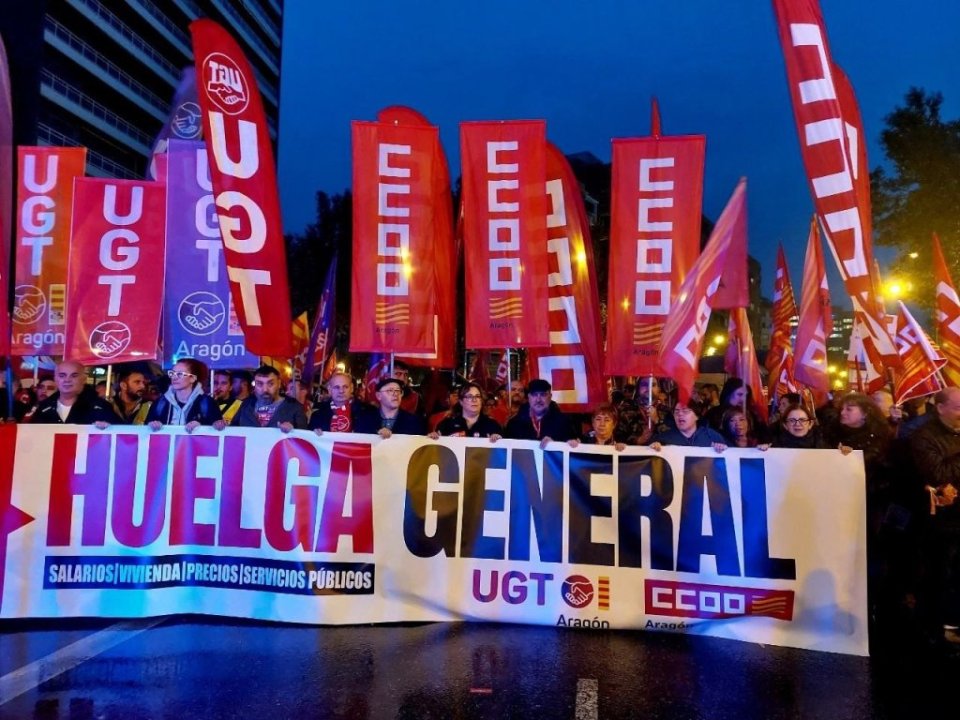
Tens of thousands of people marched through Spain’s cities on Wednesday demanding lower rents, better pay and stronger protection for tenants, bringing the country’s first nationwide general strike in 14 years to a close less than three weeks before the 29 November general election.
Heavy rain failed to deter an estimated 120,000 people from joining the Madrid march, according to the central government’s delegation in the capital. Barcelona’s municipal police put turnout there at 55,000, while housing activists gave a much higher estimate of 400,000. State broadcaster RTVE reported that 40,000 people marched in Valencia, with large demonstrations also held in Alicante, Zaragoza, Bilbao, Santiago de Compostela, Vigo and La Rioja.
The strike brought Spain’s two largest trade unions, CCOO and UGT, together with the Sindicato de Inquilinas tenants’ union and other grassroots groups under the slogan ‘Salaries. Housing. Prices.’ Spain’s previous general strike, in 2012, targeted austerity during the eurozone debt crisis. This time, an eviction in Madrid turned a longstanding grievance over housing into the catalyst for a national stoppage. ALSO READ: Spain’s housing crisis prompts general strike on 11 November, ahead of election.
The eviction that galvanised the housing movement
Marchers remembered Maricarmen Abascal, the 87-year-old Madrid resident whose eviction and subsequent death in October sparked weeks of protests. ALSO READ: Vigils and protests in Madrid after death of housing campaign symbol Maricarmen.
Housing campaigners called for a strike in the wake of her eviction and secured the backing of the major unions, broadening the demands to include higher wages and guarantees for public services and pensions. ALSO READ: 87-year-old woman evicted from Madrid home after 70 years despite mass protests and offer to pay her rent.
Tenants’ groups are pressing for lower rents, automatic lease renewals and stronger protection from eviction. The trade unions are also calling for more public housing and a new minimum wage agreement. In Madrid, protesters shook their house keys as they marched, directing chants at landlords, property companies, investment funds and the government.
‘Rents have to come down, we have to secure open-ended contracts and we have to drive out the vulture funds,’ tenants’ union spokesperson Valeria Racu told reporters before the Madrid march. She said governments of all political stripes had protected landlords and that the movement would keep up the pressure whoever took office after the election.
Average rents in Spain have almost doubled in a decade, according to the Associated Press. The Spanish Youth Council puts the average monthly rent at €1,176, equivalent to 98.7% of the average monthly wage of a young person in the country. The Bank of Spain estimates a shortfall of around 750,000 homes, which could exceed one million by 2028. ALSO READ: Bank of Spain lifts growth forecast to 2.6% but warns of housing shortfall and higher energy bills.
Unions report major stoppages as employers put turnout below 5%
CCOO leader Unai Sordo and UGT leader Pepe Álvarez said the strike had exceeded their expectations, acknowledging that participation varied considerably by region and industry. The two unions gave figures for individual sectors and regions but issued no overall turnout figure at their pre-march briefing. The tenants’ union estimated that four million people had joined the stoppage and said it expected the number to exceed five million by the end of the day.
CCOO and UGT reported participation of around 90% in the automotive and port sectors, 85% in meat processing, 82% in waste collection and 75% in energy. They pointed to production stoppages at SEAT in Martorell (Catalonia) and Volkswagen in Navarre, as well as strong participation at logistics hubs in Illescas and Guadalajara. Schools and universities were affected, and Andalusia’s public broadcaster Canal Sur temporarily went off air. The unions reported lower participation in finance.
Barcelona’s metro and buses suspended services outside rush hour, while Madrid’s metro recorded 42% fewer passengers during peak hours than in the same period the previous week. Airport operator Aena said around 5% of scheduled flights across Spain were cancelled. ALSO READ: Renfe strike opens week of rail disruption in Spain ahead of Wednesday’s general strike.
Employers’ associations CEOE and Cepyme called the strike a ‘failure’, however, and estimated average participation at below 5%, saying most workplaces operated without significant disruption. They cited electricity demand at 5pm, which was 4.7% below the grid operator’s forecast and 2.5% below Tuesday’s level. Spanish media reported that the grid operator recorded a much sharper drop earlier in the day, with demand down by as much as 15.5% between 10am and 11am.
CEOE vice-president Ángela de Miguel said housing shortages also hurt small businesses by making it harder to recruit staff. She argued for building more homes and cutting taxes on construction and home purchases.
Unions announce legal action over police response
Pickets gathered from early morning at wholesale markets, ports, factories and transport depots. At Mercamadrid, the capital’s main wholesale food market, at least 13 people required medical attention after police used pepper spray, and one person was arrested, RTVE reported. Injuries were also reported after clashes at a municipal bus depot in Madrid’s Carabanchel district.
CCOO and UGT said they would take legal action over the police response. Álvarez said the officers’ conduct ‘violates fundamental rights, because the police have a duty to guarantee the right to strike’. Later, riot police used rubber bullets and pepper spray to disperse protesters on Madrid’s Gran Vía near the end of the evening march.
In Barcelona, groups of hooded protesters smashed shop windows on Passeig de Gràcia, set rubbish containers alight and threw fireworks at police after the march ended. RTVE reported 18 arrests in the city. Catalan regional president Salvador Illa condemned the vandalism and said the violence did not represent those who had demonstrated peacefully.
The Interior Ministry logged 919 strike-related incidents nationwide between 10pm on Tuesday and 5pm on Wednesday. Europa Press reported at least 52 arrests in the ministry’s 5pm tally, and RTVE subsequently put the number of arrests at more than 60. In Andalusia, heavy rain led CCOO and UGT to cancel their marches in Seville, Cádiz, Huelva and Córdoba, although thousands demonstrated elsewhere in the region.
Housing takes centre stage before the election
Prime Minister Pedro Sánchez called the 29 November general election. after parliament rejected government measures intended to curb evictions and ease pressure on rents. ALSO READ: Pedro Sánchez calls a general election in Spain for 29 November.
His Socialist Party (PSOE) trails in opinion polls, and the campaign has also been overshadowed by corruption cases involving people close to him and the high-speed train collision that killed 69 people in October. ALSO READ: Spain’s right retains clear majority in poll as Socialists close gap on PP.
Spanish media reported government sources saying they respected both those who went on strike and those who chose to work. Labour Minister and Deputy Prime Minister Yolanda Díaz publicly backed the action. ‘The strike was a success and the streets have spoken loud and clear. We have to put an end to the great factory of inequality that is speculation,’ she wrote on social media.
Sánchez kept a low profile on the day of the strike. Earlier in the week, he credited the labour movement with advances including the 40-hour working week and warned that a right-wing government would underfund public services. ALSO READ: Sánchez seeks campaign reset after Puente’s resignation and US election setback for Trump.
The right-wing opposition People’s Party (PP) and far-right Vox accused the unions of trying to help Sánchez ahead of the vote. ALSO READ: PP and Vox strike Senate election deal with judicial appointments in their sights.
Enjoying the news from Spain in English? Add us as a preferred news source in Google.
Subscribe to the Weekly Newsletter from Spain in English.
El Gobierno cree “justa” la huelga general del 11-N y el PP la tacha de “absurda” y “electoral”. https://t.co/ozkubGxFCe
— RTVE Noticias (@rtvenoticias) November 11, 2026
🗣️Pepe Álvarez (@SG_UGT), secretario general de UGT: “La Policía tiene que garantizar un derecho constitucional, que es el derecho a la huelga. Y no solo no lo ha garantizado, sino que ha impedido que los piquetes pudieran hacer su trabajo” #LaNoche24h en #Canal24Horas
— RTVE Noticias (@rtvenoticias) November 11, 2026
🔴 DE NORTE A SUR, LA CLASE TRABAJADORA HA LLENADO LAS CALLES ✊ Hoy lo hemos hecho. Hoy será un día para recordar. Hoy hemos hecho historia. Ciudades de todo el país se han movilizado por una vivienda digna, unos servicios públicos de calidad, salarios justos y derechos laborales. Una huelga general para que escuchen a la clase trabajadora. 📢 La fuerza de la calle ha despertado y no va a detenerse. #HuelgaGeneralUGT
— UGT (@UGT_Comunica) November 11, 2026
🔴 Éxito rotundo de la huelga general y manifestaciones multitudinarias en toda España por vivienda digna y salarios justos. Un seguimiento masivo que alcanza el 84% en Catalunya, y ronda el 70% en Madrid, Andalucía, Aragón y la Comunitat Valenciana. ¡La vivienda se come los salarios y la clase trabajadora exige soluciones ya! #HuelgaGeneral https://t.co/EbmDwI8CRP
— Comisiones Obreras (@CCOO) November 11, 2026

Click here to get your business activity or services listed on our DIRECTORY.