
The 2027 pay increases were approved 12 days before the 29 November general election. The Cabinet also backed new salary transparency rules and a tax change designed to deliver the full minimum-wage rise from the first payslip.
Spain’s government approved a 5.3% increase in the national minimum wage on Tuesday, raising it by €65 to €1,286 gross per month in 14 payments from January. The Cabinet also approved a 4.5% pay rise for public-sector employees, with a further half-point increase expected in the first quarter of 2027 under an existing agreement with unions.
The new minimum wage, known in Spain as the salario mínimo interprofesional (SMI), will be €18,004 gross a year, or €42.87 a day. The increase exceeds both October’s annual inflation rate of 4.9% and the rise of the same percentage recommended by the Labour Ministry’s advisory panel. Prices had risen 4.3% since the start of the year through October. ALSO READ (16/2/26): Spain approves 3.1% minimum wage rise to €1,221 per month, over 14 payslips.
The minimum-wage decree can take effect without a parliamentary vote. The public-sector pay rise, the income tax changes and a separate decree on pay transparency all require ratification by the Diputación Permanente, the 69-member standing committee that acts on behalf of Congress while parliament is dissolved.
Minimum-wage workers to see the full rise in January
Finance Minister Arcadi España said the increase would be felt ‘from the first payslip’ because workers on the minimum wage would no longer have income tax withheld from their monthly earnings. In previous years, some workers had to wait until they filed their tax returns to recover amounts withheld.
‘The full increase must reach all these workers,’ España said. ‘This royal decree now amends the personal income tax regulations and ensures that anyone earning the minimum wage has no income tax withheld from their monthly pay. No tax will be withheld.’
The annual deduction under Spain’s personal income tax, known as IRPF, will rise from around €590 to €1,033.58. It primarily benefits single workers without children who cannot claim other tax breaks. España said the tax rate at the new annual minimum of €18,004 would be ‘0%’, with the deduction tapering off for workers earning up to €23,172.
‘The tax cut extends to wages immediately above the minimum wage to avoid a cliff edge in personal income tax. The deduction gradually decreases up to an income of €23,172,’ he said.
Around 2.5 million people earn the minimum wage, according to official estimates cited by El País, while España put the number expected to benefit from the withholding change at 2.7 million. Women, young people and migrant workers are particularly likely to earn the minimum wage, which is also common in agriculture, hospitality and domestic work.
The decree sets a minimum of €10.06 per hour for domestic workers paid by the hour and €60.88 per working day for contracts of less than 120 days. The daily rate includes a proportionate share of pay for Sundays, public holidays and extra salary payments.
Unions sought 7% as employers question timing
The minimum wage has risen by about 75% since 2018, when it stood at €736 gross in 14 payments. Prices have risen by around 28% over the same period.
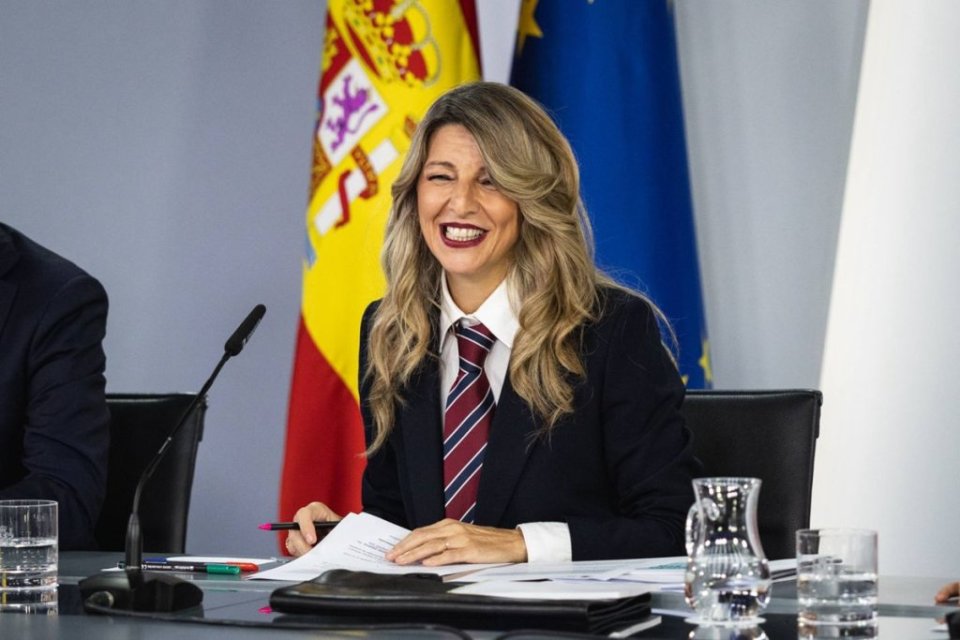
‘The steady rise in Spain’s minimum wage is a success story for our country. It was worth going against the economic orthodoxy that said we were going to sink the Spanish economy,’ Labour Minister Yolanda Díaz (main image) said after the Cabinet meeting.
The Labour Ministry’s advisory panel also found that successive increases had left many workers, including those with intermediate qualifications or experience, clustered in a narrow pay band close to the minimum. It said that ‘around 40% of the collective agreements analysed still had base salaries below the statutory minimum wage’.
Spain’s two largest trade unions, CCOO and UGT, welcomed the gains made in recent years but withheld formal backing for the latest increase, the first time they have done so since Díaz took charge of the Labour Ministry. They had sought a 7% rise and wanted changes to prevent employers from offsetting increases in basic pay against existing supplements.
In a joint statement, the unions called on the government ‘to honour its commitment to the unions on working-time records and its commitment on the offsetting and absorption of the minimum wage’. The minimum-wage decision had followed a single meeting with unions and employers and came amid a union call for a general strike over housing. ALSO READ: Tens of thousands march for affordable housing and higher wages in Spain’s first general strike in 14 years.
Employers’ organisations CEOE and Cepyme objected to the government acting before the election. CEOE president Antonio Garamendi said employers had been ‘informed’ rather than ‘consulted’ and accused the government of holding ‘two Cabinet meetings a week to campaign in the election’. Employers last backed a minimum-wage increase in 2020.
Recent increases have generally been approved around February and backdated to January. The government said it acted early this time to avoid leaving the decision to a caretaker administration.
Public-sector pay to rise 4.5% in January
The public-sector increase is part of a multi-year agreement reached last November with CCOO, UGT and CSIF, covering pay rises of around 11% from 2025 to 2028. Around three million employees are expected to benefit.
‘Today is an extraordinary day for more than three million families in this country, families of public servants. It is a 4.5% increase, the biggest pay rise since 1992,’ said Public Administration Minister Óscar López.
‘In fact, it will rise by more,’ he added. A further 0.5% adjustment, attributable to 2026, is due once official figures confirm that annual inflation for 2026 exceeded 1.5%. That confirmation is expected in the first quarter of 2027, taking the overall increase reflected in pay to around 5%. The 4.5% increase is due to apply from 1 January.
López’s department estimated gross annual gains of €1,440 for an administrative worker, more than €1,900 for a National Police officer, more than €2,700 for a teacher, €3,700 for a doctor and more than €4,000 for a judge. Rising fuel prices, driven by the conflict in the Middle East, have added to pressure on household purchasing power since February.
Employees gain the right to see pay for equivalent work
A separate decree approved by the Cabinet strengthens workers’ rights to salary and contractual information and increases penalties for employers that fail to provide it. It implements provisions of an EU equal-pay directive that Spain was due to transpose by 7 June.
‘Pay secrecy in Spain is over,’ Díaz said.
Under the decree, workers can request written information on their own pay and on average pay for colleagues doing the same work or work of equal value, with breakdowns by sex and relevant job category or pay level. Employers will have up to two months to respond. The decree expands the information employers must keep in their pay registers and extends information rights to employees on contracts of any length, including those lasting four weeks or less.
Job adverts will have to state the starting pay, and employers will be barred from asking candidates what they earned in previous jobs. The decree also establishes ‘an individual right to pay information’ and invalidates ‘contractual clauses that prevent workers from disclosing information about their own pay’. It adds explicit protection to the Workers’ Statute against ‘any unfavourable treatment, harm or retaliation as a result of exercising or asserting employment rights’, the Labour Ministry said.
Employers will also have to give part-time workers at least three days’ notice of additional hours beyond those agreed in their contracts.
Welfare measures add to scrutiny of pre-election spending
The pay decisions come as Pedro Sánchez’s PSOE-led coalition, trailing in most polls, has approved a series of welfare measures in the run-up to the election. ALSO READ: Spain’s general election campaign opens with rallies across the country ahead of 29 November vote.
Government announcements over the past month included about €820 million in support for vulnerable families, €221 million for people affected by disasters such as floods and last month’s train crash, and around €426 million in housing subsidies. Housing is voters’ leading concern, and Sánchez has pledged to tackle it if he secures a majority. ALSO READ: Spanish Congress extends eviction protections after general strike but rejects indefinite rental renewals.
‘This progressive coalition government is demonstrating … that it is possible to achieve both economic growth and redistribution,’ Sánchez told Telecinco on Monday when asked about the spending.
With no new budget approved since 2023, the government has increasingly relied on emergency decree laws. Those decrees take effect before lawmakers vote on them, generally within 30 days. A refusal to ratify can halt a measure, while expenditure already made can stand. Since parliament was dissolved, ratification has fallen to the standing committee, where the balance of seats is slightly more favourable to the coalition than in the full 350-member Congress.
Enjoying the news from Spain in English? Add us as a preferred news source in Google.
Subscribe to the Weekly Newsletter from Spain in English.
✅ El Gobierno aprueba la subida del Salario Mínimo Interprofesional, hasta los 1.286€ brutos en 14 pagas, lo que supone un incremento del 5,3%, hasta los 18.004€ anuales. ”Hoy damos una buena noticia a todos los trabajadores y trabajadoras de este país”, @Yolanda_Diaz_ https://t.co/fOboOAo8iK
— La Moncloa (@desdelamoncloa) November 17, 2026
📈 El #CMin aprueba la subida del Salario Mínimo para 2027 ‼️ 1.286€ al mes en 14 pagas 💶 18.004€ al año ⬆️ Un 5,3% más: 65€ más al mes, 910€ más al año 🗓 Se aplicará desde el 1 de enero de 2027 🙅♀️ No se tendrá que pagar el IRPF https://t.co/1TYNsQquul
— Ministerio Trabajo y Economía Social (@empleogob) November 17, 2026
Mañana, el Gobierno aprobará una nueva subida del SMI hasta los 1.286 euros mensuales y una subida salarial del 4,5% para más de tres millones de empleados públicos. Para que la buena marcha de la economía se traduzca en mejores salarios y más poder adquisitivo para la gente. https://t.co/w2YHKLH8HQ
— Pedro Sánchez (@sanchezcastejon) November 16, 2026
Hoy, el Gobierno le sube el salario a 5 millones de trabajadores y trabajadoras. Porque se lo merecen. Porque el éxito económico de nuestro país es, también, fruto de su esfuerzo. https://t.co/a3DlEE2E16
— Pedro Sánchez (@sanchezcastejon) November 17, 2026

Click here to get your business activity or services listed on our DIRECTORY.