
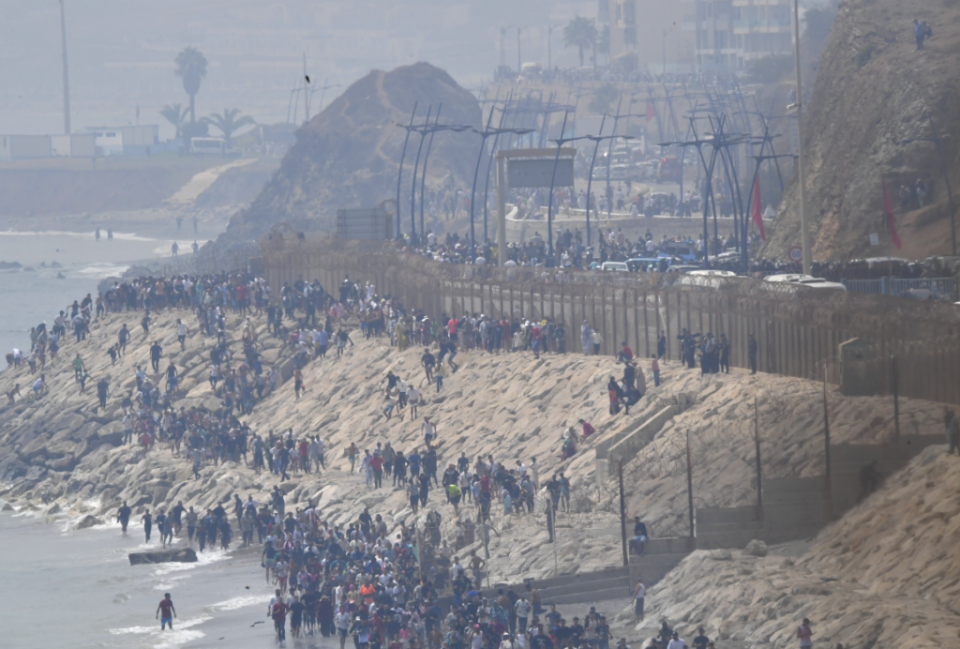
Spain’s National Intelligence Centre (CNI) has found no evidence that Moroccan authorities organised the mass crossings into Ceuta on 30 and 31 July, when more than 80,000 people entered the Spanish city.
The agency says Morocco knew that calls to cross were spreading widely online, but prioritised security for its Throne Day celebrations and failed to mount an effective response at the border once the crossings were under way.
The findings are set out in a report dated 11 November and submitted to National Court investigating judge María Tardón, who had asked the CNI to expand on an earlier assessment. ALSO READ: Spanish court to investigate deadly Ceuta migrant surge as possible ‘hybrid warfare’ operation.
A separate Guardia Civil report, dated the same day, examines what Spain’s security services knew beforehand. It concludes that the information the CNI shared on the eve of the crossings gave officers too little to anticipate a breakdown in border controls on that scale. ALSO READ: Spain had warnings of mass migrant crossings into Ceuta, but not their scale, documents reveal.
Online calls spread without a central organiser
The CNI told the judge that it had found no evidence to date that the crossings were ‘instigated, planned or coordinated’ by Moroccan authorities. Investigators traced the mobilisation to several people spreading calls on social media independently of one another.
The messages reached people who were already considering emigrating as well as a much broader audience in areas of Morocco near Ceuta. The agency found no central organisation directing the campaign, no link between the online organisers it identified and the Moroccan state, and no evidence that people-smuggling networks were involved. ALSO READ: Thousands march in Madrid over Ceuta crisis, demanding early election and migrant returns.
The agency said a government could, in theory, use migration pressure on this scale as a tool against another country. In its assessment, such an operation would require approval at the highest level and would probably involve the state’s intelligence services. Its enquiries found no evidence that Moroccan state bodies had planned or carried out such an operation in July.
The CNI reached a different conclusion about May 2021, when around 10,000 people entered Ceuta from Morocco. It concluded that Moroccan authorities deliberately used those crossings to put diplomatic pressure on Madrid after Spain admitted Polisario Front leader Brahim Ghali for hospital treatment. ALSO READ: Polisario leader leaves Spain after denying war crimes allegations.
The Moroccan security apparatus, it said, circulated voice messages and rumours about border surveillance. The report also examined a failed attempt to enter Ceuta en masse in 2024. Among the possible factors in July 2026, it cited weather conditions and a Spanish Supreme Court ruling barring immediate returns of people who swim into Ceuta or Melilla. ALSO READ: Spanish PM backs Morocco over Ceuta migrant crisis as King Felipe visit is announced.
What Morocco knew and how it responded
On the afternoon of 29 July, the CNI sent a formal notice to Moroccan intelligence about possible attempts to enter Ceuta during the week of Throne Day. Its November report says Moroccan authorities already knew that the online calls had gained wide circulation. It concludes that their decision to prioritise security for the celebrations, attended by King Mohammed VI at the nearby royal palace in Rincón, left people able to enter Ceuta without effective intervention once the mass crossings began. ALSO READ: Spain will not ‘turn migrants into the enemy’, Sánchez tells UN as he highlights Ceuta crisis.
The Guardia Civil found that Moroccan forces had still been intercepting people in the hours before the surge. Its report says they stopped 493 of 1,109 attempts to enter Ceuta by swimming between the morning of 29 July and the morning of 30 July. It also says Moroccan officers appear to have detained many people in the preceding days. The Guardia Civil took that as evidence that the border operation was still functioning and that Moroccan forces were still trying to contain crossings before numbers surged. ALSO READ: Morocco stops new mass attempt to reach Ceuta as almost 300 migrants detained.
Guardia Civil says July warning gave no sense of scale
Declassified messages show that a CNI officer contacted the Guardia Civil on 29 July about Facebook and WhatsApp groups encouraging people to swim into Ceuta or climb the border fence the following day. In a subsequent call, the two services discussed the online messages and the effect of the Supreme Court ruling.
The Guardia Civil says 273 people had already entered by swimming in the preceding 24 hours. It says its intelligence headquarters did not receive the formal notice the CNI sent to Morocco. ALSO READ: Spain’s police chief says Ceuta report does not attribute ‘planning or execution’ of migrant crisis to Morocco.
The Guardia Civil described the information it received as ‘partial’ and ‘insufficient’ to gauge the threat. Officers could not establish who was behind the online calls, how credible they were or how many people were likely to act on them. The exchanges gave no indication that the crowds could overwhelm Moroccan forces or that officers on that side of the border might scale back their efforts. The Guardia Civil says that intelligence pointing to an imminent crisis of that magnitude should have gone to senior commanders and political leaders.
The handling of the intelligence had already become a political issue in Ceuta. Gonzalo Sanz, chief of staff to the Spanish government’s delegate in the city, resigned on 11 September after insisting he had passed the information to his superior. ALSO READ: Ceuta government delegate resigns after migrant influx, citing harassment and pressure on his family.
Military analysts say Moroccan forces were likely overwhelmed
Defence Staff assessments included in the Guardia Civil’s submission show that on 29 July the military knew thousands of people were waiting for a chance to cross near Castillejos and Rincón. It nevertheless judged a mass attempt to scale the fence the following day unlikely.
Once the crossings began, its leading explanation was that the number of people had taken Moroccan forces by surprise and overwhelmed them. It also considered whether officers had been reassigned to Throne Day duties or had held back from using force during the celebrations. It ranked deliberate Moroccan involvement as the least likely of the scenarios it examined.
The Guardia Civil’s most likely explanation is that several factors converged in a short period. Calls circulated rapidly online, reaching many young Moroccans facing economic hardship, while the holiday created an opportunity to cross. The force identified a recurring pattern of calls coinciding with major holidays, including Eid al-Fitr, the Prophet’s birthday and Throne Day. Once large numbers of people entered the water, it says officers concentrated on preventing deaths at sea and around the border breakwater.
Enjoying the news from Spain in English? Add us as a preferred news source in Google.
Subscribe to the Weekly Newsletter from Spain in English.
El CNI no ha encontrado evidencias de que Marruecos estuviera detrás de la entrada masiva a Ceuta de este verano. https://t.co/ZIpX3zXPJ4
— RTVE Noticias (@rtvenoticias) November 16, 2026

Click here to get your business activity or services listed on our DIRECTORY.