
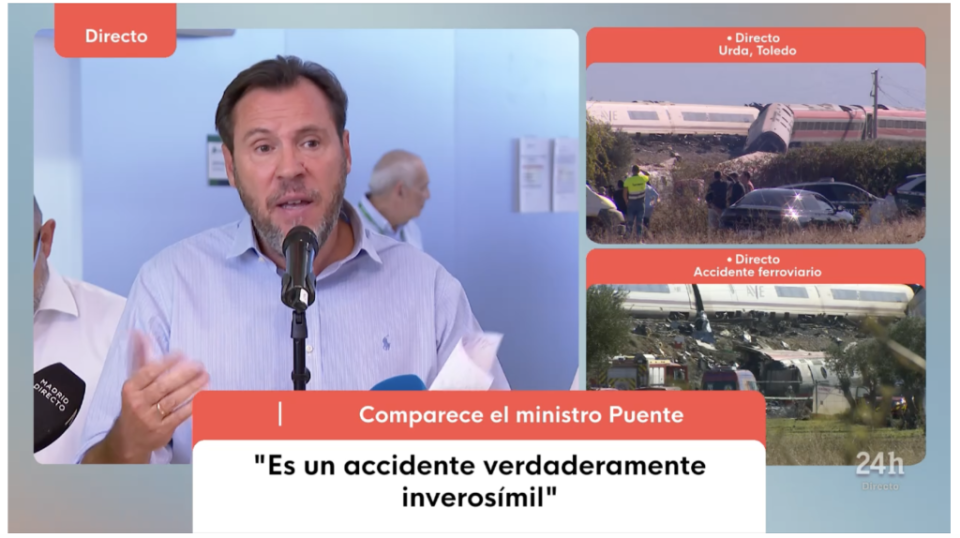
Spain’s Transport Minister, Óscar Puente, has described as ‘inexplicable’ the decision to allow a RENFE high-speed AVE train to resume normal running while an Iryo service remained stopped ahead of it, before Wednesday’s collision near Urda in Toledo province. ALSO READ: At least 68 dead and over 50 injured in high-speed train collision near Toledo.
Speaking at Adif’s Atocha control centre in Madrid, Puente said the AVE had been authorised to proceed despite a mandatory stop indication, a red signal and the presence of the stationary Iryo on the track. The collision killed at least 64 people, according to Castilla-La Mancha government.
The minister’s account set out a sequence beginning with a computer communications fault shortly before the crash. His explanation placed the decision to restart the AVE at the centre of the questions surrounding the disaster, although the precise speed of the train and other details remained unresolved.
Puente began by expressing his ‘dismay’ and solidarity with victims’ families at what he described as ‘one of the hardest moments anyone can face’.
‘A rear-end collision on the Spanish railway network is truly implausible, and we have therefore spent the morning trying to understand what happened, what could have happened to cause this accident,’ he said.
Computer fault halted trains over a 63-kilometre stretch
According to Puente, a communications failure involving three computers on the network occurred at around 8.30am, disabling the LZB train control and protection system along a 63-kilometre section near Urda station.
The loss of the system automatically brought trains in the affected area to a halt. The minister provisionally put the number of stopped trains at six, while stressing that this still needed to be checked.
With LZB unavailable, Adif’s control centre at Atocha took over management of movements through the section using manual procedures. Controllers then communicated with the stopped trains and issued instructions about restarting services.
Authorisation to restart despite an occupied track
Puente identified 8.36am as the moment when the control centre authorised the RENFE train to resume its journey ‘normally’.
He said the AVE was subject to an indication known as ‘target zero’, requiring it to stop. Railway regulations and Adif’s own procedures did not permit it to resume normal running in those circumstances, he explained.
The Iryo was still stationary near the entrance to Urda station, occupying the track circuit ahead. A red signal also prohibited the following train from proceeding.
‘Was this correct?’ Puente asked during his explanation of the authorisation.
He described the circumstances in which permission was given as ‘inexplicable’ and attributed the decision to the control centre.
Seventeen minutes before impact
The AVE subsequently travelled approximately 25 kilometres over about 17 minutes, striking the rear of the Iryo at 8.53am, according to the minister’s reconstruction.
Puente said the speed reached by the RENFE train had not yet been established. He noted that speeds of up to 200km/h were permitted on the section, but that figure was not a confirmed estimate of its speed at impact.
Both services had been travelling from Madrid towards Seville. The collision occurred near kilometre 118 of the Madrid–Andalusia high-speed line, close to Urda station, causing carriages to derail and some to fall down an embankment.
More than 540 passengers were aboard the two trains, according to the initial figures supplied by the Castilla-La Mancha government.
Reconstruction draws on control-centre communications
Puente said he learned of the accident a few minutes before 9am, as he was preparing to attend an event at Madrid’s Polytechnic University. He subsequently went to Adif’s H24 control centre at Atocha to obtain information about the collision.
During the morning, he met the technical staff responsible and watched a full replay of the sequence of railway movements – known in railway terminology as a moviola – alongside the communications between controllers and the trains that had been brought to a halt.
‘This is the account of events I can provide you with,’ he said.
His statement provided a more detailed official account of the events preceding the crash, following earlier reports of possible human error after the signalling failure. It did not establish why the computer communications failed, why the Iryo remained stopped or why the following AVE was authorised to proceed under those conditions.
The collision forced the suspension of rail services between Madrid, Ciudad Real and Andalusia.
Enjoying the news from Spain in English? Add us as a preferred news source in Google.
Subscribe to the Weekly Newsletter from Spain in English.

Click here to get your business activity or services listed on our DIRECTORY.