
Italy has rejected Spain’s demand to lift temporary border checks on travellers arriving from Spain, confirming the restrictions will remain in force until at least 15 August and deepening an increasingly bitter diplomatic dispute between the two European Union allies.
The Italian government dismissed Madrid’s warning that it could face reciprocal measures if the controls were not removed by the end of Sunday, insisting it would not bow to ‘ultimatums or impositions’. In response, Spain reiterated that it considers the checks ‘unfair, contrary to the interests of the European Union and discriminatory against the Spanish population’, and maintains it is prepared to introduce ‘proportional measures’ to protect ‘the interests and dignity’ of its citizens if Rome does not change course.
The dispute erupted after Italy last week temporarily suspended normal Schengen free-movement arrangements with Spain following the unprecedented migrant crisis in the Spanish North African enclave of Ceuta, where around 72,000 people crossed from Morocco in just a few days. ALSO READ: Ceuta crisis sparks emergency EU meeting requests as Sánchez rejects Schengen criticism.
Rome says the temporary controls are necessary to protect national security and guard against any potential security, terrorism or migration risks, while Madrid insists there is no evidence to justify the restrictions and notes that secondary migration from Spain into Italy is ‘practically zero’.
Speaking from Colombia, Spain’s Foreign Minister José Manuel Albares stepped up his criticism of the Italian decision, describing it as both ‘unjust and unjustifiable’. He said the measures ‘attack the dignity of Spaniards’ while also undermining European unity, calling them ‘a torpedo below the waterline of European unity’.
The Spanish government has also pointed out that Italy currently records more irregular migrant arrivals than any other European Union member state – roughly twice as many as Spain – yet Madrid says it has consistently shown solidarity with Rome during previous migration emergencies, including by accepting migrants rescued in the central Mediterranean.
Spanish authorities further argue that fears of migrants travelling onwards from Ceuta into the rest of Europe are unfounded. They note that around 70,000 of the approximately 72,000 people who entered the enclave have already returned to Morocco, while Ceuta and Melilla’s special border regime makes it impossible to reach mainland Europe without passing through police controls.
The diplomatic dispute has its origins in the height of the Ceuta crisis on 30 July, when Italian Deputy Prime Minister and Foreign Minister Antonio Tajani publicly backed suspending Schengen arrangements with Spain and linked the migration surge to the Spanish government’s proposed regularisation of undocumented migrants. Spain responded by summoning Italy’s ambassador for an explanation.
Italian Prime Minister Giorgia Meloni said the scenes in Ceuta demonstrated once again that ‘uncontrolled illegal immigration represents a concrete threat to the security of Europe’s borders’ and insisted Italy would not ‘stand by and do nothing’. ALSO READ: Diplomatic row erupts as Italy urges Schengen action against Spain over Ceuta crisis.
Italy’s tougher stance initially received support from Denmark, Finland and the Czech Republic, while several political parties in Portugal also backed calls for stricter internal border controls.
The crisis was discussed earlier this week during a videoconference of EU interior ministers requested by Spain and supported by 22 member states. Ahead of the meeting, Spanish Prime Minister Pedro Sánchez had called for a coordinated European response, warning against what he described as an ‘asymmetrical’ reaction driven by ‘prejudices, fake news, ignorance or political interests’. ALSO READ: Ceuta crisis sparks emergency EU meeting requests as Sánchez rejects Schengen criticism.
Some member states, however, argued that Spain’s proposed large-scale regularisation of undocumented migrants could act as a ‘pull factor’ encouraging further irregular migration. They also linked the events in Ceuta to a recent Spanish Supreme Court ruling confirming that Spanish immigration law does not permit so-called ‘pushbacks’ of migrants arriving by sea, claiming the decision had been exploited by criminal trafficking networks.
Despite those differences, EU ministers ended the meeting by expressing ‘firm solidarity’ with Spain and praising the country’s handling of the emergency. They also agreed on the need to strengthen the bloc’s external borders, deepen cooperation with third countries and continue the fight against migrant smuggling networks. ALSO READ: EU backs Spain after Ceuta migration crisis while ministers push for tougher anti-smuggling measures.
Ireland’s Justice Minister Jim O’Callaghan, whose country currently holds the rotating presidency of the Council of the European Union, said: ‘The EU is united and ready to support Spain. We congratulate Spain for its swift response to the situation in Ceuta and express our deepest condolences for the tragic loss of life. The EU’s external borders are a shared responsibility, and migration requires a united European response.’
Even Finland’s Interior Minister Mari Rantanen, whose government had previously supported temporary internal border controls, said they were no longer necessary because the situation in Ceuta had stabilised.
‘It is fantastic that Spain has managed to quickly get the situation under control and has received the unconditional support of all countries,’ she said. LATEST: Spain installs sea barrier as Ceuta slowly returns to normality and death toll rises to 72.
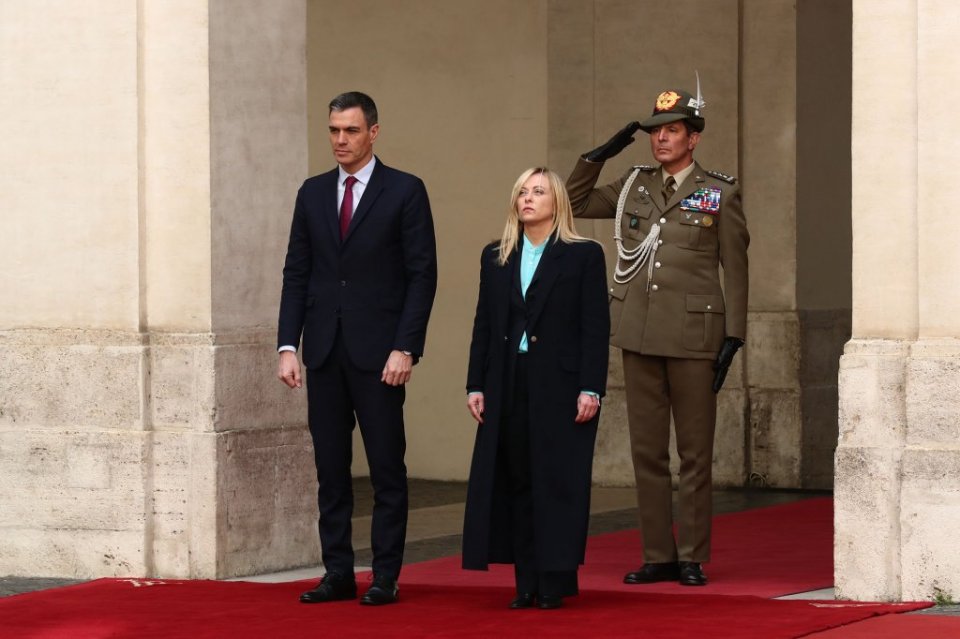
Main image: Spanish Prime Minister Pedro Sánchez together with Italian PM Giorgia Meloni meeting in Rome, 5 April 2023. (Pool Moncloa / Fernando Calvo).
Enjoying the news from Spain in English? Add us as a preferred news source in Google.
Subscribe to the Weekly Newsletter from Spain in English.
No te dejes engañar por información falsa.
— José Manuel Albares (@jmalbares) August 6, 2026
Entrar irregularmente en Ceuta o Melilla no permite permanecer en España o llegar al continente europeo.
Consulta la web y redes del @MAECgob y @EmbEspanaRabat para obtener información veraz. https://t.co/8esfV6BVBB

Click here to get your business activity or services listed on our DIRECTORY.