
LATEST: Spain installs sea barrier as Ceuta slowly returns to normality and death toll rises to 72.
ALSO READ: Ceuta crisis sparks emergency EU meeting requests as Sánchez rejects Schengen criticism.
Spain has summoned Italy’s ambassador in Madrid after senior members of the Italian government called for Spain to be suspended from the Schengen free-travel area following the mass arrival of migrants into Ceuta, and linked the crisis to the Spanish government’s migrant regularisation policy.
Spanish Foreign Minister José Manuel Albares announced he had called in the Italian ambassador after Italian Foreign Minister Antonio Tajani claimed on social media that Spain’s handling of irregular migration justified closing the Schengen area to the country.
Tajani wrote on X that he supported suspending Spain from the passport-free travel zone, arguing that the events unfolding in Ceuta highlighted the dangers of uncontrolled migration.
‘I am in favour of closing the Schengen area with Spain,’ he wrote. ‘Irregular and uncontrolled immigration poses a danger to national security.’
He also claimed that, ‘The images coming from Ceuta show how the Madrid government’s decision to grant Spanish, and therefore European, citizenship to over 500,000 irregular immigrants is profoundly wrong and encourages human trafficking.’
Thousands of migrants, many of them swimming from neighbouring Morocco using inflatable rings and other flotation devices, reached the Spanish North African enclave on Thursday, placing local authorities under intense pressure. ALSO READ: Ceuta faces new migration emergency after mass border crossings from Morocco.
Spain, however, strongly rejected Tajani’s comments, insisting they misrepresented both the legal situation in Ceuta and the government’s immigration policy.
Responding on X, Albares described the remarks as ‘improper’ coming from the foreign minister of ‘a partner and friendly country’.
‘We expect European solidarity and not partisan demagoguery,’ Albares wrote, adding that the developments in Ceuta were linked to a recent Spanish Supreme Court ruling and ‘have nothing to do with what the tweet says’.
He confirmed that Italy’s ambassador had been summoned to the Foreign Ministry.
The minister was referring to a Supreme Court judgment earlier this month which ruled that migrants who reach Ceuta or Melilla by swimming cannot automatically be returned to Morocco through so-called ‘hot returns’, altering the legal framework governing such arrivals.
Madrid also rejected Tajani’s assertion that Spain had granted citizenship to more than 500,000 undocumented migrants.
Under an exceptional regularisation programme introduced by the government, irregular migrants and international protection applicants who had arrived in Spain before 1 January 2026, and had lived continuously in the country for at least five months, were able to apply between April and June for temporary legal status. ALSO READ: Deadline day for Spain’s mass migrant regularisation as over one million apply for legal status.
The measure allows successful applicants to live and work in Spain for at least one year while gaining access to healthcare, social services and labour market integration. It does not confer Spanish citizenship.
Italian Prime Minister Giorgia Meloni later reinforced her foreign minister’s position, describing the scenes in Ceuta as ‘shocking’ and warning that Italy was prepared to take extraordinary action.
‘The images coming from Ceuta are shocking and demonstrate, once again, that uncontrolled illegal immigration represents a concrete threat to the security of Europe’s borders,’ Meloni wrote on X.
‘We are in the process of bringing together the competent bodies and, once these meetings are over, we are ready to act, including through exceptional measures … such as suspending the Schengen agreement with Spain.’
‘Italy will not stand idly by,’ she added.
Meloni also insisted her government would not retreat ‘one millimetre’ from its approach to illegal migration, saying Italy would continue to prioritise protecting Europe’s external borders, combating human trafficking networks and ensuring effective deportations.
The Schengen Area allows more than 450 million people to travel across the internal borders of 29 participating European countries without routine passport checks, making any proposal to suspend a member state an extraordinary political step.
The exchange marks a sharp deterioration in relations between Madrid and Rome, with Spain accusing Italy of exploiting the Ceuta migration crisis for domestic political purposes while calling instead for a united European response to the latest surge in irregular arrivals.
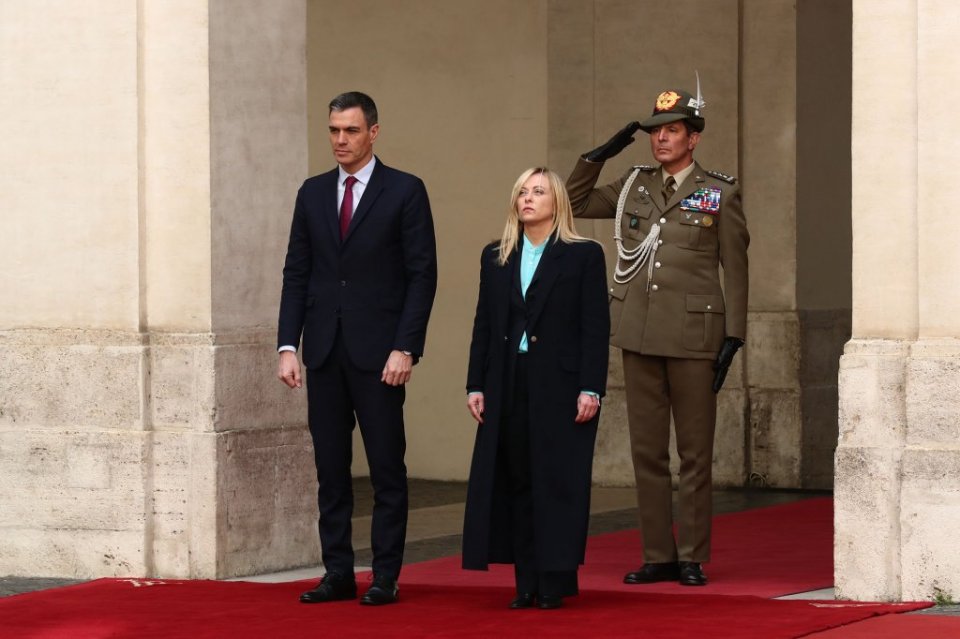
Main image: Spanish Prime Minister Pedro Sánchez together with Italian PM Giorgia Meloni meeting in Rome, 5 April 2023. (Pool Moncloa / Fernando Calvo).
Enjoying the news from Spain in English? Add us as a preferred news source in Google.
Subscribe to the Weekly Newsletter from Spain in English.
Le immagini che arrivano da Ceuta sono impressionanti e dimostrano, ancora una volta, che l’immigrazione clandestina fuori controllo rappresenta una minaccia concreta per la sicurezza dei confini europei.
Mi sono confrontata con il Ministro dell’Interno Matteo Piantedosi.…
— Giorgia Meloni (@GiorgiaMeloni) July 30, 2026
Sono favorevole alla chiusura dello spazio Schengen con la Spagna e ho piena fiducia nell’operato del Ministro Piantedosi. L’immigrazione irregolare e incontrollata rappresenta un pericolo per la sicurezza nazionale. Le immagini che arrivano da Ceuta dimostrano come la scelta del…
— Antonio Tajani (@Antonio_Tajani) July 30, 2026

Click here to get your business activity or services listed on our DIRECTORY.