
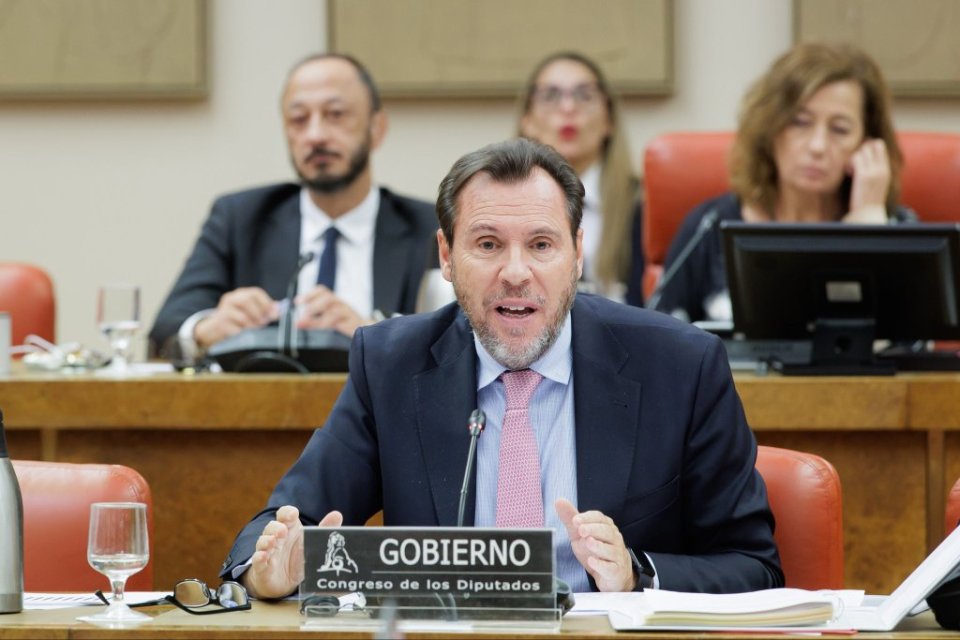
Spain’s transport minister, Óscar Puente, announced his resignation on Tuesday, six days after a high-speed train collision killed 69 people and injured dozens near Urda, in the province of Toledo (Castilla-La Mancha).
He also withdrew from the 29 November general election, in which he had been due to lead the Socialist Party’s (PSOE) list for Congress in Valladolid. ALSO READ: Spain’s latest rail tragedy puts safety and accountability at centre of election campaign.
Puente made the announcement in his closing remarks after more than four hours before the Congress’s Permanent Deputation, the body that sits while parliament is dissolved. He said he had decided to step down within minutes of learning of the crash and had told his family on his way to a control centre run by Adif, Spain’s rail infrastructure manager. He said he had waited to announce his decision until immediate measures to improve rail safety were in place. ALSO READ: Puente refuses to resign as train crash investigation examines safety failures and control-room orders.
‘A minister cannot remain in office after two accidents of this severity in less than a year,’ Puente told lawmakers. He described his decision as a matter of ‘political dignity’.
The Urda collision followed a crash in January near Adamuz, in the province of Cordoba (Andalusia), that killed 46 people. Both involved Renfe and Iryo trains on the Madrid–Seville line, Spain’s first high-speed route, which opened in 1992. ALSO READ: Families of Adamuz train crash victims to receive €216,000 under €20m compensation plan.
Visibly emotional, Puente spoke of the families who had lost loved ones and of those still living with serious injuries. He invoked the words of former Portuguese minister Jorge Coelho after the 2001 Hintze Ribeiro bridge collapse, which killed 59 people. ‘Blame cannot die single,’ he said. ALSO READ: Twelve foreign nationals confirmed among 69 killed in Spain’s latest train tragedy.
He thanked Prime Minister Pedro Sánchez for his trust and urged progressive voters to support him. Sánchez later praised Puente for putting victims first and taking political responsibility. The resignation comes less than four weeks before a snap election in which the PSOE are trailing in opinion polls. ALSO READ: Sánchez pledges urgent support for train tragedy victims and vows to restore trust in high-speed rail.
How the Urda collision unfolded
The crash occurred on 28 October near Urda, around 130 kilometres south of Madrid. A failure in the automatic train protection system had brought trains to a halt along a 63-kilometre stretch of the Madrid–Seville line. With traffic being managed from the Atocha control centre in Madrid, a state-owned Renfe service was authorised to resume its journey. It then struck the rear of a stationary train operated by Iryo. Investigators estimated that the Renfe train was travelling at between 160 and 200 km/h at the point of impact.
Puente’s initial account drew criticism from opposition parties and unions, which said it appeared to place too much responsibility on an individual controller. ALSO READ: Transport Minister says decision to let AVE proceed before fatal Toledo crash was ‘inexplicable’.
The crash also renewed scrutiny of whether maintenance investment had kept pace with rising passenger numbers since Spain opened its high-speed network to competition in 2021.
The train drivers’ union Semaf, which has called strikes at Renfe for 10 and 12 November, has complained of deteriorating working conditions and the use of ‘degraded systems’.
Calls to resign came from across Congress
The right-wing People’s Party (PP) and far-right Vox party had already called for Puente to go. During the hearing, PP spokesperson Ester Muñoz accused him of mishandling both disasters and criticised the leak of recordings between the Renfe driver and the Atocha control centre. ALSO READ: Toledo crash recordings reveal restart orders as Iryo driver reported train still stopped.
Puente acknowledged that giving explanations could do little to ease the suffering of victims and their families, but said appearing before Congress was a basic duty. Vox spokesperson Pepa Millán compared travelling on the rail network to ‘Russian roulette’ before her party’s representatives walked out.
The pressure extended to parties that have supported Sánchez’s government in parliament. The left-wing Sumar group and and Izquierda Unida (IU) demanded accountability, with IU’s Toni Valero arguing that a safe system had to be able to withstand an individual mistake.
Gabriel Rufián of the Catalan Esquerra Republicana (ERC) party asked what the left would demand of a PP minister in the same circumstances. Junts per Catalunya (JxCat) spokesperson Míriam Nogueras blamed years of underinvestment and centralisation, while the Basque Nationalist Party’s Mikel Legarda said the two crashes had caused a national trauma and that restoring public trust required Puente to resign.
EH Bildu took a different position. Its spokesperson, Mertxe Aizpurua, declined to demand Puente’s resignation and warned against assigning blame prematurely, whether to the minister or to railway workers.
€30 million in aid and new safeguards for high-speed rail
Earlier on Tuesday, the cabinet approved a €30 million package of direct aid and advance compensation payments for the injured and the families of those killed at Urda. The emergency decree is designed to get money to those affected while insurance and legal proceedings are still under way.
Puente also announced that a second controller would have to confirm decisions to move trains when the automatic protection system was out of service. Where drivers must rely on sight to detect obstacles after a system failure, trains will be limited to 40 km/h. ALSO READ: Spain to reduce Madrid-Seville train services and tighten safety procedures after recent disaster.
Services on the Madrid–Seville line are to be reduced while the Railway Safety Agency reviews the line’s safety arrangements and the government completes the delayed rollout of the European Rail Traffic Management System.
The government plans to introduce software that alerts controllers to unusual train movements and an AI tool to flag anomalies and monitor exchanges between drivers and control centres. Puente also announced changes to staffing, rest breaks and fatigue monitoring for controllers.
Enjoying the news from Spain in English? Add us as a preferred news source in Google.
Subscribe to the Weekly Newsletter from Spain in English.
Óscar Puente: “Como ministro, asumo mi responsabilidad de garantizar que los procedimientos funcionen, que se investigue lo sucedido y que se adopten las medidas necesarias para evitar que vuelva a ocurrir. Respecto a las peticiones de dimisión, respeto todas pero creo que las decisiones de esta naturaleza deben valorarse a partir de los hechos, de las responsabilidades que se determinen y de las respuestas que demos a la ciudadanía. Y no a la presión del momento que, evidentemente, es muy grande” https://t.co/aDLeVPNBAb
— RTVE Noticias (@rtvenoticias) October 30, 2026
🔴 ÚLTIMA HORA Óscar Puente anuncia su dimisión como ministro de Transportes. https://t.co/rVbYjtIEz3 https://t.co/bx4XTfrlu2
— RTVE Noticias (@rtvenoticias) November 3, 2026

Click here to get your business activity or services listed on our DIRECTORY.