
ALSO READ: Ceuta crisis sparks emergency EU meeting requests as Sánchez rejects Schengen criticism.
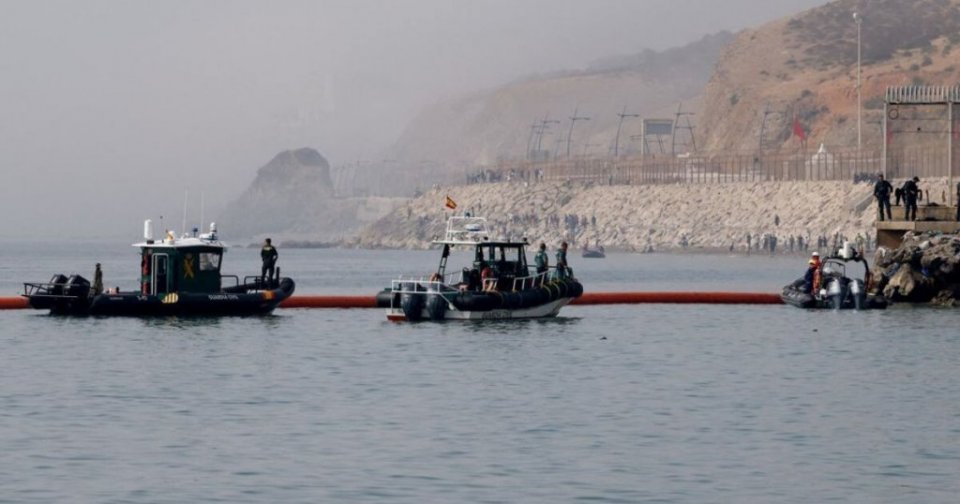
Spain has begun installing a floating sea barrier along part of its maritime border with Morocco as the North African enclave of Ceuta gradually returns to normality following last week’s unprecedented mass arrival of migrants that left at least 72 people dead. ALSO READ: Sánchez condemns mass Ceuta crossing as ‘violation of Spain’s territorial integrity’.
Authorities said the vast majority of the estimated 50,000 migrants who entered Ceuta by land and sea on Thursday and Friday have now returned voluntarily to Morocco, with fewer than 2,000 believed to remain in the Spanish territory. Officials said overnight attempts to cross into Ceuta had virtually stopped, although reinforced police and military deployments will remain in place while the situation continues to be monitored.
Guardia Civil officers started installing the new 500-metre pneumatic floating barrier early on Saturday at the Tarajal breakwater, one of the main crossing points used during the migrant surge.
The structure, supported by a line of anchored buoys, rises between 30 and 70cm above the water while extending up to one metre below the surface. A navigation channel has been left open to allow Guardia Civil patrol boats to continue operating in the area.
The barrier was introduced after one of the largest migration incidents ever recorded on the European Union’s only land border with Africa.
Spanish authorities now say 72 people lost their lives attempting to reach Ceuta. Many drowned while trying to swim around coastal defences, while others were crushed during desperate attempts to climb the Tarajal breakwater and border fencing. The latest official figure marks an increase from earlier casualty estimates released during the crisis.
Hundreds of migrants continued making their way back into Morocco on Saturday, many carrying few belongings and showing signs of exhaustion after spending days in Ceuta. Several told Spanish media they had been forced to sleep in woodland areas because they could not find shelter, while shortages of food had led to fights among those who remained.
Most of those involved in the crossing were Moroccan nationals, although smaller numbers arrived from sub-Saharan African countries. Many had entered by swimming around the coastal border barriers from the nearby Moroccan town of Fnideq, a journey of around five kilometres.
On the Moroccan side of the frontier, security forces attempted to stem the flow using water cannon, tear gas and warning shots, while Spanish authorities deployed additional police officers and military personnel to reinforce security inside Ceuta.
Spain’s Interior Minister Fernando Grande-Marlaska said criminal smuggling organisations had exploited vulnerable migrants by spreading misleading claims on social media about a recent Spanish Supreme Court ruling concerning migrants intercepted at sea.
Speaking in Ceuta, he said Spain had succeeded in restoring order within 24 hours but stressed that the operation was not yet complete.
‘Morocco isn’t any threat to Ceuta or the rest of Spain – it’s a fully reliable partner,’ he said, adding that there had been no intelligence suggesting such a large-scale crossing was imminent.
Grande-Marlaska also said the situation had been ‘almost entirely reversed’, with almost all of those who entered the enclave having now left.
The crisis has also affected Spain’s other North African enclave, Melilla, where the Beni-Enzar border crossing reopened gradually on Saturday as conditions began to stabilise.
The mass influx has reignited political debate across Europe over migration and external border security. Twenty-two EU member states have called for an urgent meeting of the bloc’s interior ministers to coordinate a common response and prevent further uncontrolled crossings.
Spanish Prime Minister Pedro Sánchez has also requested an emergency meeting of EU interior ministers, criticising what he described as the ‘selfish’ reaction of some European governments during the crisis.
European Commission President Ursula von der Leyen said the European Union should undertake ‘a lessons learned process to improve our European resilience’, while noting that ‘not a single person reached mainland Spain or the rest of the EU’ during the mass crossing.
The cause of the sudden surge remains unclear, and Moroccan authorities have yet to provide an official explanation.
Ceuta and neighbouring Melilla, both Spanish territories on Morocco’s Mediterranean coast, have long been focal points for irregular migration into Europe. The latest incident is the largest since 2021, when more than 10,000 migrants entered Ceuta over a two-day period during a diplomatic dispute between Spain and Morocco.
ALSO READ: Sánchez condemns mass Ceuta crossing as ‘violation of Spain’s territorial integrity’.
ALSO READ: Diplomatic row erupts as Italy urges Schengen action against Spain over Ceuta crisis.
Enjoying the news from Spain in English? Add us as a preferred news source in Google.
Subscribe to the Weekly Newsletter from Spain in English.
Unidades de @salvamentogob están terminando el despliegue de una barrera flotante en Ceuta.
En la operación, coordinada por nuestro centro en Tarifa a solicitud del Ministerio del Interior y en colaboración con todas las instituciones del Estado desplegadas en la zona,… pic.twitter.com/i78RBBh8f8— SALVAMENTO MARÍTIMO (@salvamentogob) August 1, 2026
Hoy ha comenzado la instalación de las barreras de contención en el espigón del Tarajal (Ceuta), en un operativo conjunto de la Guardia Civil, la @Armada_esp y @salvamentogob Marítimo (Sasemar).
✔️ El dispositivo consta de una barrera neumática de 500 metros, reforzada con una… pic.twitter.com/gRlBK2kk7D
— Guardia Civil (@guardiacivil) August 1, 2026
Asciende a 72 el número de personas muertas al tratar de llegar a las costas de Ceuta desde Marruecos https://t.co/dwUE1BM2kC
— RTVE Noticias (@rtvenoticias) August 2, 2026

Click here to get your business activity or services listed on our DIRECTORY.