
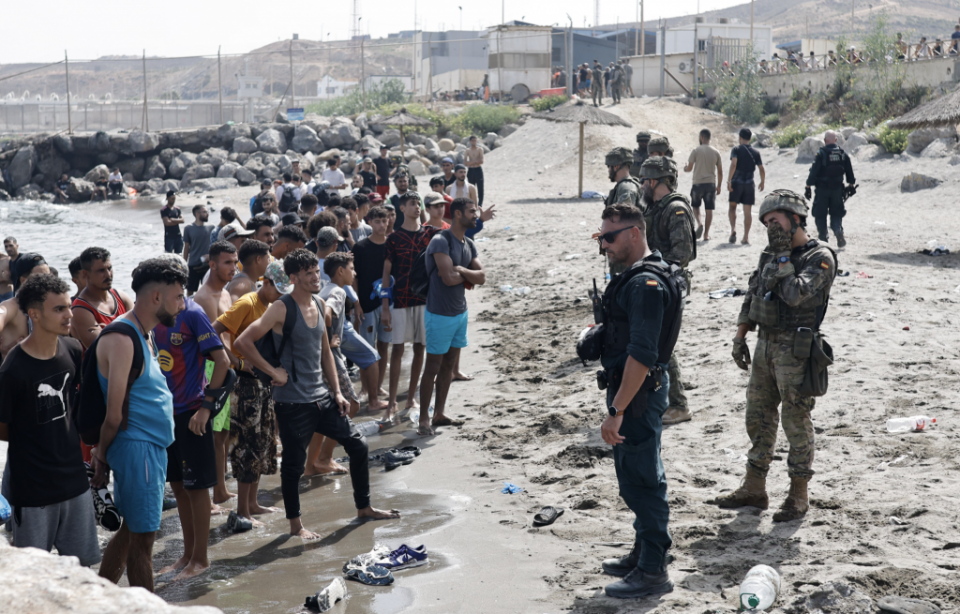
Spain’s Audiencia Nacional (National Court) is to investigate the mass arrival of migrants into Ceuta at the end of July, after a judge ruled that the events could constitute a serious attack on the country’s territorial integrity and involve alleged offences committed outside Spain.
Investigating judge María Tardón has accepted jurisdiction over the case, which will examine possible crimes against territorial integrity, negligent homicide and criminal organisation. The decision follows a complaint filed by the organisation Iustitia Europa and an opinion from the Public Prosecutor’s Office supporting the court’s competence to investigate. ALSO READ: Spanish court opens security inquiry into Ceuta mass crossing as Morocco cites trafficking networks and false rumours.
The case concerns the unprecedented influx into the Spanish enclave on 30 and 31 July, during which over 72,000 people crossed from Morocco, including by swimming around the border breakwater. ALSO READ: Sánchez convenes National Security Council as government steps up response to Ceuta migrant crisis.
In her ruling, Tardón said the Audiencia Nacional was competent to investigate ‘criminal conduct allegedly committed abroad that has seriously attacked Spain’s territorial integrity’, which is guaranteed under Article 2 of the Spanish Constitution. She said the alleged conduct had used mass entry into Spain, accompanied by irregular migration flows that had seriously affected the lives and rights of Ceuta’s residents. ALSO READ: Sánchez condemns mass Ceuta crossing as ‘violation of Spain’s territorial integrity’.
The Prosecutor’s Office had argued that the court should take responsibility because ‘the most significant effects’ of the events occurred on Spanish territory and because the Audiencia Nacional has the capacity to ‘deal with complex and organised criminal phenomena’.
Police report points to coordinated operation
The investigation is based on a report by Spain’s National Immigration and Borders Centre (CENIF), which concludes that the influx was not spontaneous but coordinated, with migration flows allegedly used as cover for a form of ‘hybrid warfare’.
According to the ruling, the mass movement of people could constitute one of the characteristic methods of ‘hybrid warfare’ or the ‘grey zone’, intended to disrupt the lives and rights of Spanish citizens in Ceuta.
The judge also highlighted what the police report described as ‘total permissiveness’ on the part of Moroccan security forces. The report alleges that their conduct facilitated the border crossings rather than preventing them. ALSO READ: Spain’s police chief says Ceuta report does not attribute ‘planning or execution’ of migrant crisis to Morocco.
Tardón referred to ‘a clear and undeniable facilitation of the process’ from Morocco, particularly through ‘the verified and visually documented behaviour of Morocco’s security forces’. ALSO READ: Spanish PM backs Morocco over Ceuta migrant crisis as King Felipe visit is announced.
According to the ruling, uniformed Moroccan officers made ‘no serious attempt’ to stop the influx, while some allegedly provided ‘active guidance’ on how to cross into Ceuta. However, these assertions form part of the investigation and have not been established by a final judicial judgment. ALSO READ: Morocco stops new mass attempt to reach Ceuta as almost 300 migrants detained.
Five levels of alleged organisation
The court’s investigation will examine what the ruling describes as a structure comprising at least five levels. Three of those levels contain people who can potentially be identified individually, while the identities of those responsible for the remaining two have not yet been established. The judge said the latter nevertheless appeared to operate from Morocco or in connection with it.
The first level consists of the migrants who entered Ceuta. The second comprises those who amplified and promoted messages encouraging the crossings on social media. The third involves organisers of the movement of people on the ground, including both uniformed and non-uniformed members of Morocco’s security forces.
The fourth level concerns the alleged planners of the operation. The ruling says their existence is suggested by comparisons with other significant migration episodes affecting Ceuta, including those in 2021 and 2024. The fifth level would consist of those responsible for directing the operation. ALSO READ: Five arrests as police bust migrant smuggling ring charging €9,000 from Ceuta to mainland Spain.
‘We are faced with a process planned and executed through the coordination of actors of the significance of those mentioned in Levels 3 and 4, and this requires a high capacity for influence on social media, over people linked to Morocco’s security forces, and over people or institutions with the capacity and experience necessary to form part of the planning level of the process,’ the judge stated.
The investigation will therefore seek to establish whether the influx resulted from an organised operation, who may have planned or directed it, and whether any criminal responsibility can be attributed to identifiable individuals.
Deaths and possible criminal offences
The proceedings will also examine the deaths associated with the crossings and whether they could give rise to charges of negligent homicide or offences against the rights of foreign nationals.
The decision to investigate does not amount to a finding that Morocco, its authorities or any individual committed a crime. It establishes the court’s jurisdiction and the scope of the inquiries that will now be carried out.
The proceedings will be subject to partial secrecy, although the restriction will not apply to the Public Prosecutor’s Office.
The ruling also orders the private prosecutions to act as a single group. Separately, it has prevented the political group Se Acabó la Fiesta from joining the proceedings at this stage and requires it to provide a €6,000 bond.
Spanish government urges caution over Morocco allegations
The judicial investigation comes amid differing assessments of the events. Spain’s left-wing government has said there is no ‘solid proof’ that the influx was planned by Morocco, with which Madrid has spent years seeking to improve historically complicated relations.
Moroccan authorities have not publicly responded to the Spanish police report, according to the second report. Moroccan media, however, have criticised the document as ‘botched’ and argued that it lacks material evidence.
The allegations are particularly sensitive because Rabat has claimed sovereignty over Ceuta and Spain’s other North African enclave, Melilla, since Morocco gained independence in 1956.
The influx has also had lasting consequences for Ceuta. Although most of those who entered have reportedly returned to Morocco, thousands have remained in the small city, some in difficult living conditions. The situation has increased local tensions and generated a political controversy for the Spanish government. ALSO READ: Tens of thousands rally across Spain in support of Ceuta as crisis fuels anger at Sánchez government.
The Audiencia Nacional’s investigation will now seek to determine whether the events were the result of a coordinated criminal operation, the extent of any involvement by individuals or institutions linked to Morocco, and whether the deaths and other consequences can be connected to prosecutable offences. ALSO READ: Spain’s Ceuta crisis: Polls show widespread disapproval of Sánchez as PP and Vox pass 50%.
Enjoying the news from Spain in English? Add us as a preferred news source in Google.
Subscribe to the Weekly Newsletter from Spain in English.
🗣️Ángel Víctor Torres, ministro de Política Territorial y Memoria Democrática, sobre la investigación de la entrada masiva en Ceuta abierta por la Audiencia Nacional:
— RTVE Noticias (@rtvenoticias) September 7, 2026
“El Gobierno de España se va a personar en esta causa como perjudicado”#LaNoche24h en #Canal24horas…
La Audiencia Nacional se queda con la investigación sobre Ceuta tras el respaldo de la Fiscalíahttps://t.co/OFr00WC71q pic.twitter.com/lhFYLBIG9j
— Europa Press TV (@europapress_tv) September 7, 2026
Albares en @LaHoraTVE “no puede” certificar quién está detrás del asalto a Ceuta pero apunta a la desinformación en redes sociales de la sentencia del Supremo, días después de que la Comisión Europea se reuniese con plataformas digitales y que la “internacional reaccionaria”… pic.twitter.com/Up7R2q4RE5
— RTVE Noticias (@rtvenoticias) September 8, 2026

Click here to get your business activity or services listed on our DIRECTORY.