
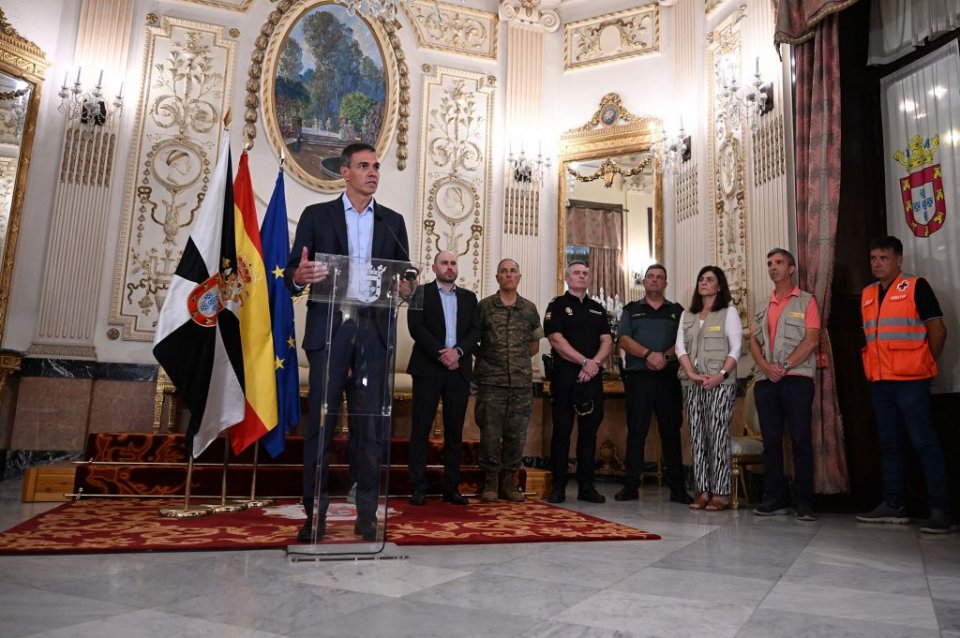
Spanish Prime Minister Pedro Sánchez has described the unprecedented mass arrival of tens of thousands of migrants into Ceuta as a ‘violation of Spain’s territorial integrity’, pledging that his government will use every available resource to restore order, strengthen border security and accelerate the return of those who entered illegally.
Speaking during a visit to the North African enclave on Friday, Sánchez said the government’s priority was to guarantee the safety of Ceuta’s residents while responding to what has become Spain’s most serious border crisis since 2021.
According to Spain’s central government, around 50,000 people crossed into Ceuta from neighbouring Morocco within the space of 24 hours, although Ceuta regional president Juan Jesús Vivas later estimated the figure had reached 60,000. Officials said that by early Friday afternoon roughly half of those who had entered had already returned to Morocco at a rate of approximately 150 people per minute.
Vivas also confirmed that 34 people had died during the crossings.
Sánchez characterised the events as ‘a violation of the territorial integrity of Spain’ deserving ‘our strongest possible condemnation’, while rejecting suggestions that the influx reflected a breakdown in relations with Morocco.
Instead, he blamed organised human trafficking networks for exploiting a recent Spanish Supreme Court ruling concerning migrants who enter Ceuta by swimming rather than crossing a recognised land border.
According to the prime minister, criminal gangs rapidly spread their own interpretation of the judgment through social media, encouraging thousands of people to attempt the crossing.
‘This ruling has spread like wildfire through the social networks of the human trafficking mafias and has produced an avalanche of the scale and characteristics that we witnessed yesterday,’ Sánchez said.
Spain’s Supreme Court recently ruled that migrants who reach Ceuta by sea cannot automatically be subjected to immediate ‘pushbacks’, distinguishing such cases from attempts to enter by crossing or climbing the territory’s land border fence.
Sánchez said his government would respond by speeding up repatriation procedures for those who had entered irregularly, with Spain’s asylum commission already meeting to streamline administrative processes.
He also announced additional security deployments and the installation of floating buoys along the Tarajal breakwater to create a clearly defined maritime boundary intended to prevent further confusion over the court ruling.
‘The Government of Spain will use all the mechanisms and resources of the State to guarantee the security of the people of Ceuta and coexistence in the city,’ he said.
He added that the government’s commitment to Ceuta was ‘absolute, total and unequivocal’, declaring: ‘The State is here. We defend the border from Ceuta just as we would defend the M-30 in Madrid.’
Sánchez stressed that co-operation with the Moroccan authorities remained ‘constant and fluid’, contrasting the current situation with the diplomatic tensions that fuelled the 2021 migration crisis. He said Spain’s migration policy continued to rest on three pillars: protecting external borders, working with countries of origin and transit to combat people-smuggling networks, and strengthening co-operation with partners including Morocco, Senegal and countries across the Sahel.
The prime minister travelled to Ceuta alongside Interior Minister Fernando Grande-Marlaska, where they met local officials, senior National Police and Guardia Civil commanders, representatives of the migrant reception centre (CETI) and the Red Cross.
After concluding his visit, Sánchez was confronted by a hostile crowd that jeered, whistled and shouted insults as he left the area under heavy police protection. Among those present were several local Vox representatives, who voiced support for the protesters.
Ceuta overwhelmed
Juan Jesús Vivas described the situation as one of ‘helplessness and abandonment’, noting that the estimated 60,000 arrivals represented more than half of Ceuta’s resident population of around 85,000 and were roughly five times greater than the influx recorded during the migration crisis of 2021.
He said he would closely monitor implementation of the measures announced by the Spanish government but insisted that Ceuta urgently required a comprehensive recovery plan.
That, he said, should include the swift return of those who entered illegally, measures to restore public security, continued humanitarian assistance for those caught up in the emergency and financial support for self-employed workers and small businesses forced to close during the crisis.
Originally, Sánchez and Vivas had been expected to appear jointly before the media, but they instead held separate press conferences, with the Ceuta leader saying he needed additional time to prepare his own remarks following their meeting.
Meanwhile, Spain’s right-wing opposition People’s Party (PP) called for Sánchez to appear urgently before parliament to explain the government’s response to what it described as the ‘extremely serious situation’ in Ceuta.
The party said it wanted details of the measures being taken to safeguard both Spain’s and the European Union’s external borders, guarantee national sovereignty and clarify co-operation with Morocco over migration control.
International reaction
The crisis prompted concern across Europe and beyond as images showed thousands of people crossing into Ceuta by swimming around the Tarajal breakwater, walking through shallow water or climbing coastal barriers after Moroccan border controls appeared to ease.
Large numbers of young men, as well as families with children, were filmed entering Spanish territory, while beaches became littered with discarded clothing, rubber rings and flotation devices. Many migrants later wandered the streets searching for food and water. ALSO READ: Ceuta faces new migration emergency after mass border crossings from Morocco.
Although Spain said almost half of those who crossed had already returned voluntarily to Morocco, the government insisted that those who entered illegally would not be allowed to continue onwards to mainland Europe.
Italian Prime Minister Giorgia Meloni described the scenes as ‘shocking’ and said Italy was prepared to consider ‘exceptional measures”‘ including seeking Spain’s temporary suspension from the Schengen free-travel area.
Her comments prompted Madrid to summon Italy’s ambassador in protest. ALSO READ: Diplomatic row erupts as Italy urges Schengen action against Spain over Ceuta crisis.
Finland and Sweden subsequently voiced support for Italy’s position, while French Interior Minister Laurent Nunez announced that France had ordered tighter controls along its border with Spain.
European Commission President Ursula von der Leyen called the scenes in Ceuta ‘unacceptable’, saying: ‘We cannot allow anyone to come to our (European) Union without abiding by our rules.’
German Chancellor Friedrich Merz welcomed Spain’s decision to prevent migrants from travelling onwards into mainland Europe and said Morocco should take back those who had crossed illegally.
In the United States, President Donald Trump described the images from Ceuta as ‘terrible’, while Vice-President JD Vance said they highlighted ‘the consequences of mass migration’. White House Deputy Press Secretary Anna Kelly urged Spain to ‘immediately reverse course’, and Deputy Chief of Staff Stephen Miller accused Spain’s migration policies of encouraging illegal immigration.
Spanish police union Jupol also criticised Morocco’s role in the crisis, accusing Rabat of exploiting ‘a window of opportunity as part of its hybrid warfare strategy, once again using migratory pressure on Ceuta as a tool for political blackmail’.
Spain’s Interior Ministry, however, maintained that co-operation with Morocco had been ‘exemplary’, arguing that organised people-smuggling networks had deliberately exploited confusion surrounding the recent Supreme Court judgment to trigger the mass crossings.
Enjoying the news from Spain in English? Add us as a preferred news source in Google.
Subscribe to the Weekly Newsletter from Spain in English.
The images coming from Ceuta are unacceptable.
— Ursula von der Leyen (@vonderleyen) July 31, 2026
We cannot allow anyone to come to our Union without abiding by our rules.
Dangerous crossings must stop immediately. Smuggling networks must be dismantled. And returns must be swift, as our rules allow.
I tasked two Commissioners…
El Gobierno garantizará la seguridad de los vecinos y vecinas de Ceuta, intensificando la presencia de las Fuerzas y Cuerpos de Seguridad en las calles de la ciudad.
Además, vamos a desplegar una barrera física de contención en el mar para facilitar la repatriación en frontera,… pic.twitter.com/Mj2LrcoBV9
— Pedro Sánchez (@sanchezcastejon) July 31, 2026

Click here to get your business activity or services listed on our DIRECTORY.