
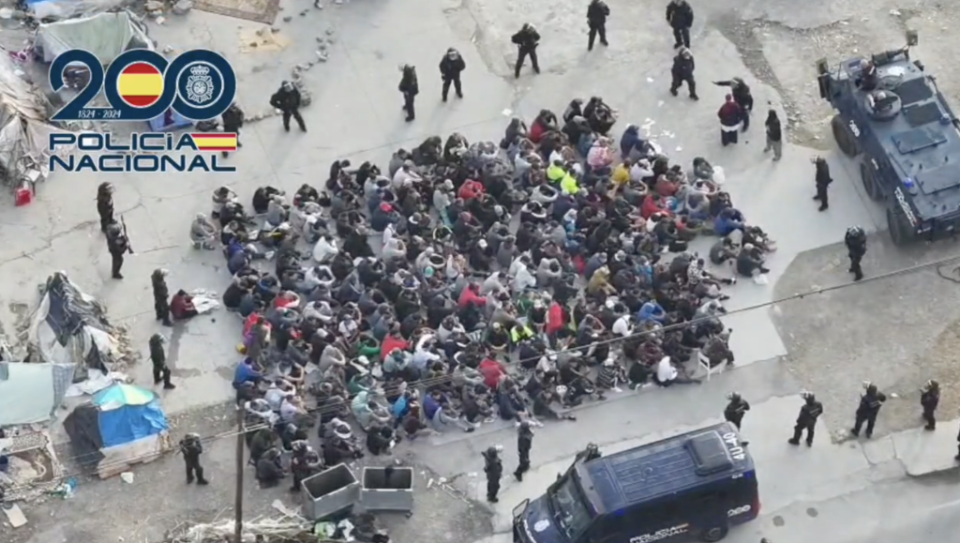
Police cleared the El Guano migrant settlement in Ceuta on Sunday, moving around 150 people from the site as the Spanish city continued to struggle with the aftermath of mass arrivals from Morocco in late July.
The operation took place two days before King Felipe VI and Queen Letizia are due to visit Ceuta. It was the fifth major clearance of public spaces occupied by migrants in recent weeks, although people continue to sleep outdoors elsewhere in the city and accounts differ over how much emergency accommodation remains available. ALSO READ: Felipe VI and Letizia to visit Ceuta and Melilla in October following migration crisis.
More than 350 officers were deployed, with the National Police leading an operation involving the Guardia Civil, local police and the armed forces. Police vans and armoured vehicles were positioned around the settlement, while a drone monitored the surrounding area.
El Guano had become a makeshift refuge for people displaced by earlier clearances, particularly the removal of the nearby El Trampolín beach camp on 4 and 5 October. Many had been living outside for weeks following the arrivals of 30 and 31 July. ALSO READ: Spanish court to investigate deadly Ceuta migrant surge as possible ‘hybrid warfare’ operation.
Residents leave before police arrive
The settlement had already begun to empty before officers closed its access points shortly before 8am on Sunday. Young migrants gathered their belongings during the night and left, with some heading towards nearby hills to avoid being taken away on buses. ALSO READ: Spain had warnings of mass migrant crossings into Ceuta, but not their scale, documents reveal.
Residents had anticipated the clearance. The previous day, some were asking: ‘Morocco tomorrow?’ Others showed documents they hoped would establish that they were under 18, uncertain how their age or circumstances would be assessed.
Police encountered no significant resistance. Those remaining were gathered into separate groups of adults and children before three buses arrived at around 8.20am. Approximately 150 people left during the operation, although others had departed independently before dawn.
Adults were due to be taken to the Temporary Reception Centre for Foreigners, known as the CATE, in warehouses at El Tarajal near the Moroccan border. The facility carries out identification and initial assessments before people are referred elsewhere.
According to sources at the central government’s delegation in Ceuta, children were to pass through police headquarters before being directed to available reception facilities, including those at Loma Colmenar.
The National Police said the operation was necessary to maintain public order and security, identify migrants and ensure sanitary conditions in reception facilities. The interior ministry described the recent operations as ‘aimed at clearing public areas of the city’.
Within about two hours, El Guano was empty. Cleaning teams began removing tents, blankets, mattresses, plastic sheeting and improvised structures, with the site due to be cleaned and restored.
Accommodation remains under strain
Clearing the settlement leaves unresolved the question of where everyone can stay. ALSO READ: Tensions erupt in Ceuta as protesters block food aid to migrants and government appeals for calm.
Places were reportedly available at emergency facilities in the port, Loma Colmenar, Loma Margarita, the Hípica and Caballería sites, alongside accommodation provided by Ceuta’s autonomous administration for children.
Other reports said that adult reception camps and the Temporary Stay Centre for Immigrants, known as the CETI, were practically full.
Ceuta’s normal reception arrangements were overwhelmed after thousands crossed into the city by land and sea at the end of July. Authorities have since opened emergency accommodation, organised transfers and conducted identification operations among those living outside official facilities.
More than 70,000 people entered Ceuta on 30 and 31 July. Most returned to Morocco within days, but thousands remained, including people sleeping on beaches and in the streets. Scores died during the influx, which prompted alarm across the European Union and a political crisis in Madrid. ALSO READ: Thousands march in Madrid over Ceuta crisis, demanding early election and migrant returns.
Conditions in the informal settlements have deteriorated as temperatures have fallen. Residents have had insufficient sanitation and relied heavily on volunteers and humanitarian organisations for food and other essentials.
The government is preparing another reception site beside Fuerte Mendizábal prison, on land brought into the emergency arrangements through a royal decree approved in late September. It is intended to accommodate around 1,000 people, but no opening date has been confirmed.
Meanwhile, migrants continue to sleep outdoors in the El Tarajal industrial estate and neighbourhoods including El Príncipe and Los Rosales. Some lack documentation; others have been unable to secure accommodation or do not know which administrative steps to follow.
Returns to Morocco raise further questions
Some people taken from El Guano by bus on Sunday were later seen at the El Tarajal border facilities. After passing through immigration offices, they left Ceuta through a gate beside the border breakwater, accompanied by uniformed officers.
Authorities describe these departures as ‘voluntary’. However, the reporting from the scene did not establish how many people returned during Sunday’s operation or the circumstances in which they agreed to leave. ALSO READ: Spain orders investigation into alleged military abuse of migrants in Ceuta.
Following the clearance of El Trampolín, authorities recorded more than 1,000 returns to Morocco, also classified as voluntary. ALSO READ: Ceuta police clear migrants from Trampolín beach and move them to temporary shelters.
For some migrants, returning has offered a way out of prolonged hardship and a lack of alternatives. Others fear that immigration procedures will result in their removal. People who say they are minors, or who wish to seek asylum, face the additional uncertainty of whether their circumstances will be examined before a decision is made about their future.
The successive clearances have also shifted people between locations. Police acted at the desalination plant area on 27 September and Benítez beach on 29 September, followed by the two operations at El Trampolín in early October. Many displaced from that beach subsequently moved to El Guano. ALSO READ: Thousands of migrants return to Ceuta beaches after port reception camps reach capacity.
Sunday’s clearance removed another visible settlement, including the informal food distribution points, stalls and makeshift barbers that had developed around it. It did not end the need for shelter or resolve the position of those still waiting for accommodation and decisions on their status.
Royal visit comes amid political criticism
Felipe VI and Letizia are scheduled to visit Ceuta on Tuesday 13 October, before travelling to Melilla the following day. The trip has been coordinated with the Spanish government. ALSO READ: Spanish PM backs Morocco over Ceuta migrant crisis as King Felipe visit is announced.
It will be the first visit to the two cities by a Spanish monarch since King Juan Carlos travelled there in November 2007, a trip that triggered a diplomatic dispute with Morocco.
Morocco claims sovereignty over both Ceuta and Melilla, Spain’s two cities on the North African coast.
The latest clearance comes as opposition parties accuse Prime Minister Pedro Sánchez’s socialist-led government of responding too slowly to the migration crisis. Although El Guano is the last major migrant encampment in Ceuta, people remain without shelter in other parts of the city. ALSO READ: Spain’s Ceuta crisis: Polls show widespread disapproval of Sánchez as PP and Vox pass 50%.
Enjoying the news from Spain in English? Add us as a preferred news source in Google.
Subscribe to the Weekly Newsletter from Spain in English.
Las fuerzas y cuerpos de seguridad del Estado han comenzado a desalojar poco después de las ocho de la mañana la playa de Guano, en Ceuta, donde hay alrededor de 400 migrantes de los más de 70.000 que llegaron el 30 y 31 de julio. Informa @SandraAswaniAlc en el #Canal24Horas https://t.co/fGc1gcLGsl
— RTVE Noticias (@rtvenoticias) October 11, 2026
Agentes de @policia han desmantelado esta mañana el asentamiento del #Guano en #Ceuta Un operativo que ha contado con más de 350 agentes de Policía Nacional y en el que han colaborado efectivos de Guardia Civil, Policía Local y Fuerzas Armadas #SomosTuPolicía https://t.co/Vs928iRt3d
— Policía Nacional (@policia) October 11, 2026

Click here to get your business activity or services listed on our DIRECTORY.