
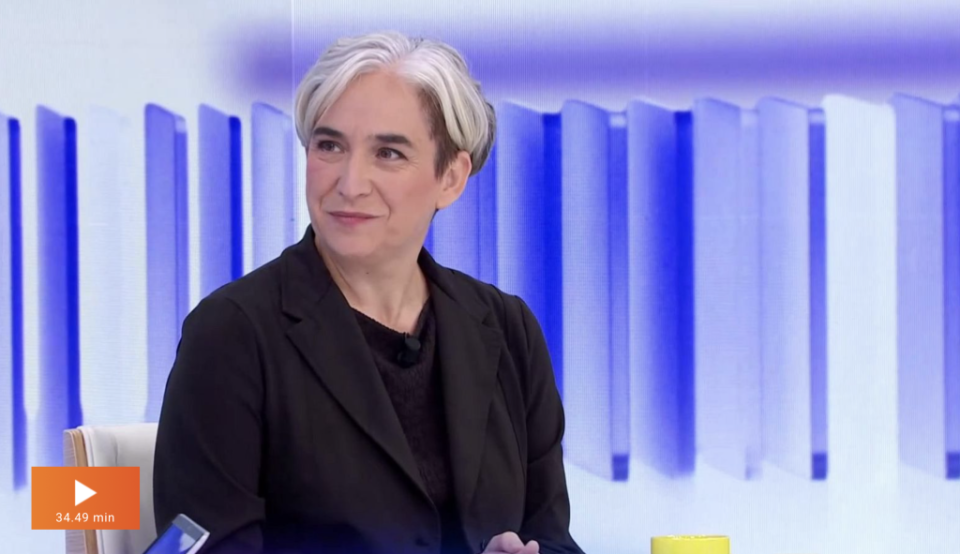
Former Barcelona mayor Ada Colau has said she is willing to lead a united left-wing alliance in Spain’s 29 November general election, provided it brings together Podemos and other parties alongside the forces currently negotiating the new Frente Amplio.
Speaking on Thursday, Colau urged parties to agree on a single electoral ticket to the left of the socialists (PSOE), arguing that choosing a lead candidate would not, by itself, resolve the divisions within that political space. ALSO READ: Pedro Sánchez calls a general election in Spain for 29 November.
‘If we are all there, I will be there too,’ she told TVE, a day after Más Madrid proposed her as the alliance’s candidate for prime minister, heading its Barcelona list. The proposal remains subject to an overall agreement between the participating parties.
Frente Amplio — or ‘Broad Front’ — is the proposed alliance being negotiated by Izquierda Unida (IU), Sumar, Más Madrid and the Comuns, with the aim of broadening the electoral platform previously represented by Sumar.
Colau said she felt honoured to be considered a possible consensus candidate, but made clear that her involvement depended on building a wider coalition rather than reproducing earlier arrangements.
‘I am available. I would like to be useful, as I have wanted to be all my life,’ she said. ‘To repeat previous experiences, I am not needed.’
A single ticket and shared leadership
Colau’s priority is to bring the different parties together around a clear programme, avoiding competing candidacies, personal rivalries and mutual vetoes.
She named Podemos, Compromís, Chunta Aragonesista and Més among the forces she wanted involved, alongside the Comuns. She also said she would welcome the participation of Podemos MEP Irene Montero and former Valencian deputy premier Mónica Oltra.
‘The more people, the better; there is a role for everyone,’ she said.
Colau confirmed that she had spoken to Montero, as well as Health Minister and Más Madrid leader Mónica García and IU leader Antonio Maíllo.
In a subsequent interview with Cadena SER, she described an agreement with Podemos as feasible and warned that voters would punish any party choosing to stand separately.
‘If any party decides to go it alone, the public would not understand it and would penalise it heavily,’ she said.
For Colau, unity must also extend to how the alliance is led. She advocated a collective leadership, with several prominent figures sharing responsibility, rather than expecting one person to carry the entire project.
‘One person, one leadership, is not going to resolve this,’ she said, arguing that a shared approach would also help withstand opponents’ campaigns of discredit, harassment and fake news.
The programme, she added, should combine housing rights and other ambitious measures with the defence of peace, rights and freedoms.
Barcelona proposal puts electoral lists at centre of talks
Más Madrid’s proposal would place the alliance’s candidate for prime minister at the head of its Barcelona ticket, departing from the usual practice of that candidate standing first on the Madrid list.
The party presented this as a reflection of the coalition’s commitment to territorial balance, generosity and a confederal structure, giving its constituent organisations recognition and autonomy in their respective territories.
The Comuns had initially suggested that Colau lead the Madrid list, with Culture Minister Ernest Urtasun heading Barcelona. Más Madrid, however, asserted its claim to lead the ticket in its own region and proposed that Colau stand in Barcelona instead.
That arrangement is viewed favourably by the Comuns, with Urtasun potentially taking second place behind her.
Madrid remains particularly sensitive. García wants to head the list there, while Podemos is demanding joint primaries to choose the alliance’s candidate for prime minister and determine leading positions on its electoral tickets. Podemos is putting forward Montero for the premiership.
Colau sought to play down the geographical dispute.
‘It is not about whether Barcelona or Madrid,’ she said, insisting that ‘there is room for everyone on the lists’. What mattered, she argued, was ensuring that every participating organisation received recognition and visibility.
Nevertheless, the allocation of places with a realistic prospect of winning seats remains one of the main obstacles, alongside the division of funding within the coalition.
Polling suggests the parties could have fewer winnable positions to distribute than in the 2023 general election. Bringing Podemos into the alliance would therefore reduce each existing partner’s share, even if a united ticket improved their overall electoral prospects.
The negotiations are also complicated by the requirement to alternate men and women on candidate lists, limiting the combinations available when accommodating leading figures from different parties.
Andalusia is one region where Podemos’s participation could prove particularly significant. Teresa Rodríguez’s Adelante Andalucía, strengthened by its performance in the latest regional election, threatens to take seats from the emerging alliance. A broader agreement could help it secure additional representation, with IU expected to lead its lists in the region. ALSO READ: PP wins Andalusia election but loses majority, leaving it reliant on far-right Vox.
On Wednesday, Urtasun said the parties were accelerating talks and that the coming hours would be crucial.
‘We are moving as fast as we can,’ he said, appealing for calm and promising that the alternative left would ‘do things right’ to ‘maximise’ its results.
IU was also preparing to adapt its internal selection process to the shortened election timetable. Maillo was due to convene an extraordinary meeting of its Federal Coordinating Body on Wednesday afternoon to discuss the political situation and an urgent revision of the recently approved schedule for primaries open to IU supporters.
Housing crisis and Maricarmen’s death
Alongside the election negotiations, Colau expressed ‘pain and anger’ over the death of Maricarmen, the 87-year-old woman with a disability whose eviction became a rallying point for housing campaigners. ALSO READ: Vigils and protests in Madrid after death of housing campaign symbol Maricarmen.
Maricarmen had been unable to return home despite a subsequent agreement with the company that owned the property. RTVE reported that her deteriorating health prevented her return.
Colau said the case marked a turning point and called for the housing protests to continue, including the encampment in Madrid’s Puerta del Sol and the general strike called for 11 November. ALSO READ: Spain’s housing crisis prompts general strike on 11 November, ahead of election.
‘We owe her that fight, keeping those demonstrations going,’ she said.
Housing activism was central to Colau’s rise to public prominence: she became a leading figure in Spain’s anti-eviction movement between 2009 and 2014 before entering municipal politics. ALSO READ: Opinion: three women in Spanish politics – No.1 Ada Colau: agent of change.
She criticised the time institutions had taken to respond to the housing emergency, pointing to the delay between Pedro Sánchez’s commitment to introduce rent regulation and its implementation in 2024.
‘Institutional politics cannot be so slow when lives are at stake,’ she said.
Colau argued that the lack of sufficiently rapid action had fuelled public anger over access to housing. She called for wider restrictions on rents and stronger action against property speculation. ALSO READ: Sánchez revives housing measures with €10bn loan plan as Spain heads towards election.
‘Speculation has to end, and this is a historic moment,’ she said.
An exceptional moment
Colau said she had turned down several approaches to return to institutional office since stepping away more than two years ago, believing that time outside elected politics helped maintain contact with everyday realities.
But she described the current circumstances as exceptional, saying that the growth of hate speech had consequences for people’s lives and demanded a response.
If she ultimately stood, she said, the task would require full commitment, courage and energy at a moment when much was at stake.
She accused the far right of wanting its opponents to feel dispirited and said she refused to resign herself to it governing Spain. ALSO READ: PP, Vox and Junts attack Sánchez’s record as Spain heads for November election.
Enjoying the news from Spain in English? Add us as a preferred news source in Google.
Subscribe to the Weekly Newsletter from Spain in English.
Ada Colau, no descarta su candidatura para liderar Frente Amplio y pide una “única papeleta” en la izquierda: “Me gustaría ser útil […] Si puedo ser una persona de consenso para que ese Frente amplio de lo que es hoy. Para repetir las experiencias que ya se han hecho, yo no soy necesaria” https://t.co/vBkJA1x83Y #LaHora8O
— RTVE Noticias (@rtvenoticias) October 8, 2026

Click here to get your business activity or services listed on our DIRECTORY.