
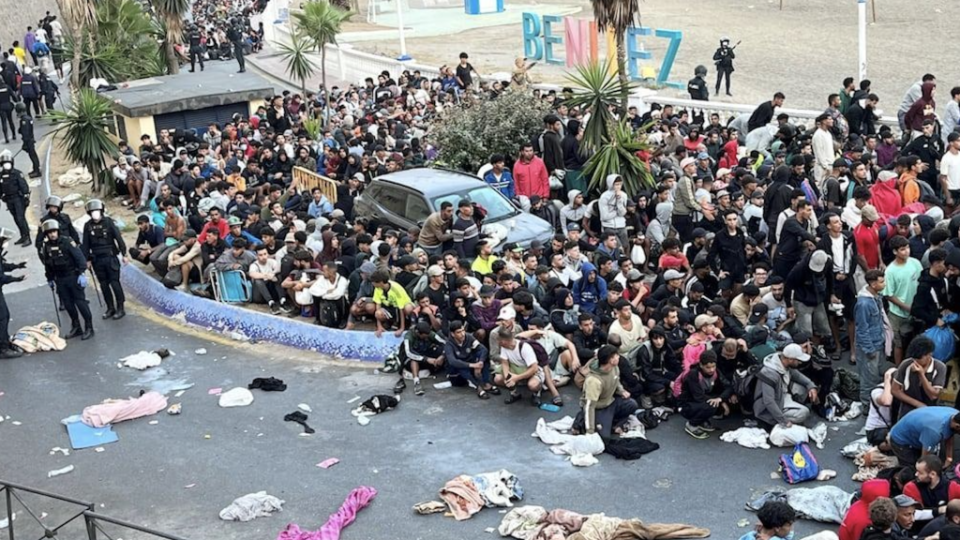
Thousands of migrants were left without accommodation in Ceuta on Friday after two temporary reception areas in the city’s port reached their combined capacity of around 1,700 people, forcing many of those who had hoped to be rehoused to return to the beach settlements where they had been living.
The major relocation operation, involving around 150 National Police officers alongside Guardia Civil and military personnel, began shortly before 7am and continued for approximately five hours.
It followed a ruling by Spain’s National Court on Thursday allowing the temporary use of the port facilities, after a series of legal and political disputes over whether migrants could be accommodated there.
But with more than 4,000 people estimated to have been living in makeshift settlements around Benítez and El Trampolín beaches, there were nowhere near enough places for everyone.
By around 11am, the largest of the reception areas in the port was already full. The remaining smaller tents subsequently reached capacity, leaving large numbers of people still waiting outside.
Police eventually dispersed the final group gathered near the industrial area adjoining the port after it became clear there were no more places available. Many then made their way back towards Benítez and El Trampolín, visibly frustrated after spending hours hoping to be admitted.
Chaotic start to relocation operation
The transfer had begun amid confusion and considerable tension.
Hundreds of migrants had gathered on the beaches before the main police deployment arrived, many having spent the night awake with their belongings packed in anticipation of being moved.
With only some Guardia Civil officers initially present, large numbers suddenly began moving quickly towards the port. What started as people jogging along the seafront developed into a rush involving hundreds of migrants.
Police reinforcements subsequently stopped the crowd close to the end of Benítez beach and the industrial area leading towards the port.
Officers then reorganised those waiting into groups along almost a kilometre of the seafront between Benítez and the port area. Police used a megaphone to appeal for calm while a security cordon controlled access to the route.
The migrants being transferred were principally from the settlement at Benítez beach, next to the considerably larger encampment at El Trampolín. Those at El Trampolín were cordoned off during the operation and, after learning that they would not be transferred on Friday, returned to their usual routine.
Many of those selected for relocation, the majority of them men, applauded as the organised walk towards the port finally began.
However, further tension developed during the first hour as large numbers pressed towards riot police controlling access to the designated route.
At one point, a crush developed as migrants attempted to move through the police-controlled passage. Officers fired shots into the air and struck several people as they attempted to contain the crowd. Several people were reported injured during the disturbances.
Once the initial disorder had subsided, the operation continued in a more controlled manner until the available accommodation was filled.
Children removed from groups entering the facility
Police also identified several children among people waiting to enter the port accommodation.
They were removed from groups that had been instructed to sit on the ground while awaiting admission because the reception facility is intended for adult men.
Unlike an earlier operation at Loma Colmenar, where unaccompanied minors were initially accommodated, authorities sought on Friday to prevent children from entering the port facility among the adult population.
There are currently no additional new reception centres specifically available for minors.
Port Authority criticises lack of coordination
The operation and the decision to accommodate migrants inside the port have faced criticism from both the Ceuta Port Authority and police representatives.
Juan Manuel Doncel, president of the Ceuta Port Authority, complained of what he regarded as poor coordination between the different authorities involved.
He said communication from the relevant ministries and the central government’s delegation had been ‘conspicuous by its absence’.
Doncel, who had previously formally opposed the use of the port for migrant accommodation, said the area had effectively been ‘occupied for 50 days’.
Speaking to Spanish public broadcaster RNE, he questioned how ‘a country capable of processing thousands of tax returns is unable to process the deportation files of 10,000 people’.
He again called for alternative accommodation to be established away from the port.
The Port Authority has warned that accommodating large numbers of people within the port could affect both logistics operations and the security of infrastructure considered critical to the autonomous city.
Political row over handling of operation
Friday’s events also triggered a political confrontation over the government’s handling of the situation.
The right-wing opposition People’s Party (PP) leader, Alberto Núñez Feijóo, accused the government of being unable to ‘maintain public order in a Spanish city’.
The PP’s spokesperson in Congress, Ester Muñoz, accused Prime Minister Pedro Sánchez of having left National Police, Guardia Civil officers and military personnel ‘in the lurch’.
The National Police union Jupol, which has been strongly critical of the government’s handling of the situation in Ceuta, also said the authorities had failed to ‘previously guarantee sufficient capacity at the facilities, the necessary material and human resources, or adequate operational conditions’.
Jupol has argued that the port is unsuitable, from both a security and operational perspective, for accommodating such large numbers of people. It has warned of possible overcrowding and inadequate sanitary conditions as well as the danger of security forces becoming overwhelmed during surges or confrontations.
The government, however, defended the operation, arguing that it had gone very well given the difficulty and unprecedented scale of transferring such a large number of migrants.
It also described Feijóo’s criticism of the operation as ‘irresponsible’.
Court ruling cleared way for temporary port camps
The relocation became possible after the National Court on Thursday lifted a temporary injunction that had prevented the port facilities from being used.
The central government has argued that opening the temporary accommodation is the only immediate means of establishing a minimum degree of control, order and administrative oversight over the large number of migrants currently in the area.
Bringing people into a designated reception facility also allows authorities to centralise registration, medical assistance and the distribution of basic supplies, while reducing the likelihood of migrants becoming dispersed throughout Ceuta.
Concerns had nevertheless been raised before Friday’s operation about what would happen when the camps reached capacity, particularly given the substantial difference between the number of people requiring accommodation and the places available.
Those concerns materialised by late morning.
After the last available places had been allocated, thousands of migrants remained outside the port reception system, with many returning to Benítez and El Trampolín beaches — leaving Ceuta still facing the fundamental problem that Friday’s large-scale relocation operation had been intended to alleviate.
Enjoying the news from Spain in English? Add us as a preferred news source in Google.
Subscribe to the Weekly Newsletter from Spain in English.
🚩 Así ha sido la avalancha durante el traslado de miles de inmigrantes al nuevo asentamiento del puerto
— El Faro de Ceuta (@ElFarodeCeuta) September 18, 2026
📍 Tienes toda la información en El Faro de Ceuta a través de nuestro enlace en bio#Ceuta #Inmigracion #FronteraSur #Marruecos #Traslado #Asentamiento pic.twitter.com/PeynHBGeci
La Policía traslada a cientos de migrantes de la playa al campamento del puerto de Ceuta https://t.co/tylXp0Du5f
— RTVE Noticias (@rtvenoticias) September 18, 2026
Juan Manuel Doncel, presidente del Puerto de Ceuta, asegura que se ha enterado a través de los medios de que hoy se iba a producir el traslado de migrantes: “Las parcelas están ubicadas donde está la infraestructura más crítica del puerto”
— RTVE Noticias (@rtvenoticias) September 18, 2026
https://t.co/3p5WY3yF4s
Los menores migrantes en Ceuta continúan sin soluciones mientras sigue la disputa entre las administracioneshttps://t.co/XW42UpqHl1
— RTVE Noticias (@rtvenoticias) September 18, 2026

Click here to get your business activity or services listed on our DIRECTORY.