
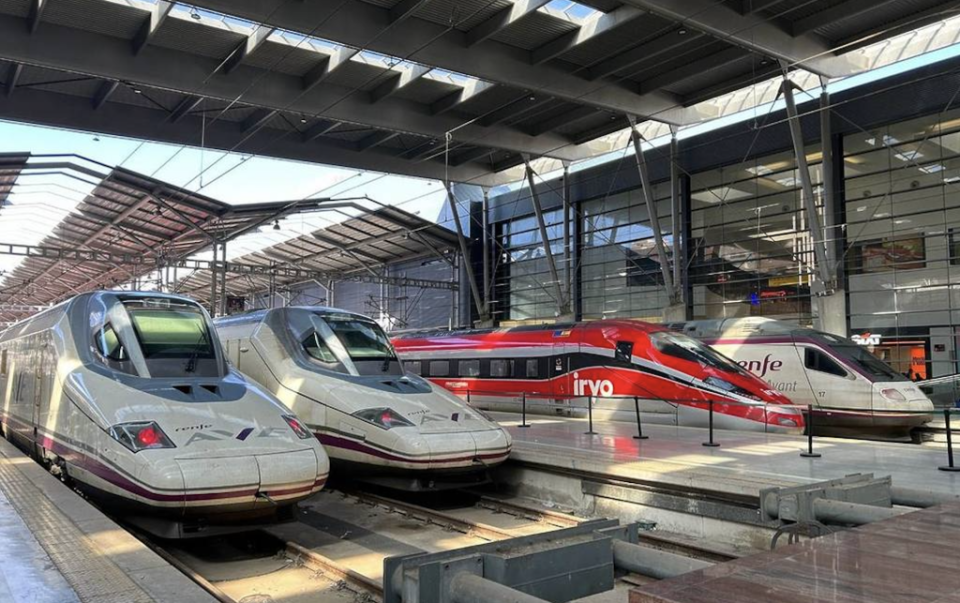
Spain will reduce the number of high-speed trains running on the Madrid–Seville line and require a second controller to approve instructions issued when automatic safety systems are unavailable, following the Urda rail disaster that killed 69 people.
Transport Minister Óscar Puente announced the measures on Tuesday after a cabinet meeting that also approved assistance for victims and their families. ALSO READ: Sánchez pledges urgent support for train tragedy victims and vows to restore trust in high-speed rail.
The collision between a Renfe AVE and an Iryo train in the Toledo province of Castilla-la Mancha on 28 October left hundreds injured, with 38 people still in hospital. ALSO READ: Twelve foreign nationals confirmed among 69 killed in Spain’s latest train tragedy.
The emergency safety plan includes changes to control-room procedures, new monitoring technology, an extraordinary safety audit and improvements to staff training and working conditions.
Fewer departures, longer trains
Services on the Madrid–Seville corridor will be reduced until the completion of both a safety review and the introduction of the newer ERTMS Level 2 signalling system, which is expected to enter service in early 2027.
The aim is to increase the separation between trains while preserving passenger capacity wherever possible by coupling two units together.
‘What we do is join two units and double the number of seats that one unit would have on its own,’ Puente explained. He illustrated the approach by saying that a double-length train every 15 minutes could offer approximately the same capacity as a single unit every seven minutes.
According to El País, installation of ERTMS was completed in June, with testing subsequently taking place during overnight weekend maintenance periods. It will replace the older LZB system on the route.
The LZB failure on the morning of the accident, and the instructions subsequently issued to drivers, are central to the investigations into the collision. ALSO READ: Transport Minister says decision to let AVE proceed before fatal Toledo crash was ‘inexplicable’.
Two controllers to approve emergency instructions
A major procedural change concerns operations under ‘degraded’ conditions, when automatic train-protection systems are unavailable.
‘From now on, all decisions taken in a control centre, when assistance from automatic block systems is unavailable, will be supervised and will have to be validated by at least a second human controller,’ Puente said.
The existing communication procedure involves a controller dictating an instruction to a driver, who repeats it back and confirms it has been understood. Under the new arrangement, two controllers will share responsibility for approving the decision and communicating it.
Puente said this would involve reallocating responsibilities among existing control-room staff rather than doubling personnel. ALSO READ: Toledo crash recordings reveal restart orders as Iryo driver reported train still stopped.
Renfe has separately introduced a 40 km/h speed limit when the automatic safety system fails. Iryo has called for that restriction to apply across operators.
New technology and staff safeguards
Control centres will receive software incorporating automatic warnings, electronic records of operational messages, validation checklists and clearer displays showing train positions and track conditions.
The ministry also plans to introduce an Artificial Intelligence (AI) system alongside a digital model of the high-speed network. These would help identify anomalies, anticipate potential problems and monitor communications between drivers and controllers. Puente acknowledged that the proposed use of this technology was largely uncharted territory.
An extraordinary and immediate audit by Spain’s State Railway Safety Agency will update the review conducted in November 2025. ALSO READ: Spain’s latest rail tragedy puts safety and accountability at centre of election campaign.
Other measures include stronger staffing provision, revised rest arrangements, wider fatigue-management controls and additional training through mentoring, accreditation and regular emergency simulations.
Independent experts will also assess changes to train interiors, including enclosed luggage compartments intended to prevent bags from striking passengers during sudden braking or a collision. Seat belts are not currently proposed.
Emergency limits on alternative transport fares
The disruption has also prompted government action on the cost of alternative travel.
According to El País, the ministry recorded some fares rising to eight or nine times their previous levels after the accident. An extraordinary mechanism will temporarily cap prices during the emergency using an earlier reference period and objectively verifiable criteria.
The intention is to prevent sharp increases in air and road transport fares while rail journeys remain disrupted. The newspaper reported that a previous proposal for a general mechanism had been rejected in Congress by the People’s Party (PP), Vox and Junts per Catalunya (JxCat).
Puente rejects resignation calls
Puente rejected demands for his resignation from PP leader Alberto Núñez Feijóo, accusing him of applying double standards over political responsibility. ALSO READ: Puente refuses to resign as train crash investigation examines safety failures and control-room orders.
The minister also dismissed suggestions that opening passenger rail services to competition explained the disaster. Although he said he had never supported liberalisation and would have preferred a more gradual increase in traffic through Renfe, he maintained that Spain’s network was not saturated.
‘To look for a cause of the accident in liberalisation is not to do justice to the truth,’ he said. ALSO READ (Nov 2022): Spain’s third high-speed train operator launches this week, with average ticket prices at €18.
Victims identified as investigators examine wreckage
All 69 people confirmed dead have been identified. They comprised 54 Spanish nationals and 15 foreign citizens; 40 were men and 29 women, all adults.
Of the 38 people still hospitalised, 26 were in Castilla-La Mancha, including seven in intensive care; 11 were in Madrid, including two in intensive care; and one was in Andalusia.
With the tracks cleared, Guardia Civil officers carried out a final search of the accident site on Tuesday for remains and evidence. Around 40 personnel took part, supported by specialist dogs, drones and other units.
The removal of the Iryo carriages was completed on Monday. The wreckage is being transferred to a secure, guarded location for examination.
Investigators are examining the signalling failure, the procedures used and the orders issued before the crash. A separate internal technical inquiry is proceeding alongside the judicial investigation.
Enjoying the news from Spain in English? Add us as a preferred news source in Google.
Subscribe to the Weekly Newsletter from Spain in English.
🔸 El ministro @oscar_puente_ explica la revisión de los protocolos de control y seguridad para mejorar la seguridad de la alta velocidad. https://t.co/LDRZx2QZfA
— La Moncloa (@desdelamoncloa) November 3, 2026
El ministro @oscar_puente_ detalla algunas de las medidas relacionadas con el plan de refuerzo de la seguridad de la alta velocidad, basado en tres ejes: ▪️Innovación tecnológica ▪️Protocolos de control ▪️Seguridad y RR.HH. https://t.co/zJBhGLD8Ll
— La Moncloa (@desdelamoncloa) November 3, 2026

Click here to get your business activity or services listed on our DIRECTORY.