
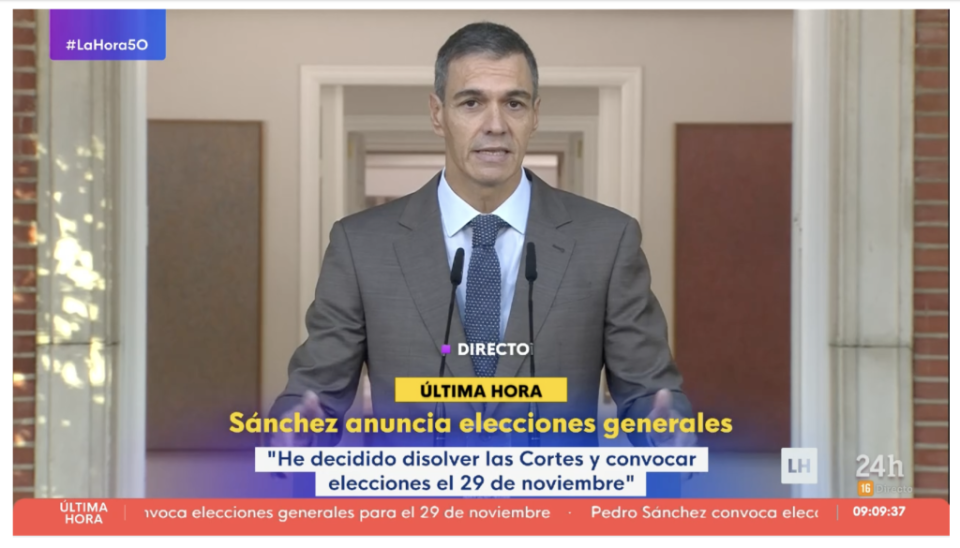
Spanish Prime Minister Pedro Sánchez has announced an early general election for Sunday 29 November, seeking a stronger mandate after the rejection of his government’s emergency housing measures exposed its inability to secure support in parliament.
Speaking from La Moncloa on Monday morning, Sánchez said he had informed the king and would convene an extraordinary cabinet meeting to formally dissolve parliament and set the election process in motion.
The announcement brings forward the vote by around nine months and follows a weekend of consultations with ministers, senior Socialist Party (PSOE) figures and representatives of other political parties.
Sánchez acknowledged mistakes and unfinished reforms, but argued that his government needed greater parliamentary backing to address housing, inequality and public services.
‘I know that we have made mistakes. There are still many social injustices to correct, many goals in public services and housing,’ he said.
‘The truth is that, to do more, we need people’s support; we must ensure that parliament gives us a much broader progressive majority.’
His brief address did not explain whether the government would attempt to revive the two housing decrees rejected by Congress on Friday. ALSO READ: Spain’s housing decrees defeated as pressure grows on Sánchez to call snap election.
Housing becomes the election battleground
The parliamentary defeat followed widespread protests over housing, including demonstrations and protest camps prompted by the eviction of 87-year-old Maricarmen Abascal from her home in Madrid. ALSO READ: Spain’s housing protests intensify as tenants’ unions push for general strike.
The government had prepared two emergency decrees in response to the mobilisation. Both were defeated when the Catalan pro-independence party Junts per Catalunya (JxCat) joined the right-wing People’s Party (PP) and far-right Vox in voting against them, despite negotiations in which ministers had incorporated some of Junts’ proposals.
The result brought Sánchez’s parliamentary difficulties into sharp focus: his government could not assemble a majority even for measures it presented as an urgent response to the housing crisis.
It also undermined his planned attempt to present the first new state budget of the parliamentary term. That initiative had been intended to reopen negotiations with other parties, outline further social measures and potentially allow the government to continue for several more months.
According to El País, senior socialists increasingly regarded the housing dispute as an opportunity to contest an election on more favourable ground than the issues dominating the preceding weeks.
The government’s handling of the migration crisis in Ceuta had also damaged morale within the PSOE and pushed immigration — an issue generally considered more advantageous to the right — to the centre of political debate. ALSO READ: Felipe VI and Letizia to visit Ceuta and Melilla in October following migration crisis.
Housing offered a different contest. El País reported that polling showed broad support for measures associated with the left, including limits on rental prices, with substantial backing even among right-wing voters.
The PSOE will now seek to turn that support into votes, particularly among progressive electors who have become disillusioned during a turbulent parliamentary term.
Sánchez defends his record and attacks the opposition
In his address, Sánchez portrayed the election as a choice over whether Spain should continue its progressive reforms. He defended the coalition’s economic and social record while accusing its opponents of obstructing measures intended to improve people’s lives.
‘More than three years ago, voters decided once again to back a progressive coalition government. We have had to manage unprecedented emergencies, navigate a very difficult international situation; we have had to work with a very combative Congress. We have had to battle very powerful elites who do not stand in elections but want to control our country. And with the worst opposition in history, which blocks policies that were good for the country and sabotages them from the regions,’ he said.
In remarks interpreted as a direct attack on Madrid’s regional president, Isabel Díaz Ayuso, he added: ‘We have transferred more resources than ever to those regional governments, and they have bought penthouses and privatised hospitals.’ ALSO READ: Opposition steps up pressure on Ayuso government over €6.3 million penthouse purchase.
Sánchez argued that Spain had continued to advance despite those obstacles.
‘Despite that, Spain has not stopped moving forward; it is the fastest-growing economy in the EU, purchasing power has increased three times as much as in France or Germany. We have expanded scholarships, maternity leave, dependency care, the range of services provided by the health service. And we have launched a profound modernisation of the country with the Next Generation fund. More than half of our energy comes from renewable sources. And we have refused to sacrifice the welfare state on the altar of 5%,’ he said. ALSO READ: Spain’s economy gathers pace with 0.7% second-quarter growth.
He also defended the government’s international stance, citing its support for Ukraine, the European Union and the United Nations, alongside increased development assistance. ALSO READ: Sánchez to Zelensky: ‘Nothing and no one will make us forget what is happening in Ukraine’.
‘We have done everything that was in our hands, we have worked hard to build a better world. We support Ukraine, the EU, the UN, fighting tyrants and techno-oligarchs. We have doubled our international development assistance. All of that has made Spain a global reference point for peace, feminism and prosperity. We have achieved the best economic and social figures of any government. That is a fact,’ he said. ALSO READ: Spain will not ‘turn migrants into the enemy’, Sánchez tells UN as he highlights Ceuta crisis.
Thanking other parliamentary parties for their support during the term, Sánchez also recognised frustration among the coalition’s supporters.
‘I know that this majority is outraged by what has happened in Congress,’ he said. ‘Now it is up to you. The world is approaching a very complex period.’
A tougher contest than in 2023
The decision invites comparisons with Sánchez’s surprise election announcement in 2023, made just hours after the PSOE suffered heavy losses in municipal and regional elections. ALSO READ: Pedro Sánchez announces General Election for Sunday 23 July 2023.
This time, the move followed several days of deliberation. Senior ministers and socialist leaders had increasingly urged him to call an election immediately, believing the political circumstances had improved sufficiently to justify the gamble.
In 2023, Sánchez defied expectations and retained office through agreements with other parties, despite the PP winning the most votes and seats. Repeating that outcome could prove considerably harder. ALSO READ: Pedro Sánchez re-elected as Spanish Prime Minister.
According to El País, almost all private polling firms currently point to a clear victory for the right, with some surveys putting the combined PP and Vox vote above 50%. ALSO READ: Spain’s Ceuta crisis: Polls show widespread disapproval of Sánchez as PP and Vox pass 50%.
The newspaper reported growing confidence within both parties, particularly after the damage inflicted on the government by the Ceuta crisis. Nevertheless, they will also compete over their relative strength and influence in any potential governing arrangement.
While the PP has remained broadly around 30% in polling over the past three years, close to its 2023 result, Vox has made significant gains. ALSO READ: PP-Vox agreement sees Juanma Moreno secure a third term as Andalusian leader.
Sánchez faces a further difficulty on his own side of the political divide. The parties to the left of the PSOE, whose support proved crucial in preventing a right-wing government in 2023, enter the election in a weaker and potentially divided position.
The grouping previously known as Sumar, now expected to become Frente Amplio, has yet to settle on a candidate. Unless its rupture with Podemos can be resolved, the two could contest the election separately.
Although the official campaign will begin only 15 days before polling day, Monday’s announcement immediately shifts Spanish politics into an election contest.
A fragile alliance reaches its limit
Sánchez’s government was formed in 2023 through a complicated set of parliamentary agreements, including the support of Junts, led by former Catalan president Carles Puigdemont.
Junts backed his investiture in exchange for an amnesty law covering offences linked to the Catalan independence process, including the events of 2017. The agreement triggered major protests from the right and became one of the defining disputes of the parliamentary term.
Former prime minister José María Aznar urged opponents of the government to act with the message: “Whoever can, should act.”
The amnesty did not initially benefit everyone it was intended to cover, including Puigdemont, amid resistance from the Supreme Court. As political attention shifted towards economic and social policy, Junts increasingly distanced itself from the alliance that had returned Sánchez to office.
On numerous votes it sided with the PP and Vox, despite their profound differences over Catalan independence.
The resulting deadlock leaves Sánchez ending the term without having presented a single new state budget in three years.
Junts has therefore helped both to begin and to end this government’s parliamentary life. El País also noted that the election announcement came shortly before an anticipated development that could clear the way for Puigdemont’s return to Spain.
Crises and judicial cases weigh on the government
Beyond its parliamentary problems, the government has faced a succession of crises, including the devastating Valencia floods of October 2024, the Adamuz rail tragedy and the recent emergency in Ceuta.
The term has also been marked by corruption cases involving figures close to Sánchez. His former senior party colleagues José Luis Ábalos and Santos Cerdán have been imprisoned, while the investigation into the network associated with Leire Díez has added to the pressure.
Other proceedings have proved particularly contentious, including cases involving Sánchez’s wife and brother, and the case that resulted in the conviction of former attorney general Álvaro García Ortiz.
These disputes have complicated the PSOE’s efforts to retain voters who supported the coalition in 2023.
Sánchez has repeatedly survived political setbacks, including his removal as Socialist leader in 2016 after refusing to facilitate a government led by Mariano Rajoy. The November election will test that ability again, with the right ahead in polling, his potential allies divided and housing now central to his attempt to rebuild support.
Enjoying the news from Spain in English? Add us as a preferred news source in Google.
Subscribe to the Weekly Newsletter from Spain in English.

Click here to get your business activity or services listed on our DIRECTORY.