
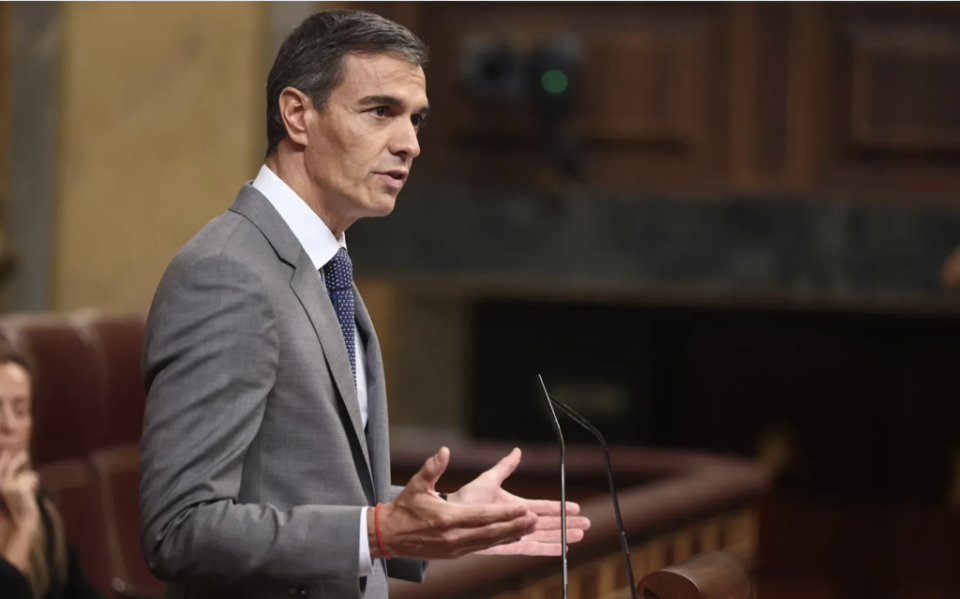
Spain’s Congress rejected both of the government’s emergency housing decrees on Friday, dealing a major blow to Pedro Sánchez (main image) amid growing calls within his Socialist Party (PSOE) for an early general election. The first decree was defeated by 178 votes to 172, and the second by 184 to 166.
A surprise intervention by the prime minister failed to secure sufficient support. Sánchez urged MPs to ‘think of the people’ and warned that ‘history will judge you’. Housing Minister Isabel Rodríguez also appealed to Junts per Catalunya (JxCat), the Catalan pro-independence party led by Carles Puigdemont, saying that 90% of its proposals had been incorporated into the decrees.
Both measures, approved by the cabinet on Tuesday, cease to be in force following their rejection. The package provided for the automatic extension of expiring rental contracts, stronger protection against evictions for vulnerable tenants and measures targeting property investment funds.
The defeat intensified uncertainty over the government’s next steps. Before the votes, El País reported that senior socialist figures and cabinet ministers favoured an early election if both decrees failed, with 29 November being discussed as a possible date.
Spain’s housing crisis has become a critical test for Sánchez’s minority government, with emergency measures to protect tenants exposing fresh divisions among its parliamentary allies and prompting senior socialists to argue that defeat should trigger an early general election. ALSO READ: Cabinet approves two housing decrees after Madrid eviction, but faces uncertain vote in Congress.
Friday’s debate and vote in the Spanish Congress follows a wave of protests over the eviction of 87-year-old Maricarmen Abascal from her long-standing Madrid home. Her case intensified demands for government intervention and placed housing at the centre of a confrontation between the governing coalition of PSOE and Sumar, opposition parties and the Catalan pro-independence party Junts per Catalunya (JxCat). ALSO READ: Spanish government pushes for new housing decree after eviction of 87-year-old Maricarmen.
MPs had begun debating the two decrees at 11am on Friday, with their passage uncertain after JxCat demanded their withdrawal and party leadership sources indicated that its seven MPs would vote against them. The right-wing main opposition party, the People’s Party (PP), and the far-right Vox group, had also already declared their opposition.
An eviction that galvanised protests
Maricarmen was evicted last week from the Madrid flat where she had lived for around 70 years, after an investment company acquired the property and sought to raise her rent by 275%.
An agreement reached with the owner on Monday is expected to allow her to return. However, the resolution of her individual case has not brought the wider protests to an end. ALSO READ: Evicted Madrid pensioner could return home under eight-year rent agreement.
Housing campaigners have maintained encampments in Madrid’s Puerta del Sol and other cities, turning her eviction into a rallying point over rents, insecurity and the role of investment firms in the residential property market. ALSO READ: Protesters vow to stay in Madrid’s Puerta del Sol as housing camp puts pressure on government.
Ahead of Friday’s parliamentary sitting, tenants’ unions urged supporters to put pressure on MPs to back the measures. Demonstrators marched from a nearby protest camp towards Congress, where police vans and barriers formed part of a substantial security operation.
Further demonstrations are planned for the weekend, adding to the pressure on a government whose ability to legislate depends on agreements with parties outside the coalition.
What the government is proposing
Approved by the cabinet on Tuesday, the two decree-laws provide for the automatic extension of rental contracts when they expire and stronger restrictions on evictions affecting vulnerable tenants. ALSO READ: Cabinet approves two housing decrees after Madrid eviction, but faces uncertain vote in Congress.
The package also seeks to curb the activities of so-called ‘vulture funds’ — investment firms that acquire properties cheaply with the aim of securing higher returns.
The government presented the measures as an urgent response to public demands for greater housing security. Officials pointed to the suspension of an eviction in Barcelona within the first 24 hours of the decrees taking effect as evidence that they were already having a practical impact.
Sánchez had repeatedly appealed for ‘responsibility’ from MPs in a fragmented parliament where his socialist-led coalition lacks a majority.
‘The political groups will have to choose whom they protect: those who live in the houses or those who make a fortune from them,’ he said on Thursday.
In a message posted on X later that evening, he argued that parties must decide whether ‘they are with the social majority or with the speculators’.
JxCat demands a rethink
JxCat’s opposition emerged after an online meeting of its executive committee that began at 9pm on Thursday.
In its subsequent statement, the party argued that several provisions could produce the opposite of their intended effect: reducing the supply of homes, pushing up prices and failing to restrain investment funds effectively.
It also maintained that the package did not adequately protect vulnerable households because it failed to guarantee compensation payments by public authorities.
A central objection concerns the treatment of small landlords. JxCat argues that families who depend on rental income should not be treated in the same way as property investment companies, warning that the measures could have ‘negative and irreversible’ consequences.
The party called on the government to withdraw both decrees and reopen negotiations. Although its statement did not explicitly set out how its MPs would vote if the government refused, leadership sources confirmed that they intended to oppose the measures.
JxCat’s parliamentary spokesperson, Miriam Nogueras, had already warned on Wednesday that party members felt ‘disappointed and concerned’ about the proposals.
‘We are not afraid to take the heat to defend the interests of Catalan families,’ she said.
The stance is particularly consequential because Sánchez relies on JxCat’s seven MPs to secure support for legislation.
Supporters also question the package
Other parties have indicated that they would support the decrees while expressing reservations about their drafting, scope and likely effectiveness.
The Basque Nationalist Party (EAJ-PNV), which also stressed the interests of households renting out property to supplement their income, argued that the proposed decree ‘protects vulnerable people and improves the situation for small landlords’.
Nevertheless, its spokesperson, Maribel Vaquero, criticised the ‘disastrous wording’ and described the measure as a ‘stopgap’.
‘You cannot fix in a decree-law what has not been done in eight years,’ she wrote on X.
Podemos leader Ione Belarra dismissed the measures as ‘crumbs’, but said her party would support them to prevent their rejection becoming an ‘excuse’ for the government to ‘continue doing nothing’.
‘In a month’s time, people will see that rents are still sky-high and that evictions are still taking place,’ she said.
Podemos also criticised the decision to divide the housing package into two decrees.
After JxCat’s position became clear, Transport Minister Óscar Puente argued that splitting the measures had failed to secure the party’s backing for even part of the package.
Health Minister Mónica García, speaking for the coalition’s left-wing Sumar partner, accused JxCat of obstructing improvements to people’s lives.
‘There are two ways of doing politics: making people’s lives a misery or putting forward solutions that improve their lives,’ she said.
Election speculation grows within the PSOE
The confrontation has fuelled discussion within the PSOE about whether Sánchez should bring forward a general election if both decrees are defeated.
According to El País, senior figures at the prime minister’s office, cabinet ministers and national and regional socialist leaders believe that rejection could give the government an opportunity to fight an election with housing as its central issue.
The newspaper reported that 29 November was being discussed as a possible polling date. Some of those consulted favoured an immediate announcement following a parliamentary defeat; others wanted Sánchez to assess the turnout at the weekend’s demonstrations before deciding, potentially on Monday ahead of a scheduled PSOE executive meeting.
Sources at Moncloa told the newspaper that the prime minister was considering an early election in the event that the PP, Vox and Junts defeated both decrees.
The argument among socialists favouring an election is that the government could present itself as responding to demands from the streets, while portraying its opponents as blocking protections for tenants.
They also believe that a housing-focused campaign could shift attention away from the crisis in Ceuta that has recently placed the government under pressure. ALSO READ: Spanish court to investigate deadly Ceuta migrant surge as possible ‘hybrid warfare’ operation.
The newspaper also reported deep frustration with JxCat – led by Carles Puigdemont – among PSOE officials, who believe the party has offered insufficient support during the parliamentary term despite the political cost to the socialists of passing the amnesty law. ALSO READ: Constitutional Court clears path for Puigdemont’s return and full amnesty for independence leaders.
A decisive test of parliamentary support
Sánchez arrived at Congress on Friday shortly before the debate and entered the chamber without making a statement, accompanied by socialist ministers. PSOE MPs greeted him with a standing ovation.
The party’s parliamentary spokesperson, Patxi López, avoided discussing an early election, instead framing the sitting as a test of each party’s priorities.
‘Junts will be on one side, with those who defend rights or with the vulture funds,’ he said.
With demonstrations continuing and the government insisting on taking both decrees to a vote, the debate has become a test of whether Sánchez can assemble a parliamentary majority around one of Spain’s most pressing social problems — and of what course he will take if that support falls away.
Enjoying the news from Spain in English? Add us as a preferred news source in Google.
Subscribe to the Weekly Newsletter from Spain in English.
🔴 ÚLTIMA HORA
— RTVE Noticias (@rtvenoticias) October 2, 2026
Pedro Sánchez decidirá este fin de semana si adelanta o no las elecciones.
Lo cuenta Almudena Guerrero pic.twitter.com/YQeG06MF5Z
Pablo Bustinduy, ministro de Derechos Sociales: “Hoy el Partido Popular, Vox y Junts se han equivocado gravemente y pagarán este error político en las urnas” pic.twitter.com/kEtT4jlUdX
— RTVE Noticias (@rtvenoticias) October 2, 2026
#ÚLTIMAHORA | El Congreso rechaza el primer decreto de vivienda con el ‘no’ del PP, Vox, Junts y UPN. pic.twitter.com/OKWlZCYsDi
— EFE Noticias (@EFEnoticias) October 2, 2026

Click here to get your business activity or services listed on our DIRECTORY.