
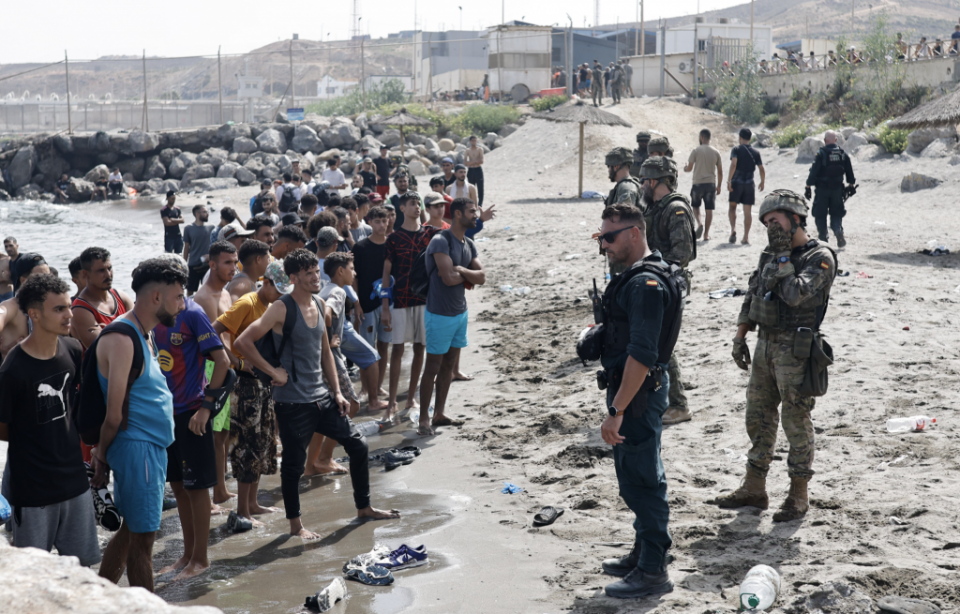
Spain’s National Court has opened a preliminary investigation into last week’s unprecedented mass border crossing into Ceuta, as Morocco issued its first official response to the crisis, attributing the events to human trafficking networks, online misinformation and confusion surrounding a recent Spanish Supreme Court ruling.
The investigation relates to the events of 30 and 31 July, when an estimated 50,000 to 60,000 people crossed from Morocco into the Spanish enclave on the North African coast. Spain has confirmed that at least 72 people died on its side of the border during the incident, while Moroccan authorities say a further eleven people lost their lives on their territory. ALSO READ: Spain installs sea barrier as Ceuta slowly returns to normality and death toll rises to 72.
Judge María Tardón ordered the inquiry after concluding there were sufficient indications of possible criminal offences in a complaint submitted by the political party Iustitia Europa. She has instructed Spain’s National Police to determine whether the mass crossing was organised or directed by criminal groups or other external actors.
The judge’s order refers to possible offences against the peace or independence of the state under Title XXIII of Spain’s Criminal Code, suggesting investigators will examine whether the operation may have involved more than criminal trafficking networks. The legal framework cited also leaves open the possibility of investigating any potential links to Moroccan state authorities or individuals connected with the Rabat government, should evidence emerge. ALSO READ: Sánchez condemns mass Ceuta crossing as ‘violation of Spain’s territorial integrity’.
While Spain’s judicial authorities begin their investigation, Morocco has rejected suggestions that the crossing resulted from spontaneous events or official involvement, instead blaming a combination of organised criminal activity and false information spread online.
In a statement issued through the Interior Ministry and reported by Moroccan media, a government spokesperson said the crisis stemmed from ‘the malicious exploitation of the digital sphere and the activities of human trafficking networks’, together with ‘the dissemination of misleading information and misinterpretations that accompanied the recent decisions issued by the Spanish judicial authorities’.
According to Rabat, widespread misunderstandings about a recent Spanish Supreme Court judgment concerning ‘immediate returns’ convinced some prospective migrants that they would not be rapidly sent back after entering Spanish territory. ALSO READ: Ceuta crisis sparks emergency EU meeting requests as Sánchez rejects Schengen criticism.
Morocco’s government also defended its own handling of the emergency, saying it had adopted ‘a proactive and comprehensive approach, based on early detection, increased levels of vigilance and mobilisation, and the strengthening of preparedness amongst the various security services and local authorities’.
It said those measures helped authorities ‘manage the course of events, protect lives, maintain public order and secure the borders, whilst strictly adhering to legal provisions and the principle of proportionality in the intervention’.
Moroccan officials placed the number of people involved in the crossing at around 40,000, lower than Spain’s estimate of between 50,000 and 60,000.
The Interior Ministry also confirmed eleven deaths on Moroccan territory, stating that ten people drowned while another died after falling ‘from a rocky area near the city of Ceuta’.
Rabat said it is continuing to work alongside the Spanish authorities to verify ‘the actual number of people affected, their identities and nationalities, with a view to completing the necessary legal, administrative and humanitarian procedures’.
The Moroccan government concluded by stressing that irregular migration can only be tackled ‘within the framework of a comprehensive approach based on shared responsibility, genuine solidarity and the equitable sharing of the burden’.
It added that Morocco ‘will continue to be, as its partners expect, a reliable and responsible partner, committed to strengthening international cooperation and coordination in the fight against irregular migration and human trafficking’.
Meanwhile, it said the country would continue ‘to take all necessary measures to protect public order, safeguard border security and ensure the safety of people and property, within the framework of the rule of law and in accordance with the Kingdom’s national and international obligations’.
Enjoying the news from Spain in English? Add us as a preferred news source in Google.
Subscribe to the Weekly Newsletter from Spain in English.
La Audiencia Nacional pide informes sobre si la entrada en Ceuta fue una “acción concertada” https://t.co/K7lpg55zGq
— RTVE Noticias (@rtvenoticias) August 3, 2026
Con patadas, golpes y a porrazos: así recibió la policía marroquí a las decenas de personas que regresaban desde Ceuta. Entre ellos, había varios niños. #Canal24Horas pic.twitter.com/gEnxUvNuUZ
— RTVE Noticias (@rtvenoticias) August 3, 2026
España y Marruecos aluden a las mafias y a los bulos para explicar la crisis migratoria en Ceuta
— Telediarios de TVE (@telediario_tve) August 3, 2026
Informa Arantxa Marculeta pic.twitter.com/JcxYxnglGH

Click here to get your business activity or services listed on our DIRECTORY.