
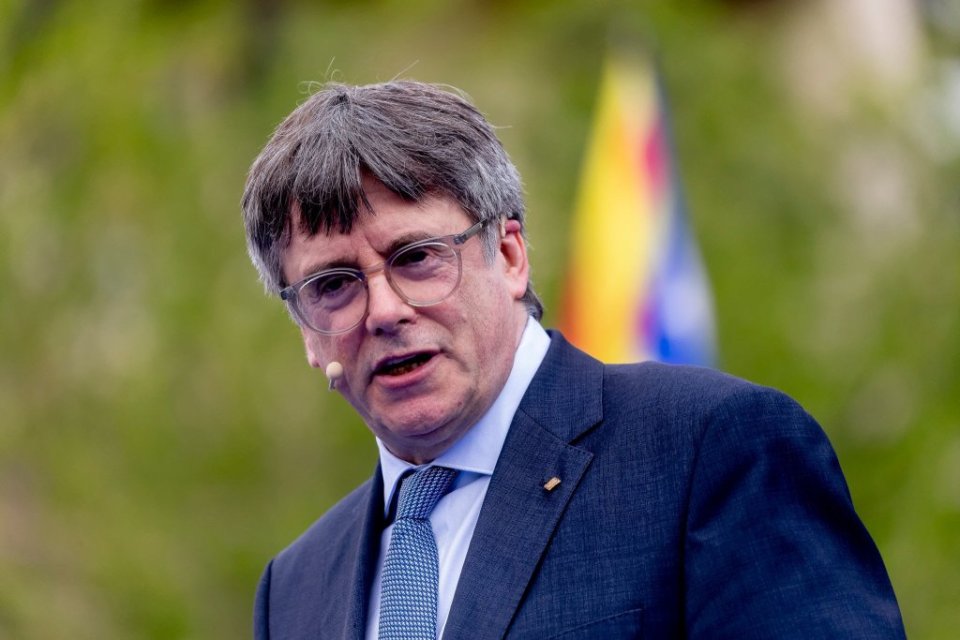
The former Catalan president says he will stay away until after Sunday’s general election. The ruling also ends proceedings against two of his former ministers.
Spain’s Supreme Court on Monday applied the amnesty law to Carles Puigdemont and permanently dismissed the last criminal charge he faced over Catalonia’s 2017 independence bid. The ruling clears the way for the former Catalan president to return from Belgium and stand in future elections, nine years after he left Spain.
The court’s Criminal Chamber also dismissed the cases against former Catalan health minister Toni Comín and former culture minister Lluís Puig. All three faced allegations of misuse of public funds in connection with the 1 October 2017 independence referendum. The chamber extinguished any criminal liability arising from those allegations.
Investigating judge Pablo Llarena had already lifted the three men’s arrest warrants in October, allowing them to travel to Spain. ALSO READ: Puigdemont cleared to return to Spain as judge lifts arrest warrant after amnesty ruling.
He formally closed his investigation on 3 November and referred the case to the Criminal Chamber for a final decision. Monday’s order, drafted by judge Manuel Marchena, confirms that decision and brings the proceedings to an end.
Puigdemont considers a December return
The ruling came six days before Spain’s 29 November general election. Puigdemont told El Mundo that he had ruled out returning during the campaign and was considering coming back in December, with no date yet set. In the same interview, he said his party, Junts per Catalunya (JxCat), had taken advantage of what he described as Prime Minister Pedro Sánchez’s ambition in order to ‘defeat’ Spain. ALSO READ: The PSOE and Junts sign a pact that will guarantee investiture of Pedro Sánchez.
His lawyer, Gonzalo Boye, said a plan for the return was already in place and would be made public once the amnesty had been fully applied. Comín and Puig have already returned to Spain. JxCat said Puigdemont would hold a press conference in Brussels on Wednesday.
Minutes after the ruling was announced, Puigdemont posted a poem on X by the Mallorcan writer Jaume Pons Alorda. Titled El necessari naixement de contrincants (The Necessary Birth of Adversaries), it offers his ‘dearest enemies’ an ironic expression of gratitude before ending with a vulgar insult. Puigdemont said he had been waiting for the right occasion to recommend it. ‘That day has arrived.’ ALSO READ: Puigdemont demands ‘amnesty’ for all independence activists as ‘precondition’ for Sánchez’s investiture.
How the courts resolved the dispute over public funds
The amnesty grew out of a 2023 deal in which Sánchez’s PSOE socialists secured the support of two Catalan pro-independence parties, including JxCat, for his re-election as prime minister. ALSO READ: Controversial Catalan amnesty law gets final approval in Spanish Congress.
The agreement provoked fierce political and public opposition. The law entered into force on 11 June 2024, and Spain’s Constitutional Court upheld its core provisions in June 2025. The dispute over whether it covered the alleged misuse of public funds remained unresolved.
The Supreme Court had relied on two grounds for excluding the referendum spending from the amnesty. One concerned possible harm to the EU’s financial interests. The other concerned whether the organisers had personally benefited by using public money to fund the vote. In July 2026, the Court of Justice of the European Union (CJEU) found that the spending had not affected the EU’s financial interests. ALSO READ: European top court rules Spain’s Catalan amnesty complies with EU law.
Spain’s Constitutional Court rejected the Supreme Court’s reasoning on personal gain and on 6 October directed it to apply the law to the referendum-related offences. ALSO READ: Constitutional Court clears path for Puigdemont’s return and full amnesty for independence leaders.
The Supreme Court granted amnesty on 20 October to former Catalan vice-president Oriol Junqueras and former ministers Raül Romeva, Dolors Bassa and Jordi Turull. All four had been barred from holding public office until 2030 or 2031.
In Monday’s ruling, the judges rejected efforts by the far-right Vox party, that acted as a private prosecutor under Spain’s system of acusación popular, to keep the case open. The party had asked the court to wait for an EU ruling on a separate referral from Catalonia’s High Court or to send its own question to the EU court. The judges concluded that the July ruling gave them sufficient grounds to decide the case.
From the 2017 referendum to a brief return in 2024
Puigdemont and several members of his government left for Belgium in October 2017 after the referendum, which Spanish courts had ruled illegal. The vote brought the confrontation between the Catalan independence movement and Madrid to a head. The criminal case opened on 31 October as prosecutors pursued rebellion allegations. Spanish judges went on to seek Puigdemont’s surrender through proceedings in Belgium, Germany and Italy. Twelve other senior figures in the independence bid went on trial in Spain in 2019. Click here for all our reports related to Catalan independence.
Puigdemont made one known return to Spain during those nine years. On 8 August 2024, he addressed supporters on Barcelona’s Passeig de Lluís Companys on the day Socialist Salvador Illa was elected Catalan president with the backing of the Esquerra Republicana (ERC) party and the Comuns. Catalonia’s regional police, the Mossos d’Esquadra, set up roadblocks across the region in an operation dubbed Jaula (‘Cage’). They failed to find him. ALSO READ: Three Mossos officers suspended following Puigdemont’s escape from Spain.
Background to Catalan political conflict
Nine Catalan politicians and activists were jailed for between 9-13 years by the Spanish Supreme Court in October 2019, convicted of sedition and misuse of public funds for their role in the 2017 illegal referendum, with the verdicts causing widespread protests across Catalonia. In June 2021, the nine walked free from prison, following pardons granted by the government led by Prime Minister Pedro Sánchez, but they remained banned from holding public office.
In late 2022, Spain passed a controversial criminal code reform that downgraded the two charges used against them, abolishing sedition and replacing it with that of aggravated public disorder, and also reducing the penalty for misuse of public funds.
Carles Puigdemont had led the government of Catalonia when it staged the referendum banned by Madrid and the courts, which was followed by a short-lived declaration of independence. He then fled to Brussels to avoid prosecution in Spain, and became an MEP.
The controversial amnesty law grew out of a 2023 deal in which Pedro Sánchez secured the support of two Catalan pro-independence parties, JxCat and ERC, for his re-election as prime minister.
Click here for all our reports related to Catalan independence.
Enjoying the news from Spain in English? Add us as a preferred news source in Google.
Subscribe to the Weekly Newsletter from Spain in English.
El Supremo aplica la amnistía a Puigdemont y cierra la causa penal del ‘procés’ nueve años después De esta forma el Alto Tribunal declara concluso el procedimiento judicial también para los exconsellers Comín y Puig https://t.co/m8FA2evCvC
— RTVE Noticias (@rtvenoticias) November 23, 2026
El Tribunal Supremo declara extinguida la responsabilidad penal de Carles Puigdemont por la amnistía en la causa del ‘procés’ 📄 Nota informativa: https://t.co/OVtRfhuom3
— Poder Judicial (@PoderJudicialEs) November 23, 2026
Quan vaig llegir aquest poema d’en @jaumeponsalorda, del seu llibre “El Corc” (LaBreu Edicions), vaig pensar que un dia tindria l’ocasió per recomanar-lo. El dia ha arribat. (Compreu el llibre, per cert, que n’hi trobareu més i uns “deliciosos propòsits de procreació” finals que us ajudaran a gaudir-ne)
— krls.eth / Carles Puigdemont (@KRLS) November 23, 2026

Click here to get your business activity or services listed on our DIRECTORY.