
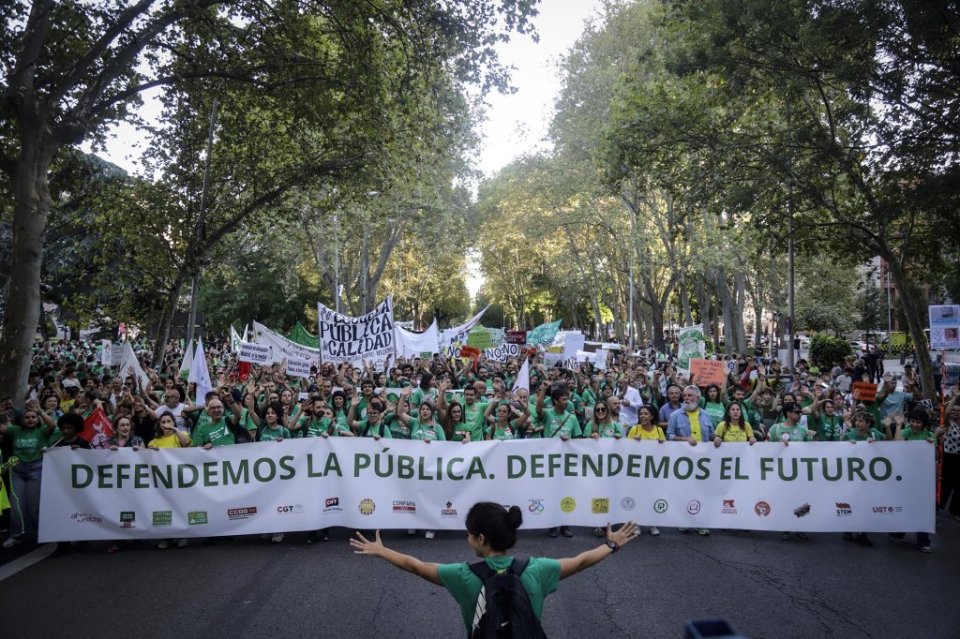
Thousands of teachers, students and families marched through central Madrid on Wednesday as an indefinite strike began across the region’s public schools, with unions demanding smaller classes, more staff, improved facilities and better pay.
The demonstration brought an estimated 25,000 people onto the streets, according to the central government’s delegation in Madrid. Protesters followed a roughly three-kilometre route from Atocha to Puerta del Sol, passing along the Paseo del Prado and through Cibeles.
The march marked the return of the Marea Verde, or ‘Green Tide’, the movement campaigning in defence of public education. Teachers wearing its characteristic green shirts were joined by parents, children and university students, alongside early-years educators whose yellow clothing represented their own long-running dispute.
Organisers put participation in the first day of the strike at around 70% of teachers. The regional education department reported 44.6%. Approximately 65,000 teachers across Madrid’s public, non-university education system have been called to take part.
Although pay is among the demands, the dispute also concerns teaching workloads, classroom support, school buildings and the resources available to pupils with additional needs.
Wednesday afternoon’s demonstration passed peacefully, following a morning of disruption that included a road blockade by early-years educators on the Paseo de la Castellana and police intervention at Complutense University.
Student and staff organisations at Complutense and Rey Juan Carlos universities had called a separate, one-day stoppage in solidarity with public education. At Complutense, police charged a picket, with five people arrested and eight injured, including two police officers, according to Spanish media. The central government’s delegate in Madrid has requested an urgent investigation into the police operation.
The People’s Party (PP) regional government, led by Isabel Díaz Ayuso, rejected the justification for the teachers’ strike, describing it as politically motivated and timed for electoral purposes.
Regional education councillor Mercedes Zarzalejo argued that unions were seeking to reopen matters covered by an agreement signed last year, including reductions in teaching hours and class sizes that are still being introduced.
The government has also pointed to Madrid’s performance in the OECD’s PISA assessment as evidence in defence of its education policies. ALSO READ: Spain’s PISA scores fall to record lows as reading, maths and science decline.
Unions, however, maintain that existing commitments do not adequately address conditions in schools. The indefinite action follows preparations that began towards the end of the previous academic year, against the backdrop of teachers’ disputes in Catalonia and the Valencia region.
A further march along the Atocha-Puerta del Sol route is planned for Friday. ALSO READ: Thousands march through Madrid for public education ahead of indefinite October strike.
Why are Madrid’s teachers on strike? The demands, the divisions and the government’s response
The strike in Madrid brings together disputes over teachers’ working conditions and wider concerns about how the region funds and organises public education.
Its supporters want changes affecting the whole school day: fewer hours teaching in front of a class, fewer pupils in each room, more help with administration and additional support for children who need it. They are also seeking a €600 monthly pay increase and investment in school buildings.
The action has no fixed end date, although unions have adopted different approaches and some are not participating.
Who is organising the action?
The joint strike has been called by CCOO, UGT, STEM, CGT, CNT and Solidaridad Obrera, together with teaching platforms and other education organisations.
Those involved include Menos Lectivas, which campaigns for reduced classroom teaching hours; Educación Especial Digna; the vocational education platform Queremos FP; Marea Verde; Confapa; and the Plataforma de Defensa del Alumnado TEA, which campaigns for autistic pupils.
Not all of Madrid’s main teaching unions have joined the common mobilisation.
ANPE, which finished second behind CCOO in the most recent union elections in Madrid’s public education sector, is not taking part.
CSIF, the third-largest union by that measure, has organised separate action: full-day indefinite strike action this week, followed by partial stoppages from Monday.
Which teachers and students are affected?
The call covers teachers in public education before university, including nursery and primary schools, compulsory secondary education, Bachillerato, vocational training and special education.
It also extends to specialist public institutions such as music conservatoires, art and dance schools, and official language schools.
Figures cited for the end of last year put the teaching workforce in mainstream and special education at 61,878, with another 3,798 working in specialist institutions.
During the previous academic year, the corresponding public education networks enrolled 666,321 and 91,384 students respectively – more than 757,000 combined.
Older school pupils can also participate in collective action. From the third year of compulsory secondary education, known as tercero de ESO, students can collectively stay away from lessons under the applicable rules. The Sindicato de Estudiantes has backed the strike call.
Student absences can significantly reduce classroom activity even where teachers continue working.
Universities are outside the scope of the indefinite schoolteachers’ strike. Wednesday’s action at Complutense and Rey Juan Carlos was a separate solidarity stoppage lasting one day.
What changes do teachers want to their working hours?
A central demand is a reduction in weekly classroom teaching hours, allowing more time for preparation, marking, coordination and individual attention to pupils.
Organisers want secondary teachers’ classroom hours cut from 19 to 17 a week, and those of nursery and primary teachers reduced from 25 to 22.
A comparison published by the STES union during the previous academic year placed Madrid among the six Spanish regions with the highest classroom teaching commitments in secondary education, and among the four highest for nursery and primary teaching.
The regional government argues that an existing agreement already provides for secondary teachers’ classroom hours to fall to 18 a week in the 2028-29 academic year.
How much smaller would classes become?
The proposed reductions vary by educational stage.
For the second cycle of nursery education, covering children aged three to six, organisers want a maximum of 13 pupils per class, compared with the current 20.
In primary schools, they are seeking a ceiling of 15, against current limits of between 20 and 25. For secondary education, they want a maximum of 20, compared with between 25 and 30 in compulsory secondary classes and 35 in Bachillerato.
They also want pupils requiring specific educational support to count as two when calculating class sizes. This would cover a range of needs, including disability, dyslexia and social or educational disadvantage.
The intention is to ensure that a class requiring additional support has fewer pupils overall, giving teachers more time to meet individual needs.
Zarzalejo has challenged the demands, arguing that the 2025 sector agreement already provides for primary classes of 20 pupils. She has also contrasted the unions’ demand for a limit of 15 in Madrid with the higher ceiling discussed nationally before the general election was called.
Why is pay part of the dispute?
Unions are requesting an additional €600 a month.
They argue that teachers’ earnings do not reflect the cost of living in Madrid, particularly housing. According to UGT’s salary comparison, the region’s teachers fall within the lowest-paid third nationally, despite working in one of Spain’s most expensive areas.
Recent settlements elsewhere have helped shape expectations. Following teachers’ strikes during the previous academic year, the governments of the Valencia region and Catalonia agreed phased monthly increases of €200 and €400 respectively. Those settlements began with an additional €75 a month at the start of this academic year.
Ayuso announced in September that negotiations would begin on a professional career progression scheme for Madrid’s teachers, potentially offering salary increases of ‘up to €350’.
Discussions have opened through the formal negotiating body, but unions have not considered that sufficient to withdraw the strike.
What are the demands on school funding and buildings?
Organisers want investment both in existing schools and in new facilities where places are needed.
Their demands include better maintenance, the removal of asbestos and sustainable systems to keep classrooms at suitable temperatures throughout the year.
They also oppose opening new schools in phases while construction continues, arguing that pupils and staff should not have to use buildings that remain active construction sites.
The funding dispute is sharpened by Madrid’s economic position. Despite having Spain’s highest GDP per person, the region recorded the country’s lowest education spending per pupil in the figures cited for 2023: €6,502 annually, compared with a national average of €7,943.
Why are administration and educational inequality also involved?
Teachers want less paperwork and at least one administrative assistant in every education centre, something that is not currently guaranteed.
Union surveys and the OECD’s Teaching and Learning International Survey, TALIS, identify administrative workloads as a major problem for the profession. Organisers argue that reducing those duties would free up time for educational work.
They are also demanding measures to address the concentration of disadvantaged pupils in public schools, compared with private schools and the publicly subsidised, privately run concertado sector.
Research cited in the dispute places Madrid among the areas with the greatest socioeconomic separation between schools in Spain. Campaigners want a more balanced distribution of pupils and adequate resources for schools supporting vulnerable children.
How does the early-years dispute fit in?
Educators working with children aged up to three had already been on indefinite strike for around six months before this week’s wider mobilisation.
Their campaign centres on low wages, working conditions and recognition of the educational role of the earliest stage of childhood provision.
The source reports put their earnings at around €1,200 a month, described as minimum-wage pay. Their action has now joined the broader education mobilisation, and early-years workers were responsible for Wednesday morning’s blockade on the Paseo de la Castellana.
What is the regional government’s position?
Madrid’s government says it is willing to listen, while accusing organisers of pursuing a ‘political and electoralist’ strike.
Its principal argument is that some participating unions signed the 2025 agreement and should allow its provisions to take effect. Alongside the scheduled reduction in secondary teaching hours, the government points to agreed changes in class sizes and the newly opened career progression negotiations.
Zarzalejo has also cited Madrid’s leading regional performance in PISA.
That comparison comes with an important qualification: the OECD’s assessment also links educational performance closely to family socioeconomic circumstances, and Madrid has the highest socioeconomic index among Spain’s regions.
The dispute therefore extends beyond exam results. At its centre is a disagreement over whether existing agreements and funding are sufficient to provide the staffing, time, facilities and support that public schools need.
Enjoying the news from Spain in English? Add us as a preferred news source in Google.
Subscribe to the Weekly Newsletter from Spain in English.
💚🔥 ¡La Marea Verde desborda Madrid! La huelga indefinida arranca con una fuerza imparable: 🛑 Un mensaje claro directo a la Consejería: no vamos a dar ni un paso atrás La educación pública madrileña se ha plantado de forma contundente. El profesorado, estudiantes y familias han dicho ¡BASTA! a las condiciones laborales actuales y al deterioro de nuestras aulas. Y esto no ha hecho más que empezar. Emplazamos a la Comunidad de Madrid a sentarse a negociar
— CCOO de Madrid (@CCOOMadrid) October 14, 2026
💚🔥 ¡HISTÓRICO! LA MAREA VERDE DESBORDA MADRID EN SU PRIMER DÍA DE HUELGA La educación pública madrileña se ha plantado de forma contundente. El profesorado, estudiantes y familias han dicho ¡BASTA! a las condiciones laborales actuales y al deterioro de nuestras aulas. https://t.co/Hzx9leVLNW
— Educación CCOO Madrid (@CCOOEducaMa) October 14, 2026
La marea verde llega a Sol en el inicio de la huelga indefinida de la educación pública madrileña y reclama más recursos, mejores salarios y menos alumnos por aula junto a la acampada por la vivienda https://t.co/sv35FBbcY5 https://t.co/G5k54J8XE2
— Europa Press (@europapress) October 14, 2026

Click here to get your business activity or services listed on our DIRECTORY.