
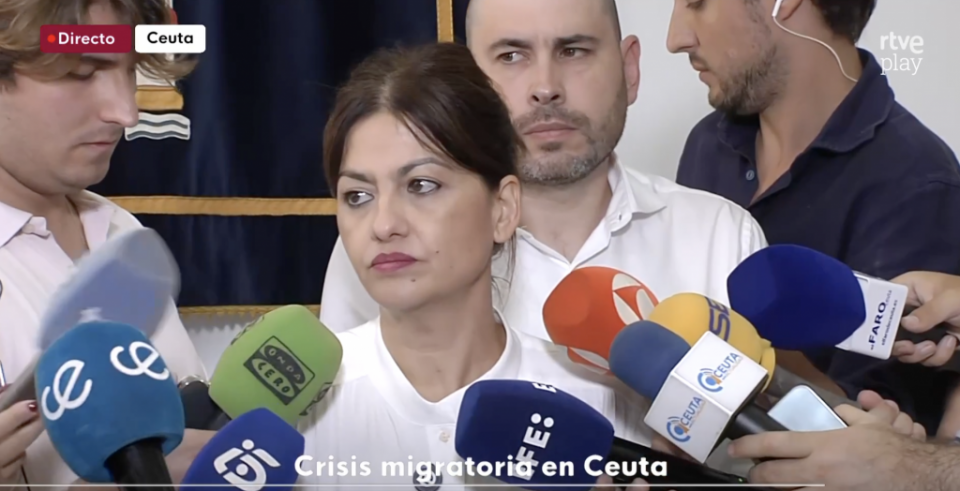
Spain’s government expects to begin transferring unaccompanied migrant children from the overcrowded North African enclave of Ceuta to mainland Spain within the next few weeks, as authorities continue to deal with the aftermath of last week’s unprecedented mass migration crisis.
Spain’s Youth and Children Minister Sira Rego (main image), who travelled to Ceuta on Friday for talks with local and national officials as well as child protection organisations, said 1,342 children had so far been officially registered in the reception system after arriving from Morocco during the large-scale border crossings. ALSO READ: EU backs Spain after Ceuta migration crisis while ministers push for tougher anti-smuggling measures.
‘My intention is that it should happen immediately,’ Rego told reporters, referring to the redistribution of children to mainland Spain. She confirmed that a ministry team will be deployed to Ceuta on 16 August to speed up the process, adding: ‘I think we can be talking about a few weeks before we begin to see transfers and reception on the mainland.’
The minister acknowledged that the situation remains ‘very complicated’ because of the sheer number of arrivals, although she said conditions were ‘gradually returning to normal’ as authorities continued registering children and expanding reception facilities. ALSO READ: Spain installs sea barrier as Ceuta slowly returns to normality and death toll rises to 72.
According to the central government, around 72,000 migrants entered Ceuta irregularly by land and sea during the mass border crossings on July 30 and 31. While most later returned to Morocco, hundreds of unaccompanied minors remained in the Spanish territory. More than 140 people are believed to have died attempting to reach Ceuta during the crisis.
Rego described the images of children sleeping on the streets as deeply distressing.
‘We are all affected by the pain when we see these images, and as a society each of us has a responsibility,’ she said. ‘I am fully aware of ours. That is why we are here and have been working throughout these past days. We have the utmost commitment to these boys and girls.’
She also expressed her ‘deep sorrow’ over the loss of more than 140 lives during the attempted crossings.
The government has already opened two reception centres for newly arrived children and adolescents and is assessing additional facilities to increase capacity and improve conditions. Extra personnel are also being deployed to accelerate the registration process.
Rego said priority would be given to younger children, particularly girls and those under the age of 13.
Although 1,342 minors have been formally entered into the reception system, the true figure remains disputed. Ceuta’s regional government estimates that around 1,100 unaccompanied children arrived during the crisis, overwhelming accommodation designed for only around 90 places and exceeding the territory’s reception capacity by around 2,600%.
However, neighbourhood associations and NGOs working directly with migrants believe the actual number could be far higher. The El Príncipe Neighbourhood Association says it has already recorded details of 2,672 minors through its own informal census and believes many more have yet to come into contact with the authorities.
Responding to those differing estimates, Rego insisted that official figures must remain accurate.
‘We have to be very rigorous with the figures,’ she said, explaining that efforts are continuing to encourage children who have not yet been registered to approach the police so they can be formally identified and receive appropriate care.
Under Spanish law, unaccompanied minors cannot simply be returned to Morocco and instead become the responsibility of the autonomous region where they arrive.
Rego stressed that family reunification remains the government’s first priority, but said each case would be considered individually.
‘There will be specialised technical services that will carry out these support procedures with all the necessary legal guarantees and while safeguarding the best interests of the child,’ she said. ‘Wherever possible, family reunification will be facilitated.’
Her comments came after Morocco reiterated that it is prepared to receive all Moroccan unaccompanied minors currently in Spain, provided what it described as Spanish judicial and administrative obstacles are removed. According to Spain’s national broadcaster RTVE, a Moroccan diplomatic source said King Mohammed VI had instructed authorities to support the return of unaccompanied children, in line with commitments first agreed following Ceuta’s previous migration crisis in 2021.
Rego rejected suggestions that Spain was preventing returns. ‘Spain has no hurdles,’ she said. ‘What Spain will do is safeguard children’s rights.’
She added that specialised teams would assess every child individually to determine what was in their best interests before any decision on family reunification or return was taken.
The minister also noted that the profile of children arriving in Ceuta has changed significantly since the 2021 migration crisis. ‘More unaccompanied girls have arrived, as well as more very young children,’ she said.
To support the response, the Spanish government has approved €25 million in funding for Ceuta and has launched what Rego described as a ‘binding and solidarity-based’ redistribution programme. A meeting of regional child welfare officials will take place next week, followed by a national conference of Spain’s autonomous communities later in August.
The relocation programme is based on reforms to Spain’s immigration law introduced in 2025 following sustained migration pressure in the Canary Islands. Under the legislation, unaccompanied minors must be redistributed from overstretched regions within 15 days of their case files being completed.
Government figures released earlier this year show that 719 children have already been relocated from the Canary Islands to mainland Spain since the reforms came into force, while more than 400 minors previously arriving in Ceuta have also been transferred elsewhere in the country.
Political division
The redistribution of migrant children continues to divide Spain’s political parties.
The far-right Vox party remains firmly opposed, arguing that the children should be returned to Morocco. Its parliamentary secretary-general, José María Figaredo, said regional governments where Vox shares power with the right-wing People’s Party (PP) would continue to oppose transfers through every available legal avenue.
The PP has softened its initial opposition, saying any redistribution must be ‘fair, properly funded and planned’. However, divisions remain within the party.
The PP’s regional president in Madrid, Isabel Díaz Ayuso, has argued that the children should instead be returned to their country of origin, while PP leader in Ceuta Juan Jesús Vivas has backed the redistribution policy, describing the situation in the enclave as ‘chaotic and unsustainable’ and appealing for ‘help, assistance and solidarity’ from the rest of Spain.
‘We not only support the reform,’ Vivas said, ‘we are applying it and will continue to apply it.’
Miguel Ángel Pérez, the central government’s representative in Ceuta, also defended the policy, saying: ‘Inter-territorial solidarity is necessary so these minors end up in other locations where they will be better off. The law must be upheld.’
The migration crisis has also had wider diplomatic repercussions, with Italy temporarily suspending passport-free Schengen travel arrangements with Spain following the events in Ceuta, adding another layer of pressure as the Spanish government works to manage one of the country’s most significant migration emergencies in recent years. ALSO READ: Ceuta crisis sparks emergency EU meeting requests as Sánchez rejects Schengen criticism.
Enjoying the news from Spain in English? Add us as a preferred news source in Google.
Subscribe to the Weekly Newsletter from Spain in English.
La ministra Sira Rego ha viajado a Ceuta para seguir coordinando con el resto de administraciones la atención a la infancia migrante que ha llegado a la Ciudad Autónoma en los últimos días.
— Ministerio de Juventud e Infancia (@JuventudInfGob) August 7, 2026
“Todas las personas menores de edad van a ser atendidas y Ceuta no va a estar sola”. pic.twitter.com/p90zlUEGR6
#Canal24Horas | Sira Rego, ministra de Juventud e Infancia: “Tenemos que ser muy rigurosos con las cifras. Estamos generando el procedimiento para que afloren estos niños, se acerquen a Policía, proceder con el registro y habilitar las infraestructuras para atenderlos” pic.twitter.com/RfI8xe2s50
— RTVE Noticias (@rtvenoticias) August 7, 2026

Click here to get your business activity or services listed on our DIRECTORY.