
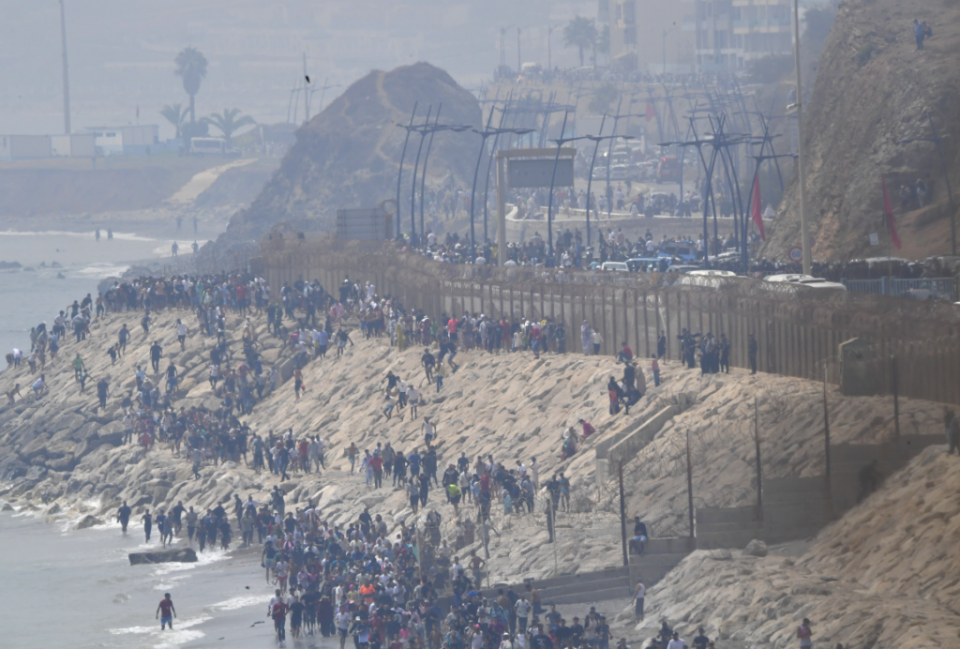
Thousands of migrants crossed from Morocco into Spain’s North African enclave of Ceuta on Thursday, triggering an unprecedented security and humanitarian response as local authorities warned the territory’s reception system had been overwhelmed and appealed to Madrid for emergency assistance.
Large groups entered the enclave by sea, many swimming around the Tarajal breakwater using inflatable rings and other flotation devices, while others forced their way through a gate in the border fence before running into the city. Television footage also showed crowds walking around the breakwaters into Spanish territory, with some shouting ‘Viva España!’ as they crossed.
Officials have not released confirmed figures for Thursday’s arrivals, although estimates varied widely. Spain’s Guardia Civil described migrants as entering ‘massively’ through the Tarajal breakwater, while several media outlets suggested the number could run into the thousands. Authorities said they were still assessing the scale of the influx.
The crossings followed several days of increasing arrivals, with Ceuta’s regional president, Juan Jesús Vivas, revealing that more than 1,500 adults and unaccompanied minors had already reached the enclave by sea during the previous week.
‘We are in a situation of total humanitarian and social emergency,’ Vivas said to broadcast media.
He warned that migrant reception centres had reached capacity, leaving hundreds of people sleeping on the streets, and said the territory could no longer cope with the pace of arrivals.
‘The reception centres are saturated — there is no more room for anyone in them and according to yesterday’s figures the number of people entering is more than 200 a day.’
The latest events have revived memories of the major border crisis in May 2021, when more than 8,000 people entered Ceuta from Morocco within two days after border controls briefly collapsed.
Calls for emergency measures
Vivas has called on Spain’s central government to declare a national emergency, arguing that the situation poses a national security risk.
He has requested additional police officers and asked for the deployment of the army to secure the border, saying the reinforcements were needed ‘to guarantee the inviolability of the frontier and citizen safety’.
The regional government also appealed for the temporary closure of the border with Morocco.
Spain’s Interior Ministry rejected calls for a national emergency, saying that existing legislation does not classify migration flows as grounds for such a declaration. However, it stressed that government departments were working together ‘to respond with speed and efficacy to the situation in Ceuta’.
The ministry said resources had been reinforced to maintain border security, manage migration and provide humanitarian assistance ‘so that no lives are put in danger at sea’.
Interior Minister Fernando Grande-Marlaska is due to travel to Ceuta on Friday to assess the situation and meet local officials.
The Defence Ministry said there were no immediate plans to deploy the military.
Spain and Morocco coordinating response
Madrid said it was working closely with Morocco to stem the crossings, describing cooperation between the two countries as ‘faithful and permanent’.
According to the Interior Ministry, Moroccan security forces were preventing ‘numerous people’ from attempting to reach Ceuta, while both governments had agreed to work together to facilitate ‘the return, as soon as possible, of all the people who entered Ceuta illegally’.
Spanish officials also accused people-smuggling networks of exploiting a recent Supreme Court ruling concerning migrants intercepted at sea around Ceuta and Melilla in order to encourage further irregular crossings.
Earlier this month, the court ruled that migrants intercepted at sea while attempting to reach Ceuta or Melilla cannot automatically be returned under the enclaves’ special border rejection procedures.
Political tensions
The surge has quickly become a political issue in Spain, with opposition parties accusing Prime Minister Pedro Sánchez’s government of failing to protect the country’s external border.
The right wing People’s Party (PP) leader Alberto Núñez Feijóo wrote on X: ‘The situation in Ceuta is desperate. The government cannot look the other way … because we are facing a national security crisis.’
The criticism comes as Spain’s socialist (PSOE) government continues to pursue one of Europe’s most migration-friendly policies, including plans to regularise the status of around 500,000 undocumented migrants. ALSO READ: Deadline day for Spain’s mass migrant regularisation as over one million apply for legal status.
Opponents argue the policy risks encouraging further irregular migration, while the government maintains it is tackling long-term labour shortages and improving integration.
Ceuta and neighbouring Melilla are Spain’s two autonomous cities in North Africa and together form the European Union’s only land border with the African continent. The enclaves have long been focal points for irregular migration, with migrants often attempting the dangerous sea crossing from the Moroccan towns of Castillejos or nearby Belyounech in the hope of reaching European territory.
Enjoying the news from Spain in English? Add us as a preferred news source in Google.
Subscribe to the Weekly Newsletter from Spain in English.
El Gobierno de España está volcado en dar una respuesta inmediata a la situación en Ceuta.
— Pedro Sánchez (@sanchezcastejon) July 30, 2026
Estamos movilizando todos los recursos necesarios, trabajando con las autoridades marroquíes e internacionales, y preparando las medidas necesarias para recuperar la normalidad lo antes…
Una oleada de personas, miles de ellas, ha cruzado sin control de Marruecos a Ceuta. La Guardia Civil y los medios de emergencia, superados, solo se ocupan de los heridos. Los agentes han tenido que abrir las verjas, porque querían evitar que se forme un tapón… pic.twitter.com/pYFnAmbgLw
— EL PAÍS (@el_pais) July 30, 2026
🔴 URGENTE | Cientos de marroquíes escapan a la carrera de la frontera de El Tarajal y penetran en Ceuta. pic.twitter.com/7qIRVECuDo
— THE OBJECTIVE (@TheObjective_es) July 30, 2026
🔴ÚLTIMA HORA | El Gobierno responde al presidente de Ceuta y recuerda que no se puede pedir la emergencia nacional por la crisis migratoriahttps://t.co/TyecxNO1Ba
— Cadena SER (@La_SER) July 30, 2026

Click here to get your business activity or services listed on our DIRECTORY.