
Italy and Spain are extending temporary border controls on travellers arriving from each other’s countries for a further 15 days, prolonging measures introduced in the aftermath of the mass arrival of migrants in Ceuta at the end of July.
The Italian government announced on Monday that checks at airports and ports on passengers arriving from Spain, which had been due to expire, would remain in force for another two weeks.
Spain responded by announcing a corresponding 15-day extension of its own controls on passengers arriving by air and sea from Italy.
Rome first introduced the measure on 1 August, following the unprecedented influx into the Spanish autonomous city of Ceuta from neighbouring Morocco on 30 July. Madrid retaliated with reciprocal controls on arrivals from Italy from 8 August, initially for one month. ALSO READ: Spain imposes reciprocal border checks on Italy as Schengen dispute escalates.
Italy’s interior ministry said its decision to extend the checks had been taken because the circumstances which prompted their introduction continued to exist.
Italian Interior Minister Matteo Piantedosi has described the situation in Ceuta as still ‘very complicated’, with thousands of migrants remaining in the city.
Spanish authorities estimate that between 5,000 and 8,000 people are still in Ceuta after at least 72,000 crossed the border from Morocco during the crisis. At least 82 migrants were found dead on the Spanish side of the border, while Moroccan authorities reported another 14 deaths. ALSO READ: Tensions erupt in Ceuta as protesters block food aid to migrants and government appeals for calm.
Italian authorities have also raised concerns that some of those who entered Ceuta could subsequently move elsewhere within the European Union. ALSO READ: Morocco stops new mass attempt to reach Ceuta as almost 300 migrants detained.
Piantedosi has previously estimated that between 5,000 and 10,000 migrants remained in the autonomous city, some of whom had yet to be fully identified. Italian officials have also referred to information concerning the possible presence of individuals with jihadist profiles among those who crossed the border. ALSO READ: Ceuta police clear migrants from Trampolín beach and move them to temporary shelters.
What the controls mean for travellers
The measures do not amount to a closure of the border between Spain and Italy, nor do they prevent EU citizens from travelling between the two countries.
Instead, passengers arriving at airports and ports can be subjected to additional identity and documentation checks, potentially causing delays.
‘It does not mean that entry is banned. It is about reintroducing controls, above all while striking a balance and taking care not to impede the movement of European citizens,’ Piantedosi said.
The checks are principally aimed at third-country nationals rather than EU citizens.
Under the Schengen Borders Code, member states can temporarily reintroduce controls at internal borders when they consider there is a serious threat to public policy or internal security. Such measures are supposed to be exceptional, proportionate and limited to what is considered strictly necessary.
Ceuta already operates under a special border regime, meaning travellers leaving the Spanish territory for mainland Spain or elsewhere in the Schengen area are subject to identity and documentation checks.
In Spain, border checks had been carried out on passengers from 1,111 flights by 31 August.
Few irregularities discovered in Italy
Despite the concerns cited by Rome, the first month of controls has apparently produced little evidence of migrants travelling from Ceuta to Italy.
Italian media reports say relatively few irregularities have been detected and that none of those stopped as a result of the additional checks had arrived from Ceuta.
Cases uncovered by the authorities have instead principally involved travellers whose visas or residence permits had expired or people with previous police records.
By mid-August, Piantedosi said the checks had resulted in three arrests and 21 foreign nationals being refused entry, including six Moroccans.
Italy nevertheless maintains that the circumstances which prompted the controls have not sufficiently changed to justify removing them.
Its interior ministry said the extension followed an assessment by the country’s Immigration and Border Security Committee.
At the same time, Rome acknowledged ‘the steps already undertaken by Spain, together with the European Union, to help bring the situation in the area back to normal in the near future’.
The Italian government has formally notified the European institutions of its decision.
Piantedosi also discussed the extension by telephone with Spanish Interior Minister Fernando Grande-Marlaska, with Rome describing their conversation as constructive.
Wider European dispute over migration
The reciprocal controls come against the backdrop of a broader disagreement within Europe over how the consequences of the Ceuta crisis should be handled.
Italy’s position has received backing from a group of EU countries seeking tougher border controls and a stricter approach towards irregular migration.
The issue is also expected to feature prominently at a meeting in Rome involving the interior ministers of the MED5 countries – Italy, Spain, Greece, Malta and Cyprus – which represent some of the principal entry points for migrants arriving in southern Europe.
Migration policy has become an increasingly sensitive political issue for Giorgia Meloni’s government, while Spain has called for greater solidarity from its European partners in dealing with the consequences of the Ceuta influx.
Spanish Prime Minister Pedro Sánchez has pointed to Spain’s response to previous migration emergencies elsewhere in Europe, including Lampedusa, while questioning why Madrid has not received stronger support from some of its EU partners. ALSO READ: Ceuta crisis sparks emergency EU meeting requests as Sánchez rejects Schengen criticism.
Sánchez has also said investigators are examining the role of disinformation in encouraging the mass crossings into Ceuta.
He claimed that ‘Russian and Israeli networks’ had distorted the meaning of a Spanish Supreme Court ruling to spread the false impression that migrants who reached Ceuta by swimming could not subsequently be returned.
The prime minister stressed, however, that the circumstances surrounding the crisis remain under investigation and that the indications uncovered so far do not necessarily imply the involvement of any foreign government.
Sánchez has meanwhile continued to defend Morocco’s response to the crisis, saying there is no information from Spain’s security forces or the CNI intelligence service that gives the government reason to question the conduct of the Moroccan authorities. ALSO READ: Spanish PM backs Morocco over Ceuta migrant crisis as King Felipe visit is announced.
He described cooperation with Rabat as ‘frankly positive’.
For travellers between Spain and Italy, meanwhile, the immediate consequence is that the additional airport and port checks introduced in August will remain in place for at least another two weeks, as both governments wait to see whether the situation in Ceuta stabilises sufficiently for the restrictions to be lifted.
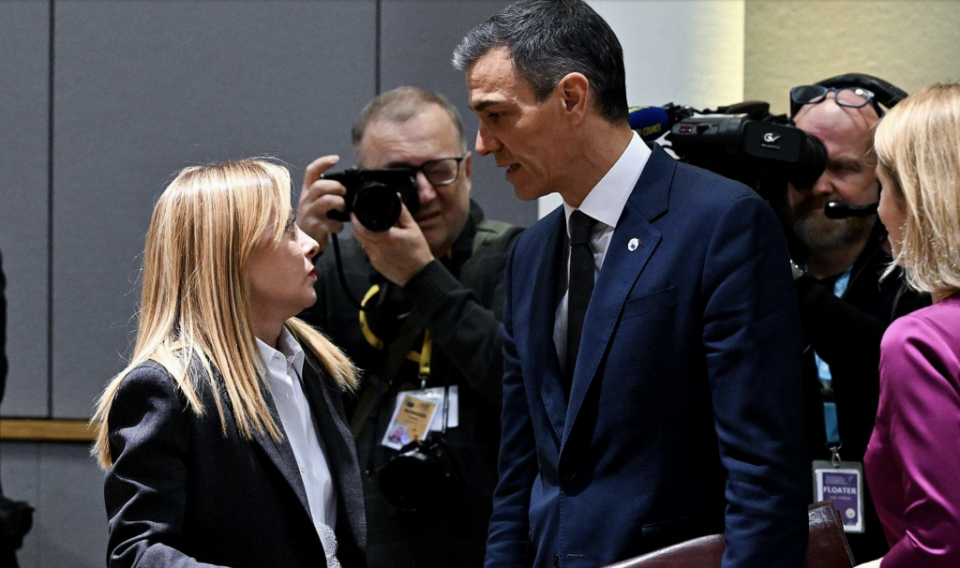
Main image: Pedro Sánchez with Giorgia Meloni in Brussels on 22 January 2026 (Frederic Sierakowski / European Council)
Enjoying the news from Spain in English? Add us as a preferred news source in Google.
Subscribe to the Weekly Newsletter from Spain in English.
El Gobierno de Meloni ha decidido mantener 15 días más la suspensión del espacio Schengen con España por la crisis de Ceuta.
— Telediarios de TVE (@telediario_tve) August 31, 2026
A juicio de Italia aún persisten los elementos que llevaron a restablecer los controles el pasado 1 de agosto. pic.twitter.com/7G29SAqMpF

Click here to get your business activity or services listed on our DIRECTORY.