
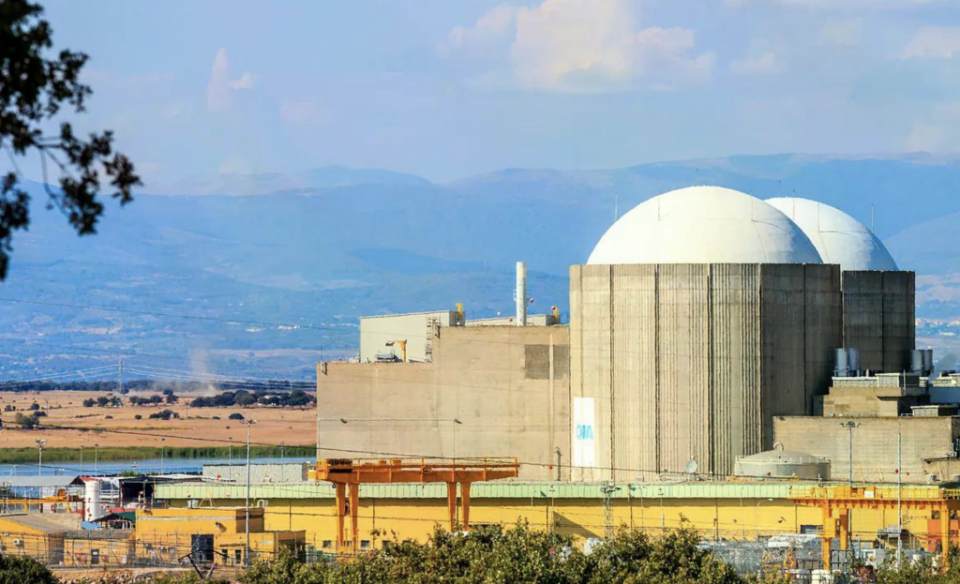
Spain has extended the operating life of the Almaraz nuclear power station until June 2030, delaying what was due to be the first stage of the country’s gradual withdrawal from nuclear energy.
The decision, published in Spain’s Official State Gazette (BOE) on Friday, allows both reactors at the plant in the region of Extremadura to continue operating until 8 June 2030.
Almaraz had been scheduled to lead Spain’s nuclear phase-out, with Unit I due to close permanently in November 2027 and Unit II in October 2028.
However, the government insists the extension applies only to Almaraz and does not change its commitment to shut down Spain’s entire nuclear power sector by 2035.
The decision follows a formal request submitted in October 2025 by the plant’s three owners, Iberdrola, Endesa and Naturgy, which sought permission to keep the two reactors operating beyond their previously agreed closure dates.
It also received the backing of Spain’s Nuclear Safety Council (CSN), which issued a favourable report on 16 July, subject to a series of nuclear safety and radiological protection requirements.
The Ministry for Ecological Transition said Almaraz was ‘safe for people’, with the CSN having confirmed both the proper functioning of the plant and its radiological safety.
The extension comes against a dramatically changed international energy backdrop since Spain’s nuclear closure timetable was originally agreed.
The government cited continuing uncertainty in international energy markets, including the effects of conflicts in the Middle East and Ukraine, which have contributed to volatile supplies and high fossil fuel prices.
It said the temporary extension could help shield Spanish consumers and the electricity system from unexpected spikes in fossil fuel prices.
‘The limited extension during this period makes a temporary contribution to mitigating the exposure of the electricity system and Spanish consumers to previously unforeseen price spikes,’ the government said.
It stressed that renewable energy and storage would remain ‘structural solutions to the exposure and vulnerability that the external dependence on fossil fuels represents’.
The future of nuclear power in Spain had already returned to the political agenda following the widespread blackout that affected Spain and Portugal in April 2025.
Investigations into the outage pointed to a surge in voltage rather than the nuclear phase-out itself, and an Energy Ministry source has rejected any connection between the blackout and the decision to extend Almaraz. ALSO READ: Reasons for Spain’s April power blackout: ‘overvoltage’ & ‘poor planning’.
Nevertheless, the incident intensified a wider debate over the resilience of Spain’s electricity system, with energy companies and business groups calling for the country’s planned nuclear shutdown to be reconsidered. Click here to read all our reports related to Spain’s blackout.
Nuclear power currently accounts for roughly one-fifth of Spanish electricity generation, while Almaraz alone produces around 7% of the country’s annual electricity demand, according to its operator, Centrales Nucleares Almaraz-Trillo.
The company says that is equivalent to the electricity consumed by around four million homes and argues that the plant also avoids approximately six million tonnes of carbon dioxide emissions each year.
The government maintains that extending Almaraz will have only a limited effect on Spain’s ambitious renewable energy programme. According to the order, renewable deployment would be around 1.4% lower than envisaged under existing climate plans, while electricity generation from natural gas is expected to fall by 7%.
The ministry also stressed that the extension had been granted without any tax concessions or other financial compensation for the companies that own Almaraz.
The nuclear industry has repeatedly argued that Spain’s tax regime makes its plants less competitive and has called for reductions. The government had previously made clear that any extension would have to meet safety requirements without placing additional costs on taxpayers.
The decision means the two Almaraz reactors are now expected to close in 2030, the same year as Ascó I in Tarragona and Cofrentes in Valencia.
Ascó II is scheduled to follow in 2032, with Vandellós II, also in Tarragona, and Trillo in Guadalajara due to cease operations in 2035.
Spain currently has five operating nuclear power stations containing seven reactors.
The government has rejected suggestions that further extensions have already been decided. The Almaraz extension has nevertheless opened a new political battle within Spain’s governing coalition.
Sumar, the left-wing junior partner in the socialist-led government, condemned the decision as being driven by ‘corporate pressure and not technical and environmental needs or economic competitiveness’.
‘Continuing to exceed the service life of this infrastructure delays real decarbonisation based on renewables and imposes unacceptable costs and risks on society, as well as making the price of energy more expensive,’ the party said.
Environmental organisations have also reacted angrily.
Greenpeace expressed its ‘rejection and indignation’, accusing the government of yielding to the ‘economic interests’ of electricity companies rather than basing the decision on technical safety or reducing consumers’ bills.
There has been strong support for keeping Almaraz open in Extremadura, however, where the plant is an important source of jobs and economic activity in a largely rural and sparsely populated region.
Extremadura regional president María Guardiola welcomed what she described as ‘a decision that provides certainty’ and protects ‘an activity that for decades has been essential for the life of so many towns and families that depend on it’. ALSO READ: Far-right Vox rejoins Extremadura government in ‘national priority’ deal with PP.
The local campaign group Sí a Almaraz, Sí al Futuro has similarly warned that shutting the plant would have serious economic consequences for surrounding communities.
For now, the Spanish government is presenting the extension as a temporary response to an increasingly uncertain international energy market rather than a reversal of its long-term strategy.
It maintains that its commitment to renewable energy remains ‘intact’ and that June 2030 will mark the definitive end of Almaraz – while the country’s last nuclear reactors are still scheduled to be switched off five years later.
Enjoying the news from Spain in English? Add us as a preferred news source in Google.
Subscribe to the Weekly Newsletter from Spain in English.
💚 Almaraz seguirá funcionando hasta junio de 2030.
— Sí a Almaraz, Sí al futuro (@SiAlmaraz) August 14, 2026
Una gran noticia para el empleo, la industria, la energía y el futuro de Extremadura. ⚡
Seguimos defendiendo que Almaraz tiene mucho que aportar.https://t.co/eg2gw0iXnT#SiAlmaraz #YoApoyoAlmaraz #EnergíaNuclear…
Almaraz seguirá abierta hasta 2030. Y con ella, seguirá latiendo una parte esencial de nuestra tierra.
— María Guardiola (@MGuardiolaM) August 14, 2026
Una decisión que da certidumbre a una comarca, que protege miles de empleos y que mantiene en Extremadura una actividad que durante décadas ha sido fundamental para la vida de…
La continuidad de Almaraz es una gran noticia para todos: en primer lugar, para las 4.000 familias extremeñas cuyo futuro dependía de esta decisión. Celebro el éxito de su lucha.
— Alberto Núñez Feijóo (@NunezFeijoo) August 14, 2026
Buena noticia también para nuestro sistema energético: la energía nuclear es imprescindible para…

Click here to get your business activity or services listed on our DIRECTORY.