
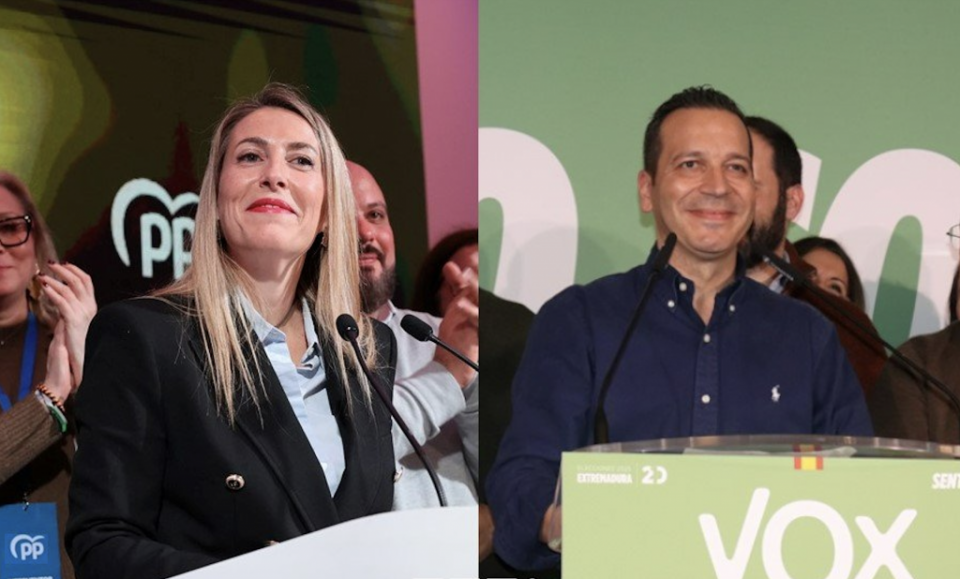
Spain’s far-right Vox party returned to government in the western region of Extremadura on Wednesday, after striking a fresh coalition deal with the right-wing People’s Party (PP), reviving an alliance that could serve as a test case ahead of a general election expected by 2027.
Under Spain’s decentralised system, regional governments wield significant powers over areas such as healthcare and education, making political developments in Extremadura closely watched as a potential bellwether for national trends.
The agreement brings Vox back into power after it withdrew in 2024 from five regional governments it had shared with the PP, including Extremadura, amid a dispute over the distribution of unaccompanied migrant minors. ALSO READ: Spain to commence mass regularisation of undocumented migrants.
On Wednesday, PP leader in the region, María Guardiola, was re-elected as head of the Junta de Extremadura with Vox’s backing, securing 40 votes in favour and 25 against in the regional parliament. She was sworn in shortly afterwards and embraced by Vox’s regional leader, Óscar Fernández, who will serve as deputy leader in the new coalition.
Defending the pact, Guardiola said she would ‘not apologise for governing with those who represent a significant part’ of the region, dismissing criticism over the inclusion of the concept of ‘national priority’ in the agreement.
‘This is not fascism — it is called democracy, it is called a parliamentary majority, it is about moving from deadlock to agreement,’ she said.
The coalition deal includes measures aimed at tightening immigration policy, notably by prioritising ‘aid, subsidies and public benefits’ for people with what it describes as a ‘real, lasting and verifiable link to the territory’.
Guardiola sought to downplay the controversy, saying there was ‘no need to be hyperbolic and that the policy amounted to “’giving priority to our country, to the people who are here and to those who come to build’, adding that her government would ‘positively value people’s roots and ties to our land’ while respecting the law.
Vox, however, leaned more heavily into the concept. Fernández emphasised that ‘national priority’ would guide access to opportunities, arguing that ‘we must defend our own people first’ and ensure that those with ties to Extremadura are prioritised ‘in access to opportunities that are not enough for everyone’.
He rejected accusations of discrimination, insisting the policy ‘is neither racism nor selfishness — it is simply common sense’, and said it would translate into ‘concrete, legal and achievable measures’, including in housing and social assistance, to ensure ‘no one from outside is placed ahead of any Spaniard’.
The agreement has sparked strong criticism from the opposition and at national level. During a debate in Spain’s parliament on Wednesday, socialist (PSOE) Prime Minister Pedro Sánchez described the PP-Vox deal in Extremadura as ‘a kick to the constitution’, warning it introduces discriminatory principles that undermine equal treatment.
The PSOE has also branded the arrangement ‘illegal’ and ‘xenophobic’, arguing it creates first- and second-class citizens, while left-wing group Unidas por Extremadura accused the PP of adopting the far right’s narrative.
Despite the backlash, Guardiola urged opponents to ‘stop demonising’ what she called a ‘necessary and urgent’ agreement, arguing that the alternative would be governing without a majority and leaving the region politically paralysed.
Meanwhile, the PP and Vox are continuing coalition discussions in Aragón and Castilla y León, both of which – like Extremadura – recently held regional elections. ALSO READ: PP wins Castilla y León election, but needs far-right’s support – and PSOE improves its result.
How this renewed collaboration unfolds is expected to be closely monitored ahead of the next general election, which Sánchez is required to call by mid-2027. ALSO READ: PP wins Aragón election, dependent on Vox after far-right surge; PSOE records all-time low.
Current polling indicates the PP would likely emerge as the largest party but would still depend on Vox’s support to secure a governing majority in Spain’s increasingly fragmented parliament. ALSO READ: Latest opinion polls show PSOE gaining on anti-war stance, as support for far right stalls.
ALSO READ: Andalusia heads to the polls on 17 May in high-stakes regional vote.
Enjoying the news from Spain in English? Add us as a preferred news source in Google.
Subscribe to the Weekly Newsletter from Spain in English.
#Canal24Horas | María Guardiola, tras ser investida presidenta de Extremadura: “Lo primero que voy a hacer es tomar posesión el viernes, publicar el decreto de estructura y seguir impulsando las políticas del cambio en esta región”. pic.twitter.com/9csuAicILP
— RTVE Noticias (@rtvenoticias) April 22, 2026
🔴 ÚLTIMA HORA
— RTVE Noticias (@rtvenoticias) April 22, 2026
María Guardiola, investida presidenta de Extremadura con los votos de PP y Vox.#Canal24Horas
▶️ https://t.co/wIMPtOsyLR pic.twitter.com/joFxLtL9LL

Click here to get your business activity or services listed on our DIRECTORY.