
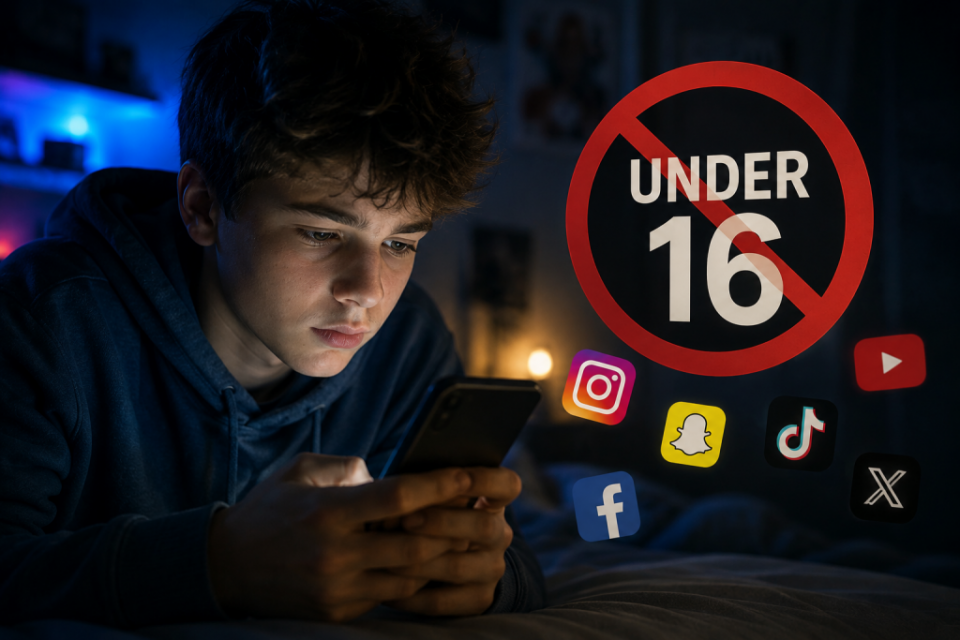
On 15 June 2026, UK Prime Minister Keir Starmer announced that children under 16 will be banned from social media. Snapchat, TikTok, YouTube, Instagram, Facebook, X. All of it. The ban is planned to come into force in spring 2027, and Starmer made clear that if tech companies push back, he intends to push harder.
Spain got there first. Back in February, Prime Minister Pedro Sánchez stood at the World Governments Summit in Dubai and declared that social media had become a ‘digital Wild West’ and that Spain would no longer accept children being left to navigate it alone. ALSO READ: Spain will seek to prohibit children aged under 16 from accessing social media.
The legislation still needs to complete its passage through parliament, and a firm implementation date has not yet been set, but the political direction is clear.
And they’re not the only ones. Australia, France, Denmark, Greece. The list keeps growing. A global conversation, long overdue, is finally turning into action.
There is plenty to applaud here. But there is also plenty to scrutinise. So, let’s do both.
Why this matters
The evidence that heavy or unrestricted social media use can cause real harm to young people, particularly girls, has been building for years, even if researchers still debate the precise scale of the effect. Mental health pressures, exposure to harmful content, algorithmic rabbit holes designed to maximise engagement at any cost. Governments around the world have talked about it for a long time. Now, a few of them are actually doing something about it.
The proposed UK ban is broader than most people realise. It’s not just Instagram and TikTok. The scope covers what the legislation calls ‘user-to-user services’, which pulls in livestreaming and gaming platforms too. So, it catches a significant chunk of teenage online life, not just the obvious apps.
And the enforcement model, at least in principle, is sensible. Starmer was clear that the penalties fall on the platforms, not the children. Companies that fail to take reasonable steps to exclude under-16s face multimillion-pound fines. The regulator Ofcom has been asked to publish its assessment of age verification options by October 2026, ahead of the regulations going before Parliament.
How to do it
The detail that makes or breaks this policy is how to verify someone’s age. And right now, that ‘minor’ detail is still being worked out, here in Spain and back in the UK.
Both governments have been emphatic that self-declaration, a date-of-birth dropdown, is no longer good enough. The UK’s regulator Ofcom is examining what it calls ‘highly effective age assurance’, which means things like digital ID, document checks, and facial age estimation. Sánchez used almost identical language in February, insisting that platforms would be required to implement ‘not just check boxes, but real barriers that work’. The rhetoric is aligned. The mechanics are still being designed. ALSO READ: Spanish government approves draft law to crack down on AI deepfakes and image misuse.
Who should be responsible for running the checks is a separate question. My instinct is that it should sit with the platforms rather than the app stores. But, given that most of us would not trust those same platforms with more of our personal data, the most sensible model might be something like a government-approved independent verification provider, the kind of plugin that sits between the user and the platform and confirms age without handing over the underlying data.
Those platforms exist and are already in use by adult content platforms under earlier age verification rules. But questions remain about whether such platforms can scale and whether their own data handling meets the required standards.
Many people also raise the VPN problem, saying that teenagers who want to get around the ban will use one. That’s very possible. But a VPN, in and of itself, doesn’t verify your age; it simply masks where you are accessing the internet from. So, using it doesn’t automatically mean you’ll be able to circumvent age-verification software. Either way, some people will, I’m sure, find ways to beat the software. That’s not a reason to abandon the policy; it’s just a reason to be honest about what it can and cannot achieve.
The scope creep question
Another interesting aspect to consider when it comes to well-meaning legislation like this is the risk of ‘scope creep’, one thing leading to something that was not originally intended. When the UK introduced age verification for online pornography, sites that were not legally required to verify ages started doing it anyway. On the surface, that looks like a win. In practice, it raises a real data protection question. Are those sites collecting sensitive identity data without a clear legal basis? Does that cross the line under GDPR and the UK Data Protection Act?
The same risk exists here. Once age verification becomes the norm for major platforms, smaller sites and services may follow suit, sometimes for legitimate reasons, sometimes out of caution, sometimes because it looks responsible even when it is not required. Regulators will need to watch that closely.
Will it work?
Australia has been running its social media ban for several months now. Research from the Molly Rose Foundation, shows that more than 60% of underage Australians are still accessing restricted platforms. That figure gets cited a lot as evidence that the ban has failed and I wouldn’t in the least dismiss their findings. The Foundation’s findings should absolutely be fed into the ongoing debate and used to improve how governments tackle this issue.
What I would say, though, is that if 40% of under-16s in Australia no longer have accounts on platforms they previously used, that is not a failure. That is 40% of young people who are, at least to some degree, less exposed to the content those platforms push at them. It’s a step in the right direction, albeit not the giant one touted by the Australian government when the law was first announced.
The other half of the equation, as the Molly Rose Foundation points out, is the content itself and how these platforms are built. Keeping young people off these platforms is one thing. Dealing with what is on them and the way they are designed to encourage addictive behaviour is another. That’s a harder fight, but arguably the more urgent one. And governments, platforms and civil society need to be addressing that simultaneously, not as a follow-up.
What this ban will really do is disrupt the default. It’s already forcing the conversation. And when it is implemented, it will create friction where there was none before. It will stop some teenagers from creating accounts, even if it does not stop all of them. And crucially, it’s the children coming down the line, those who have not yet signed up, who stand to benefit most. Those kids who would otherwise have drifted onto these platforms at 12 or 13 will now, at a minimum, face an obstacle they didn’t have before.
What this means for small businesses
Unless you’re one of the major social media platforms, or you own a business ‘whose purpose is to enable social interaction and which allows users to post material’, then the latest announcement won’t change much for you, at least in the short term.
And besides, age verification requirements have been in place for sites with adult content for a year now – at least in the UK. So, if you fall into that category, you should already have good age verification in place.
But we’re seeing a direction of travel here and if your target audience does include an adolescent demographic, or you work with broader products or services that are age restricted, it’s worth paying attention to how the age verification implementation plays out. What happens here could impact all sites that deal with age restricted products in the future.
For everyone else, this may still be a good moment to take a look at your own social media channels and ask who are you targeting and what are they doing when they get there. Age aside, a lot of business owners are active on social media but don’t really have a complete understanding of who they are reaching and how well it’s working. The data might give you some interesting insight into your own business’s reliance on these platforms.
And if you are also a parent, there may be some relief in knowing that, hopefully, your teenager is going to be a little bit less exposed to parts of the internet that were never built with their wellbeing in mind.
About the author: Ben Giddings is a digital communications consultant based in Madrid. With over 20 years of digital communications experience, including senior roles managing digital strategy across the UK Foreign Office’s global network, he now helps English-speaking businesses in Spain and the UK to improve their online visibility and use their websites as a tool for business growth. Find out more at bengiddings.com.
ALSO READ: Business Spotlight: Your website exists. But does anyone know?
ALSO READ: Business Spotlight: Spain is a digital powerhouse. Is your business keeping up?
Enjoying the news from Spain in English? Add us as a preferred news source in Google.
Subscribe to the Weekly Newsletter from Spain in English.

Click here to get your business activity or services listed on our DIRECTORY.