
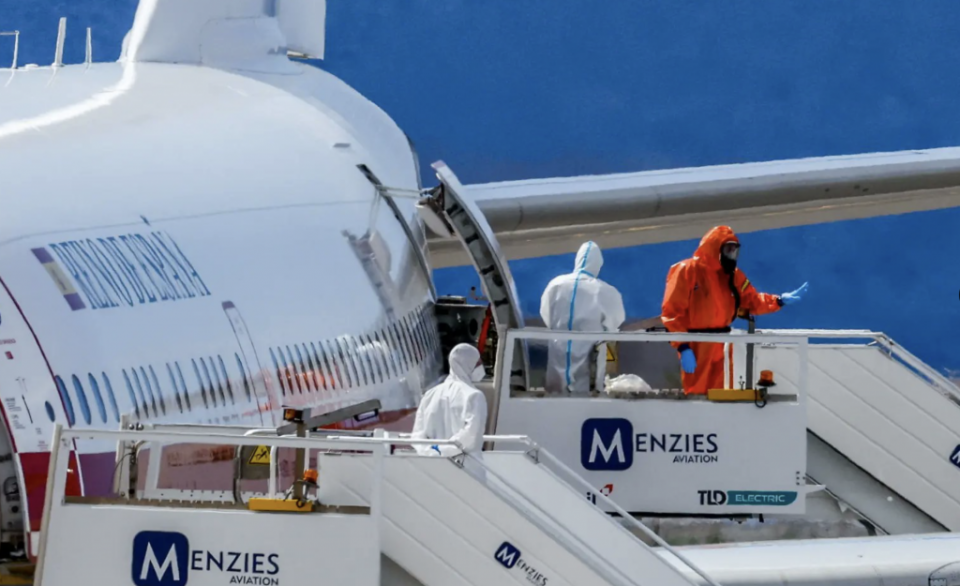
Military and government aircraft began flying passengers home on Sunday after the cruise ship at the centre of the hantavirus outbreak docked in Spain’s Canary Islands, where travellers were brought ashore by teams wearing full protective suits and breathing masks.
Spanish nationals were the first to disembark from the MV Hondius after it arrived in Tenerife, the biggest of Spain’s Atlantic islands off northwest Africa. They were flown to Madrid and transferred to the Gómez Ulla military hospital. Later in the day, a plane carrying French passengers touched down in Paris, where emergency services were waiting on the runway.
French Prime Minister Sebastien Lecornu said one of the five French passengers began showing symptoms during the flight. All five were placed into strict isolation and are due to undergo testing.
Before the evacuations began, officials from Spain’s Health Ministry, the World Health Organization (WHO) and cruise operator Oceanwide Expeditions had said that none of the more than 140 people still aboard the Hondius had displayed symptoms of the virus.
Aircraft arriving in Tenerife were expected to repatriate passengers from more than 20 countries, with the evacuation effort continuing through Monday.
Since the outbreak started, three people have died, while five passengers who previously left the vessel have tested positive for hantavirus.
WHO insists danger to wider public remains low
WHO Director-General Tedros Adhanom Ghebreyesus again stressed that the outbreak should not alarm the wider public. ALSO READ: WHO chief heads to Canary Islands to oversee hantavirus cruise evacuation.
‘We have been repeating the same answer many times,’ he said. ‘This is not another Covid. And the risk to the public is low. So they shouldn’t be scared, and they shouldn’t panic.’
Despite those assurances, strict precautions were visible throughout the evacuation at the port of Granadilla in Tenerife. Disembarking passengers and port personnel wore hazardous materials suits, respirators and masks. ALSO READ: Spain says it has ‘legal tools’ for quarantine as hantavirus cruise ship to ‘anchor offshore’ Tenerife.
Spanish media TV footage showed passengers on the tarmac dressed in similar protective clothing while being sprayed with disinfectant.
Another WHO official described the relief among passengers finally leaving the vessel.
‘It’s been great seeing all the buses coming out and people really happy to be on land again and being repatriated,’ said Diana Rojas Alvarez, the WHO health operations lead stationed in Tenerife.
Spanish authorities said both passengers and crew leaving the ship would undergo symptom checks and would not be permitted to mix with the local population. Individuals were only being removed from the vessel when their evacuation flights are ready to depart. Tedros, together with Spain’s health and interior ministers, was overseeing the operation on the island.
Hantavirus is generally spread through inhalation of contaminated particles from rodent droppings and is not normally transmitted easily between humans. However, the strain linked to the outbreak aboard the ship — the Andes virus — is believed capable of rare person-to-person transmission. Symptoms can appear anywhere from one to eight weeks after exposure. Click here for the WHO’s full fact sheet on hantavirus.
Passengers and crew leaving the ship were instructed to leave their luggage behind and were allowed to carry only a small bag containing essentials, along with a phone, charger and identification documents.
Some crew members, together with the body of a passenger who died during the voyage, will remain on board as the ship sails to Rotterdam for full disinfection, according to Spanish authorities.
The cruise company said the trip to the Netherlands would take around five days.
Countries prepare monitoring and quarantine measures
WHO official Maria Van Kerkhove said the organisation is advising countries receiving passengers to carry out ‘active monitoring and follow up’, including daily health checks either at home or in specialised facilities.
‘We are leaving this up to the countries themselves to actually develop their own policies,’ she added. ‘But our recommendations are very clear, and this is really a cautionary approach to make sure that we don’t have any opportunities for this virus to pass from others.’
Several countries have already confirmed quarantine or hospital observation plans for returning passengers. France had earlier announced that its citizens would spend 72 hours under hospital observation before completing a 45-day quarantine at home.
Following the in-flight symptoms reported on the French evacuation flight, Lecornu said the five passengers would remain in hospital ‘until further orders’.
Passengers from the United States are expected to quarantine at a medical centre in Nebraska, while British passengers and crew will undergo hospital observation in the UK, according to British authorities.
Spain’s Health Minister Mónica García said Australia had dispatched an aircraft expected to arrive Monday to evacuate Australians as well as citizens from nearby nations including New Zealand and several Asian countries. She said this was likely to be the final evacuation flight departing Tenerife.
Norway also sent an air ambulance equipped with personnel specially trained to handle patients with high-risk infectious diseases, according to the country’s Directorate for Civil Protection.
British military medics deployed to remote island
Separately, British military medics parachuted into the isolated South Atlantic territory of Tristan da Cunha, where one of the island’s 221 residents is suspected of having contracted hantavirus.
The patient had previously travelled aboard the MV Hondius and disembarked last month.
Britain’s Defence Ministry said six paratroopers and two medical specialists jumped onto the island on Saturday from a Royal Air Force aircraft, which also delivered oxygen supplies and medical equipment.
Tristan da Cunha, Britain’s most remote inhabited overseas territory, lies roughly 1,500 miles from the nearest inhabited island, Saint Helena. The volcanic archipelago has no airport and can normally only be reached by a six-day sea journey from Cape Town.
Meanwhile, Spanish health officials said a woman in the province of Alicante who was suspected of carrying the virus tested negative on Saturday.
The woman had travelled on the same flight as the Dutch passenger who later died in Johannesburg after leaving the cruise ship. ALSO READ: Hantavirus-hit cruise ship eyes Canary Islands after Cape Verde refusal.
Enjoying the news from Spain in English? Add us as a preferred news source in Google.
Subscribe to the Weekly Newsletter from Spain in English.
El mundo entero nos está mirando y España ha demostrado su capacidad para liderar una emergencia sanitaria internacional.
— Mónica García (@Monica_Garcia_G) May 10, 2026
Estamos ejecutando una evacuación sin precedentes en coordinación con 23 países.
Somos un país solidario y eficiente al mismo tiempo. pic.twitter.com/IhTJT3qD7T
Los vuelos de España, Francia, Canadá y Países Bajos partían desde Canarias esta mañana.
— Telediarios de TVE (@telediario_tve) May 10, 2026
Hace unos minutos comenzaban las maniobras de despegue del avión de Reino Unido
Desde @rtvecanarias, Zuleima García pic.twitter.com/oPm28Dw1x0
Los 14 españoles del Hondius cumplen ya cuarentena en el Gómez Ulla
— RTVE Noticias (@rtvenoticias) May 10, 2026
Poco antes de las 06.00 (hora canaria) el MV Hondius llegaba al puerto de Granadilla.
Siguiendo todo lo que ocurría estaba un equipo de RTVE Noticias.
Así lo ha visto @noemisanjuanhttps://t.co/8PwNRduyaF pic.twitter.com/G5G5wmQVAW

Click here to get your business activity or services listed on our DIRECTORY.