
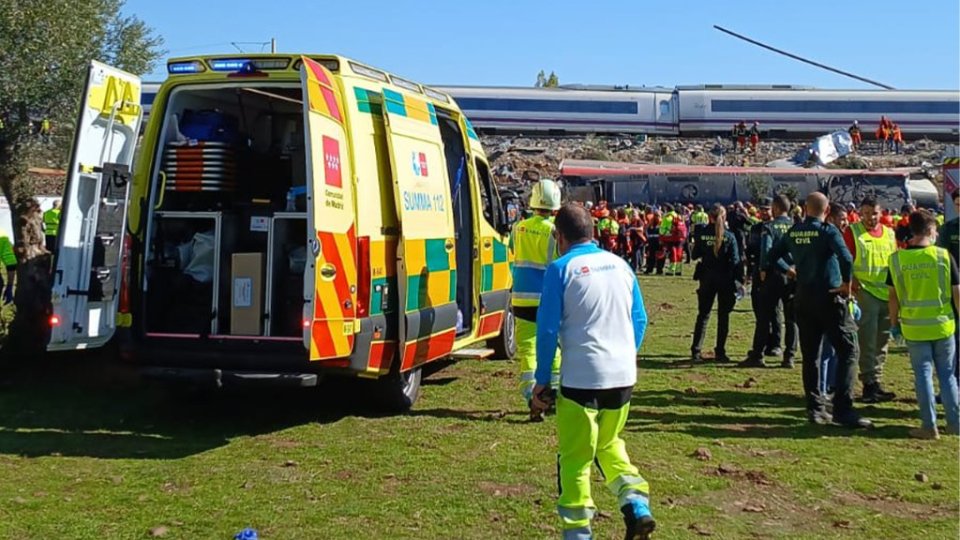
Twelve people from nine countries outside Spain have been confirmed among those killed in the Urda rail disaster, with forensic teams awaiting the arrival of relatives to help complete the identification of three remaining victims.
Authorities have identified 66 of the 69 people who died in the collision in the Toledo province of Castilla-La Mancha last Wednesday. They include 54 Spanish nationals and 12 foreign citizens, according to the Integrated Data Centre (CID), which brings together information from the police and forensic identification operation.
The confirmed foreign victims are four US citizens and one citizen each of Argentina, Canada, the Czech Republic, France, Japan, Mexico, Portugal and Tunisia.
Three missing-person reports remain active, concerning two Australians and another Japanese citizen. Authorities believe the three people still awaiting identification are foreign nationals, but their identities have yet to be formally confirmed.
‘As the contacted families have expressed their wish to travel to Spain to carry out in-person identification, we are awaiting their arrival in the country,’ the CID said in its statement.
The latest information was released late on Sunday, as relatives continued to wait for news and specialists worked to establish the identities of everyone killed.
Families await completion of forensic work
Fingerprint comparisons have established the identities of 53 victims, while DNA analysis has identified a further 13.
The fingerprint work is being carried out by the Guardia Civil’s criminalistics service. The National Institute of Toxicology is conducting DNA testing in cooperation with the force, whose specialists are also analysing samples supplied by relatives of missing passengers.
At the time of the latest statement, the families of 60 identified victims — 36 men and 24 women — had been informed. Notifications concerning the other six identified victims were still being completed.
Families are notified personally and in person before the corresponding information is incorporated into the CID’s public reporting process. The remains of 47 victims had been made available to their relatives.
More than 60 professionals have been involved in post-mortem examinations and identification work in Toledo since Wednesday. They include forensic doctors from Toledo, Ciudad Real and Cáceres, together with two forensic advisers from the ministry responsible for justice.
The operation also includes six post-mortem technicians, nine National Institute of Toxicology specialists carrying out DNA tests, and 27 Guardia Civil criminalistics officers.
Four forensic-service psychologists have been assigned to support bereaved families.
Thirty-nine injured people remain in hospital
The number of injured people still receiving hospital treatment has fallen to 39, according to the latest update from the Castilla-La Mancha government.
Regional government spokesperson Esther Padilla said 29 patients remained in hospitals in Castilla-La Mancha, including nine in intensive care, while ten others were being treated in Madrid and Andalusia. Eighty-one injured people have been discharged.
The regional government said patients were progressing favourably. At Toledo University Hospital, three people had been moved from intensive care to ordinary wards, while another patient had been discharged.
Hospitals in Alcázar de San Juan, Ciudad Real and Albacete are also continuing to treat survivors.
Search continues around the wreckage
Around 50 Guardia Civil personnel remain deployed at the crash site, where the recovery operation is continuing alongside the investigation. ALSO READ: Train crash judge demands more workers after staff shortage halts overnight search.
Officers are searching for biological remains among the damaged carriages and surrounding ground, assisted by specialist dogs, drones and judicial police teams.
The Renfe AVE carriages that remained on the track have been removed. Recovery work has also focused on Iryo carriages seven and eight, with wreckage being transferred to a secure area to allow further examination and searches.
Explaining the painstaking nature of the operation, the Guardia Civil said ‘the entire area will be searched metre by metre’.
The perimeter remains secured under an order from the judge overseeing the investigation, preventing unauthorised access while recovery and evidence-gathering work continues.
Renewed scrutiny of rail safety
The collision occurred outside the village of Urda, around 130 kilometres south of Madrid, when a Renfe high-speed AVE service struck the rear of a stationary Iryo train.
Reports of the sequence preceding the crash indicate that a failure affecting an automatic safety system brought trains to a halt along a 63-kilometre section of the line. A control centre subsequently authorised the Renfe service to resume its journey while the Iryo train remained stopped. ALSO READ: Transport Minister says decision to let AVE proceed before fatal Toledo crash was ‘inexplicable’.
The circumstances surrounding those instructions and the operation of the safety systems are central to the investigation. ALSO READ: Toledo crash recordings reveal restart orders as Iryo driver reported train still stopped.
The disaster is Spain’s second fatal high-speed rail collision this year. A crash in Andalusia in January killed 46 people on the same Madrid–Seville corridor, intensifying concern about a network long associated with fast and safe travel.
Prime Minister Pedro Sánchez has promised an investigation and improvements intended to restore public confidence in the railway system, which carried around 45 million passengers last year, including millions of tourists. ALSO READ: Sánchez pledges urgent support for train tragedy victims and vows to restore trust in high-speed rail.
The latest collision also places infrastructure investment and railway safety under heightened political scrutiny ahead of the 29 November general election, in which Sánchez is seeking to extend his eight years in office. ALSO READ: Spain’s latest rail tragedy puts safety and accountability at centre of election campaign.
Enjoying the news from Spain in English? Add us as a preferred news source in Google.
Subscribe to the Weekly Newsletter from Spain in English.
Los heridos del accidente de Urda presentan una evolución favorable. Siguen ingresados en hospitales de Toledo, Ciudad Real, Albacete y Madrid. Todavía hay once en las UCI y 4 de ellos están en el hospital de Toledo. 🎙️@lobera_marta https://t.co/MOxUjXYjAa
— RTVE Noticias (@rtvenoticias) November 2, 2026
27 agentes del Servicio de Criminalística de la #GuardiaCivil son los encargados de tomar las muestras de ADN y huellas por las denuncias de desaparición de un familiar en el accidente ferroviario de Urda. https://t.co/ZoJqsHgoyf
— Guardia Civil (@guardiacivil) November 1, 2026
Mantenemos activo el dispositivo desplegado en la zona cero del accidente ferroviario, donde se han iniciado las labores de traslado de los coches siniestrados a una zona segura. El dispositivo está integrado por efectivos del Servicio Cinológico, unidades de drones y contradrones del Servicio Aéreo, Policía Judicial, Agrupación de Reserva y Seguridad (ARS) y unidades de seguridad ciudadana, que se encargan de garantizar la vigilancia, el control y la protección del perímetro. Insistimos: es una zona de exclusión de vuelo, incluidos los drones. #GuardiaCivil
— Guardia Civil (@guardiacivil) November 2, 2026

Click here to get your business activity or services listed on our DIRECTORY.