
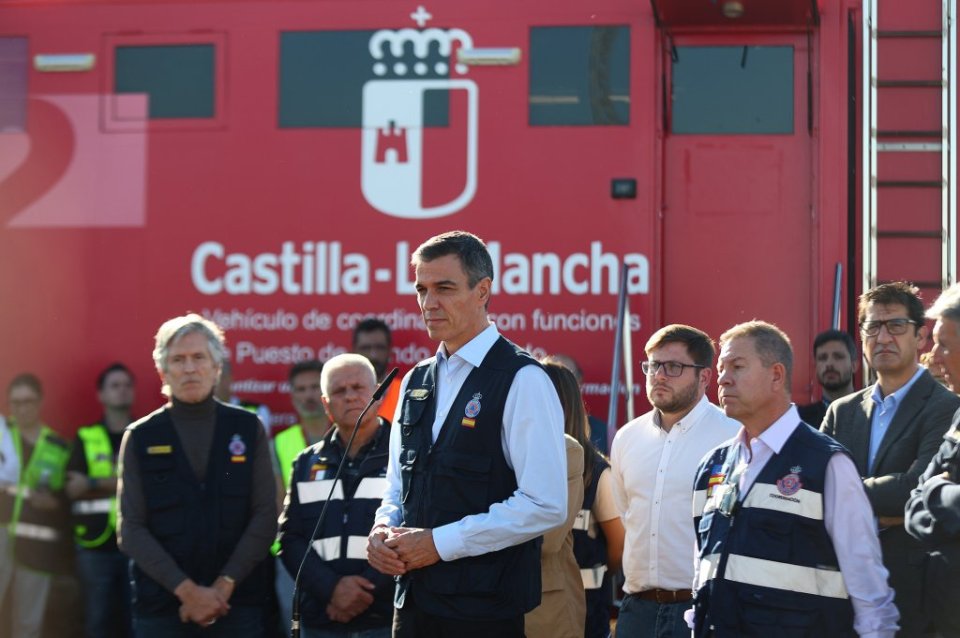
Spain’s second fatal high-speed rail collision in nine months has transformed the political agenda ahead of the 29 November general election, placing Pedro Sánchez’s government under renewed pressure over railway safety and the future of Transport Minister Óscar Puente.
At least 69 people died in Wednesday’s collision near Urda in the Toledo province of Castilla-La Mancha, with dozens injured. Rescue teams continued searching the wreckage on Thursday as the country began three days of official mourning. The disaster has interrupted campaigning barely a month before voters go to the polls. ALSO READ: At least 68 dead and over 50 injured in high-speed train collision near Toledo.
Until the crash, the socialists (PSOE) had been seeking to focus the election debate on housing, pensions, the minimum wage, public spending and the prospect of a government formed by the right-wing People’s Party (PP) and far-right Vox.
Railway safety now threatens to dominate the contest, confronting the government with questions about a public service for which it has direct responsibility.
The political consequences extend beyond the opposition’s response. Sánchez’s left-wing coalition partner, Frente Amplio, has demanded political accountability and an independent audit, while relatives of victims of January’s Adamuz collision in Cordoba (Andalusia) are renewing their criticism of Puente. ALSO READ: Spain’s train crash victims mourned as families call for truth and justice.
Sánchez stands by his transport minister
Sánchez is currently maintaining his support for Puente, a close political ally who had been expected to play a prominent role in the PSOE campaign.
The government’s initial assessment points towards human error in the sequence of events preceding the Urda collision. That remains a preliminary explanation, rather than a final finding establishing the causes or allocating responsibility. ALSO READ: Toledo crash recordings reveal restart orders as Iryo driver reported train still stopped.
Puente has said an instruction to restart a train after a signalling system failure was ‘inexplicable’. His account raises questions about both operational decisions and the safeguards that should prevent an error from resulting in a collision. ALSO READ: Transport Minister says decision to let AVE proceed before fatal Toledo crash was ‘inexplicable’.
Sánchez’s description of two fatal high-speed accidents in the same year as ‘unacceptable’ has nevertheless intensified speculation about whether the minister can remain in office. ALSO READ: Sánchez pledges firm action over Toledo train disaster as Feijóo demands answers.
Senior government sources cited by El País said the prime minister continued to back Puente, although the newspaper reported that any decision to remove him would be more likely to come after the immediate emergency.
Puente has said his concern is establishing what happened and ensuring railway safety, rather than his own political future.
For Sánchez, either course carries a political cost. Removing Puente would deprive him of an influential ally during an election campaign and invite questions about why he had retained him after Adamuz. Keeping him would leave the government defending the minister as further details emerge.
PP demands answers as Vox continues campaigning
PP leader Alberto Núñez Feijóo initially adopted a restrained response, cancelling campaign events and avoiding an immediate demand for resignations.
‘This is a time to show respect for the dead, the injured and their families,’ he said.
‘That does not mean ignoring the fact that Spaniards are asking tough questions and deserve answers. Spain has the right to know what is happening with its infrastructure.’
Feijóo has demanded information about the condition of the tracks and safety systems, the warnings received since Adamuz and the measures taken in response. He also called for an ‘immediate’ government and judicial investigation ‘without interference’, alongside a ‘complete and independent review of the entire railway network’.
PP representatives joined tributes to the victims outside town halls across Spain on Wednesday evening. Behind that public restraint, Spanish media has reported considerable anger towards the government among senior PP figures, with criticism expected to intensify after the mourning period.
The party’s official social media account had already signalled a harder line with a message declaring ‘enough is enough’, while Andalusian president Juanma Moreno also sharpened his criticism.
The tragedy also has a personal dimension for the PP. Former employment minister Fátima Báñez, now president of the CEOE employers’ organisation’s foundation, was reported missing after travelling on one of the trains. The CEOE confirmed on Wednesday that she had been aboard and that it was awaiting news.
The far-right Vox party took a more confrontational approach from the outset. Unlike the other main parties, it continued its campaign activities on Wednesday.
Its leader, Santiago Abascal, denounced the ‘intolerable deterioration’ of Spain’s railway infrastructure and institutions. The party directly blamed Sánchez, using the slogan ‘corruption kills’. ALSO READ: Spain’s ex-transport minister sentenced to 24 years as corruption pressure mounts on government.
Coalition partner calls for political accountability
Pressure on the government is also coming from Frente Amplio, the new alliance comprising Izquierda Unida (IU), Comuns, Más Madrid and Sumar. ALSO READ: Spain’s left heads into election divided as unity talks collapse.
In a statement issued on Wednesday afternoon, the coalition demanded ‘political accountability’ and an ‘independent audit’ to establish what happened. Its response went further than the PP’s initial position, bringing criticism from within the governing alliance itself.
After expressing condolences to bereaved families and support for those affected, the parties said the seriousness of the disaster required the greatest possible ‘clarity and transparency about what happened’.
‘The recurrence of such a serious accident on the high-speed network in the same year is unacceptable,’ the statement concluded.
Adamuz returns to the centre of the debate
The Urda collision has reopened the unresolved controversy surrounding the 18 January crash near Adamuz in the Córdoba province of Andalusia, which killed 46 people. ALSO READ: Sánchez: Spain’s rail network is ‘not perfect but safe’, vows ‘justice will be done’ for victims’ families.
Investigators examining that disaster have considered a possible defect in a welded rail joint and earlier warnings about the condition of the track. The final official investigation has yet to establish the cause. ALSO READ: Initial report from train tragedy investigators points to fracture in track prior to accident.
Relatives of Adamuz victims had already demanded Puente’s resignation. One victims’ association representative accused him of dismissing those demands by saying he had not personally welded the rail.
Relations with victims’ relatives deteriorated further last week after Puente appeared in a television comedy sketch joking about RENFE breakdowns. The Adamuz victims’ association condemned the appearance as insensitive and repeated its demand that he resign.
On Wednesday evening, protesters gathered outside the transport ministry calling for his departure, in scenes broadcast by RTVE.
The political challenge extends beyond explaining the two collisions. Ministers must also respond to passenger frustration over delays, cancellations and breakdowns on a network long presented as a symbol of Spain’s modernisation. ALSO READ: One dead, 37 injured, as commuter train ploughs into rubble of collapsed wall near Barcelona.
A campaign already under strain
Sánchez called the election early against a backdrop of housing protests, seeking to mobilise left-wing voters following the eviction and subsequent death of an 87-year-old woman in Madrid, where the PP control the regional and municipal governments. ALSO READ: PP, Vox and Junts attack Sánchez’s record as Spain heads for November election.
His minority administration was already contending with corruption cases involving people from his political and family circles, alongside criticism of its response to the housing shortage. ALSO READ: Pedro Sánchez calls a general election in Spain for 29 November.
The PSOE had nevertheless appeared comfortable with the emerging campaign debate. Sánchez adopted an unusually upbeat approach, describing it as ‘the campaign of love’, with smiling appearances, dancing and a public kiss with his wife, Begoña Gómez, at a rally. ALSO READ: PSOE considers legal action over PP video using AI to impersonate Sánchez’s wife and senior socialists.
That tone will be difficult to resume after Urda.
The disaster also adds to the succession of emergencies experienced during Sánchez’s eight years in office: the 2024 Valencia floods, which killed 233 people in the province; last year’s nationwide electricity blackout; and a mass migrant crossing into Ceuta in July in which more than 100 people were reported dead. ALSO READ: Spain’s Ceuta crisis: Polls show widespread disapproval of Sánchez as PP and Vox pass 50%.
These events had different causes and involved different authorities. Politically, however, the opposition is likely to present the latest tragedy as further evidence of deteriorating public services and government competence, despite Spain’s relatively strong economic performance.
An RTVE polling average projected 133 seats for the PP and 107 for the PSOE, with a combined PP–Vox total of 199 seats in the 350-member Congress – comfortably above the 176 needed for an absolute majority. Those projections predate any measurable electoral response to Wednesday’s disaster. ALSO READ: PP and Vox strike Senate election deal with judicial appointments in their sights.
Recent confrontations between demonstrators and police in Galicia, Bilbao and Barcelona had already contributed to tensions surrounding the campaign. The rail tragedy now introduces a further source of grief, anger and demands for accountability. ALSO READ: Spain’s housing crisis prompts general strike on 11 November, ahead of election.
The immediate priority remains the victims and their families. As campaigning resumes, however, the government will face sustained questions about how two catastrophic collisions occurred within nine months, what lessons were acted upon after Adamuz, and whether the measures protecting passengers are sufficient.
Enjoying the news from Spain in English? Add us as a preferred news source in Google.
Subscribe to the Weekly Newsletter from Spain in English.
Declaración del presidente del PP, Alberto Núñez Feijóo, tras el accidente ferroviario en Urda:
— Partido Popular (@ppopular) October 28, 2026
Consternados por el accidente ferroviario de hoy, enviamos nuestro cariño a las familias de las personas fallecidas y nuestro apoyo a todas las personas afectadas. Exigimos claridad, una auditoría independiente de la red ferroviaria y responsabilidades técnicas y políticas. https://t.co/wS0717Se51
— Frente Amplio (@Frente_Amplio_) October 28, 2026
🔴 URGENTE | Presentamos querella ante el Tribunal Supremo contra Óscar Puente. https://t.co/a340xcbylE
— VOX 🇪🇸 (@vox_es) October 29, 2026
Todas las instituciones estamos trabajando día y noche no solo para dar una respuesta a las víctimas y a sus familiares, sino para esclarecer hasta el último detalle de esta tragedia y reforzar la seguridad para que no vuelva a suceder. Desde el primer momento se ha puesto en marcha el Plan General Estatal de Emergencia de Protección Civil, movilizando a la UME, la Guardia Civil, la Policía Nacional y todo el sistema de Protección Civil. Quiero agradecer a todos los servicios de emergencia y de asistencia psicológica su labor en estas horas tan duras.
— Pedro Sánchez (@sanchezcastejon) October 29, 2026

Click here to get your business activity or services listed on our DIRECTORY.