
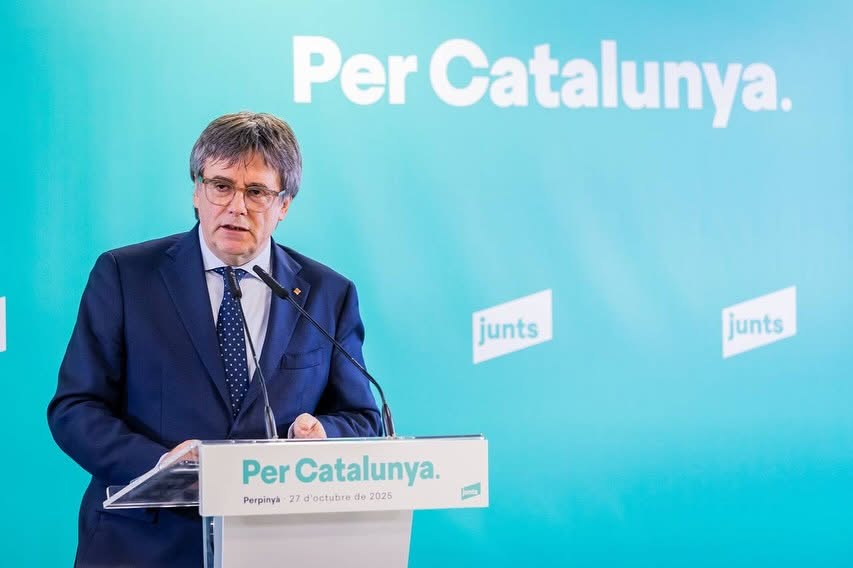
Spain’s Constitutional Court has taken a significant step towards extending the country’s controversial amnesty law to cover the misuse of public funds during Catalonia’s 2017 independence referendum, potentially removing the remaining legal obstacles preventing former Catalan president Carles Puigdemont (main image) from returning to Spain.
The court’s progressive majority agreed on Tuesday to reject a draft ruling that would have upheld the Supreme Court’s refusal to grant an amnesty for the offence of misusing public funds, known in Spanish law as malversación. ALSO READ: Spanish Supreme Court refuses to grant Puigdemont amnesty despite EU court ruling.
Although a formal judgment has yet to be issued, the decision signals that the Constitutional Court is preparing to overturn the Supreme Court’s interpretation of the amnesty legislation, with potentially far-reaching consequences for several leading figures in the Catalan independence movement.
The immediate case concerns Jordi Turull, the former Catalan government minister and current secretary-general of the pro-independence Junts per Catalunya (JxCat) party, who appealed against the Supreme Court’s decision to exclude his conviction for misuse of public funds from the amnesty.
The Constitutional Court announced that a draft judgment prepared by conservative judge José María Macías had failed to secure the support of a majority of its judges.
Macías must now prepare a revised judgment reflecting the majority’s position, which will be considered at the court’s next plenary session on 6 October.
The anticipated ruling could establish the legal precedent necessary to extend the amnesty to other independence leaders, including Puigdemont, who remains subject to a Spanish arrest warrant, and Oriol Junqueras, the leader of Esquerra Republicana party (ERC), who is currently barred from holding public office.
The dispute over the misuse of public funds
The legal controversy centres on the interpretation of Spain’s 2024 amnesty law, introduced to address the judicial consequences of Catalonia’s failed attempt to declare independence in October 2017. ALSO READ: Controversial Catalan amnesty law gets final approval in Spanish Congress.
The legislation has already benefited approximately 400 people involved in the independence movement, but several prominent political leaders have remained excluded from its full application because of outstanding proceedings or convictions relating to the misuse of public funds.
The Supreme Court has maintained that the expenditure of public money on organising the referendum falls within the exceptions established by the legislation.
Its reasoning is that although the independence leaders did not personally receive money, they nevertheless obtained an indirect financial benefit by using public resources to finance activities that would otherwise have required alternative funding.
This interpretation has prevented the amnesty from being fully applied to several leading figures involved in the referendum.
Macías supported the Supreme Court’s position in his original draft judgment concerning Turull’s appeal.
He argued that the Supreme Court’s interpretation could not be regarded as surprising, unpredictable or arbitrary, nor could it be attributed to alleged hostility towards the appellant. Instead, he maintained that it was consistent with established legal doctrine concerning the criminal offence of misusing public funds.
His draft also supported the Supreme Court’s broader interpretation of financial enrichment, under which avoiding a personal expense or benefiting from the use of another party’s money can constitute an economic advantage.
However, the Constitutional Court’s progressive majority rejected his proposed judgment, indicating that it favours a different interpretation of how the amnesty should apply.
The court has instructed Macías to submit a revised proposal incorporating the majority’s reasoning at its forthcoming session on 6 October.
That session will also consider the appeal submitted by former Catalan government minister Dolors Bassa, who was convicted over her involvement in the independence referendum.
Constitutional Court president Cándido Conde-Pumpido is expected to present a draft judgment recommending that Bassa receive the full benefit of the amnesty.
Puigdemont’s possible return to Spain
The Constitutional Court’s position could have particularly important consequences for Carles Puigdemont, who led Catalonia’s regional government during the 2017 referendum and subsequently left Spain for Belgium to avoid arrest.
Puigdemont remains subject to a national arrest warrant because the Supreme Court has refused to apply the amnesty to the allegations concerning the misuse of public funds. ALSO READ: Three Mossos officers suspended following Puigdemont’s escape from Spain.
The anticipated Constitutional Court judgment in Turull’s case could establish a precedent allowing that legal obstacle to be removed.
Supreme Court judge Pablo Llarena, who is responsible for the proceedings involving Puigdemont, is reportedly prepared to apply the Constitutional Court’s interpretation as soon as its first judgment is issued, without waiting for the court to resolve Puigdemont’s individual appeal.
If the Supreme Court subsequently applies the amnesty and lifts the outstanding arrest warrant, Puigdemont would be able to return to Spain without facing arrest in connection with those proceedings.
However, Tuesday’s decision does not itself constitute a final judgment, nor does it automatically cancel the arrest warrant. Those developments depend on the formal ruling and its subsequent application by the Supreme Court.
The Constitutional Court’s decision could also have significant implications for Oriol Junqueras, who was convicted of misuse of public funds and remains subject to a 13-year disqualification from holding public office.
If the amnesty is applied to his conviction and the disqualification is removed, Junqueras could once again stand for election, potentially including the next Catalan parliamentary elections, scheduled for 2028 if the current regional government completes its full term.
Turull welcomes decision but criticises delays
Speaking at a press conference at JxCat’s headquarters following Tuesday’s announcement, Jordi Turull welcomed the Constitutional Court’s decision as an important development, although he criticised the length of time it had taken to reach this stage.
Turull described the rejection of Macías’s draft judgment as a repudiation of judges whom he accused of engaging in ‘political activism’ and practising ‘politics in judicial robes’.
He nevertheless acknowledged that the decision represented only one stage in the process of securing the full application of the amnesty.
According to Turull, the Constitutional Court’s position should be sufficient for the Supreme Court to begin applying the legislation immediately, rather than waiting for the formal judgment expected following the 6 October session.
He also declined to reveal what arrangements Puigdemont might be making in anticipation of a possible return to Spain.
Asked about the former Catalan president’s plans, Turull replied: ‘I can’t share anything.’
He added that anyone claiming to have such information was simply pretending to know more than they did.
Political background and the next legal steps
The amnesty legislation was approved in 2024 as part of Prime Minister Pedro Sánchez’s efforts to ease tensions following Catalonia’s unsuccessful independence bid, which triggered one of Spain’s most serious political crises in decades.
Its approval also formed a crucial part of the political agreements that enabled Sánchez to remain in office following the inconclusive 2023 general election. READ: The PSOE and Junts sign a pact that will guarantee investiture of Pedro Sánchez.
With no party securing an outright parliamentary majority, the socialist leader required the support of several other political groups, including Catalan pro-independence parties, to secure his investiture.
However, the legislation’s implementation has remained contentious, particularly over the Supreme Court’s interpretation of the exceptions relating to the misuse of public funds.
The Spanish government has repeatedly maintained that the amnesty should extend to all political leaders involved in the independence movement and has called for it to be implemented ‘as soon as possible’.
The Constitutional Court’s latest deliberations also follow developments at the European level, including a July ruling by the Court of Justice of the European Union concerning the amnesty legislation. ALSO READ: European top court rules Spain’s Catalan amnesty complies with EU law.
Attention will now turn to the Constitutional Court’s plenary session on 6 October, when judges are expected to consider the revised judgment in Turull’s case alongside the appeal brought by Bassa.
The eventual judgment in Turull’s case is expected to establish the Constitutional Court’s interpretation of the legislation and provide guidance for the remaining appeals.
Its application by the Supreme Court will determine whether the outstanding legal restrictions affecting Puigdemont, Junqueras and other independence leaders can finally be lifted.
For Puigdemont in particular, the forthcoming judgment could represent a decisive development in the legal proceedings that have prevented his permanent return to Spain since 2017.
Click here for all our reports related to Catalan independence.
Enjoying the news from Spain in English? Add us as a preferred news source in Google.
Subscribe to the Weekly Newsletter from Spain in English.
El Constitucional está un paso más cerca de avalar la aplicación de la amnistía a Carles Puigdemont.
— Telediarios de TVE (@telediario_tve) September 22, 2026
Hoy el pleno ha rechazado dar la razón al Supremo que decidió no aplicarsela a Jordi Turull al considerar que la malversación que cometió suponía un enriquecimiento personal. pic.twitter.com/N9V1zS2UbK

Click here to get your business activity or services listed on our DIRECTORY.