
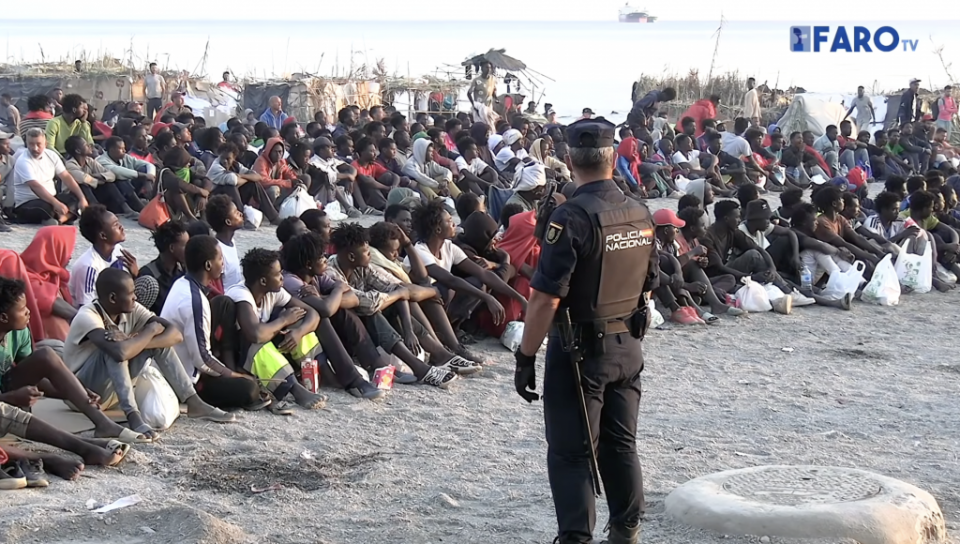
Spanish police have cleared migrants who had been sleeping rough around Trampolín beach and Loma Colmenar in Ceuta, transferring them to temporary reception facilities established by the government in response to the recent surge in arrivals from neighbouring Morocco. ALSO READ: Thousands remain in Ceuta as Spain moves to expand emergency accommodation.
The operation began at around 7am on Thursday, when National Police and Guardia Civil officers started moving people from the area to two sites at Loma Margarita and El Embolsamiento, in an operation coordinated with the regional government of Ceuta. See link to video from FaroTV Ceuta below.
Around 1,500 people were reported to have been transferred from the beach area, although police sources cited by Spanish public broadcaster RTVE put the number of people cleared from the beach at as many as 4,000.
The evacuation was largely completed shortly before 10.30am and passed off peacefully. However, some groups reportedly remained close to the beach afterwards, while others were unsure where they were supposed to go.
Spain’s Minister for Inclusion, Social Security and Migration Elma Saiz, who was in Ceuta on Thursday and met representatives of the NGO Médicos del Mundo, said the two reception facilities currently have space for around 1,800 people.
Loma Margarita is a newly established facility, while further work is being carried out to expand the overall accommodation available as authorities respond to the thousands of migrants who entered Ceuta through the Tarajal border from Morocco on 30 and 31 July. ALSO READ: Spain installs sea barrier as Ceuta slowly returns to normality and death toll rises to 72.
The immediate priority of the operation is to provide accommodation for people who have been living on the streets and around Trampolín beach and Loma Colmenar.
According to the government, the intention is to offer an ‘alternative form of accommodation and reception so that they do not have to continue spending the night on the streets or on the beach’, while providing access to reception facilities under ‘appropriate and safe conditions’.
Many of those staying around the beach had been living in extremely poor conditions, with thousands of people reportedly sharing just two toilets and a small number of showers. The situation had become increasingly unsanitary and prompted some migrants to begin a hunger strike, which was subsequently called off.
Authorities say the transfer is intended to be carried out in an ‘orderly and safe’ manner, with the National Police and other state security forces working alongside the Ceuta government.
The two sites being used on Thursday form part of a wider expansion of emergency accommodation agreed between Spain’s central government and the authorities in the autonomous city.
Other locations earmarked for temporary reception facilities include the Hípica installations, the former football pitch at the Caballería barracks and an area known as El Guano.
Saiz said work was continuing to prepare the remaining sites and did not rule out the possibility that the additional accommodation could eventually provide as many as 4,000 places once all four of the new humanitarian reception facilities are operational.
The measures form part of an extraordinary government response designed to increase Ceuta’s reception capacity following the exceptional pressure placed on the Spanish enclave by the latest arrivals.
NGOs including Engloba and ACCEM are also involved in the emergency operation, which is intended to provide more suitable temporary accommodation while migrants’ individual circumstances are assessed.
For some, that process could include asylum applications, identification procedures or eventual return.
Questions nevertheless remain over what will happen to people who cannot immediately be accommodated in the new facilities, as well as the situation facing Moroccan nationals who do not qualify for asylum simply on the basis of their country of origin.
The government has said it will continue working with the Ceuta authorities to bring additional reception capacity into use as the emergency response develops. ALSO READ: Morocco stops new mass attempt to reach Ceuta as almost 300 migrants detained.
Enjoying the news from Spain in English? Add us as a preferred news source in Google.
Subscribe to the Weekly Newsletter from Spain in English.
🚩 Policía y Guardia Civil se despliegan en el Trampolín para su desalojo#Ceuta #FronteraSur #Marruecos #Inmigración https://t.co/x1uVkkyWM8
— El Faro de Ceuta (@ElFarodeCeuta) August 20, 2026
La Policía desaloja a los migrantes de la playa de Trampolín y los traslada a dos espacios habilitados por el Gobierno https://t.co/7Ir8x0Yf8G
— RTVE Noticias (@rtvenoticias) August 20, 2026
🔶 @MariaMoreno____ habla con uno de los migrantes que ha sido desalojado por la Policía de la playa del Trampolín, en Ceuta:
— RTVE Noticias (@rtvenoticias) August 20, 2026
🗣️ “Mucha gente entra aquí por el futuro, para cosas buenas. Hay un poco de gente mala, pero mucha gente buena que no hace nada malo”. pic.twitter.com/O6X1AUcQFB

Click here to get your business activity or services listed on our DIRECTORY.