
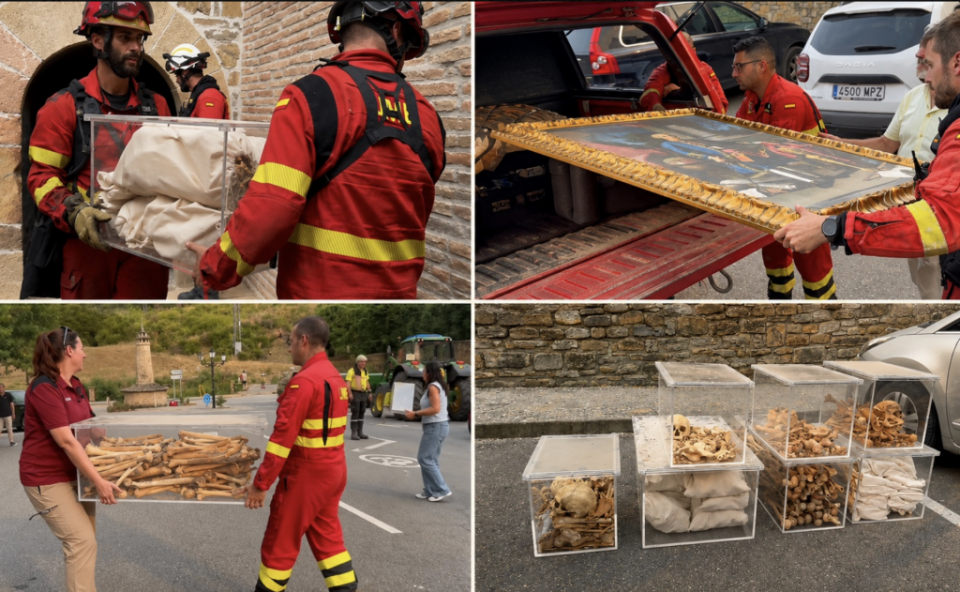
The remains of the first kings of Aragón have been removed from one of Spain’s most important medieval monasteries after an advancing wildfire came dangerously close to the historic site in the province of Huesca.
An emergency operation was launched at the Monastery of San Juan de la Peña as the wildfire that began on Monday in Las Peñas de Riglos intensified and moved towards the complex.
The remains of three 11th-century monarchs — Ramiro I, Sancho Ramírez and Pedro I — were among the historic items taken from the monastery and transferred to the Museum of Huesca, around 80 kilometres away, where they will remain until it is considered safe for them to return.
The kings, who ruled between 1035 and 1104, are buried in the monastery’s Royal Pantheon alongside other members of the royal dynasty.
The evacuation came during what Aragón’s regional vice-president Mar Vaquero described as a ‘critical moment’ between 1pm and 5pm on Thursday, when the flames came close to reaching the Old Monastery.
The first emergency team to enter the deserted building included members of Spain’s Military Emergency Unit (UME). Among the objects they managed to recover was the original ceremonial military clothing of Pedro Pablo Abarca de Bolea, the Count of Aranda, an influential 18th-century Spanish statesman who is buried at the monastery.
Archaeological pieces were also removed during the operation, which took place in increasingly difficult conditions as smoke and the approaching fire threatened escape routes.
Joaquín Nuñez, head of the UME’s 4th Battalion, said instructions from Aragón government heritage specialists had to be relayed remotely as telephone coverage in the area deteriorated.
Firefighters were sent audio messages telling them which objects should be prioritised, but the first team eventually had to abandon the building when ‘the smoke became unbearable along the escape routes’. Nuñez described it as ‘a stressful situation’.
When conditions allowed another attempt, a multidisciplinary team from Aragón’s Department for Culture and Cultural Heritage entered the monastery accompanied by the UME and Guardia Civil.
This time, they were able to remove the skeletal remains of the early kings and other members of the royal family, together with sections of historic wall paintings that had already been mounted on supports and other valuable objects.
After further entries into the monastery, the royal remains were transported to the Museum of Huesca as a precaution.
Despite the danger, San Juan de la Peña remained undamaged on Friday morning. Parts of the monastery are carved directly into the rock, providing some natural protection, while emergency teams continued to guard the complex and the access routes surrounding it.
The UME, Huesca firefighters, Guardia Civil and Aragón’s nature protection agents were coordinating surveillance of the area, with the roads and approaches to the monastery being used as containment lines against the fire.
The wildfire had worsened considerably on Thursday amid high temperatures and strong winds. More than 9,000 hectares had been burned and 16 towns evacuated.
Emergency services warned that conditions remained difficult, although lower temperatures — and possibly storms — were forecast over the coming days. The monastery could again be threatened if the fire advances towards the bottom of the valley.
Birthplace of the Kingdom of Aragón
San Juan de la Peña is one of Aragón’s most important historical and religious sites and is closely associated with the origins of the medieval kingdom.
The monastery, whose beginnings date back more than a thousand years, was built beneath a vast overhanging rock in the Pyrenees and became an important centre of the emerging Kingdom of Aragón.
It was also a significant stopping point on the Camino de Santiago. In 1071, it became the first place in the Iberian Peninsula where Mass was celebrated according to the Roman liturgical rite. The monastery also adopted the Benedictine rule under Sancho III of Pamplona and, according to tradition, housed the Holy Grail for several centuries.
Its Royal Pantheon contains the tombs of Aragón’s earliest rulers and members of the royal dynasty, making the complex particularly important for understanding the development of the kingdom.
Among the other treasures rescued from the fire was the funerary coat belonging to the Count of Aranda, together with a facial reconstruction of the prominent Enlightenment-era politician.
The latest wildfire threat is not the first time San Juan de la Peña has faced destruction by fire. A major blaze in 1675 devastated much of the old complex and led to the construction of the nearby New Monastery on the Llano de San Indalecio. The open rocky plateau surrounding that later building has now provided a useful natural firebreak.
While the operation continued in Huesca, another major wildfire was causing widespread disruption in southern Spain. A blaze in the province of Huelva had burned around 31,000 hectares by Thursday and forced approximately 700 people to leave their homes. ALSO READ: Hundreds evacuated as fierce Huelva wildfire continues to defy firefighters.
Enjoying the news from Spain in English? Add us as a preferred news source in Google.
Subscribe to the Weekly Newsletter from Spain in English.
⛪ Técnicos del @GobAragon y efectivos de la @UMEgob rescataron del Monasterio Viejo de San Juan de la Peña los restos óseos del panteón real y otros restos medievales de gran valor. El hermano mayor de la @rhsanjuandelape, Félix Longás, ha explicado el proceso en… pic.twitter.com/HENuJargkb
— Aragón Noticias (@AragonNoticias_) August 14, 2026
👩🏼🚒 El Gobierno de Aragón traslada al Museo de Huesca los restos de los reyes que se encontraban en el Panteón Real en San Juan de la Peña ante el avance del fuego.
— Gobierno de Aragón (@GobAragon) August 13, 2026
➡️ La UME, Guardia Civil y un equipo de la Dirección General de Cultura y Patrimonio Cultural se han dirigido al… pic.twitter.com/xKACJwjMbV
Ante el avance de las llamas en el #IFPeñasdeRiglos, Agentes para la Protección de la Naturaleza y técnicos de Patrimonio del @GobAragon, junto a @UMEgob, han llevado a cabo una actuación decisiva para proteger el Monasterio de San Juan de la Peña y poner a salvo bienes… pic.twitter.com/Z2x3AVbMnc
— UME (@UMEgob) August 13, 2026
Las llamas se han quedado muy cerca del monasterio de San Juan de la Peña, aunque un ataque in extremis consiguió salvarlo del fuego.
— RTVEAragón (@RTVEaragon) August 14, 2026
Efectivos de la UME evacuaron del Monasterio Viejo bienes de incalculable valor y los restos de los primeros reyes de Aragón.
🎙️ Silvia Barraca pic.twitter.com/TX2QeqisLr

Click here to get your business activity or services listed on our DIRECTORY.