
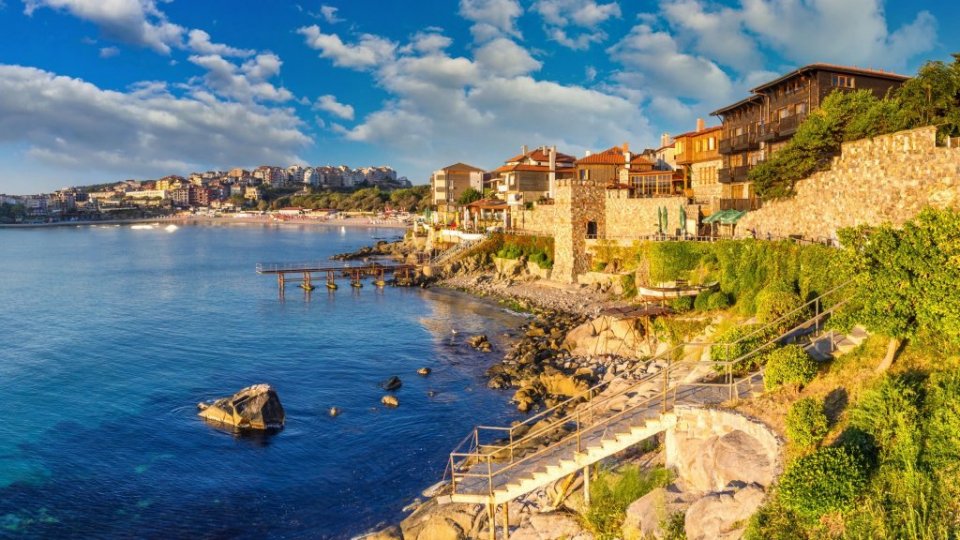
Bulgaria’s Black Sea city of Burgas has been selected to host the 2027 Eurovision Song Contest, bringing the event to the Balkan country for the first time following its historic victory earlier this year. ALSO READ: Sánchez: Eurovision boycott over Israel’s participation puts Spain ‘on right side of history’.
The European Broadcasting Union (EBU) and Bulgarian National Television (BNT) announced on Thursday that the 71st edition of Eurovision will be staged in Burgas in May, with the two semi-finals scheduled for 11 May and 13 May and the grand final taking place on 15 May.
The announcement comes just a day after Eurovision organisers unveiled significant changes to the contest’s rules, including new provisions preventing a winning country from hosting the following year’s event if war, geopolitical tensions or other circumstances pose a serious security risk.
Bulgaria earned the right to stage Eurovision after singer Darina Yotova, better known as Dara, won the 2026 contest in Vienna with her upbeat track ‘Bangaranga’, beating 24 other finalists and securing the country’s first victory in the competition.
Burgas was chosen ahead of the Bulgarian capital, Sofia, following what BNT described as a complex assessment of the rival bids against the EBU’s hosting requirements.
Eurovision director Martin Green said, ‘Burgas will bring something truly special to Eurovision.’
‘It is a dynamic and welcoming city on the Black Sea coast with a strong musical and cultural identity, which possesses the ambition, infrastructure, and passion needed to welcome the big Eurovision family,’ he said in a statement.
Burgas, home to around 190,000 people, is Bulgaria’s second-largest city on the Black Sea coast and an important commercial port. It is also a major gateway to the country’s popular coastal holiday resorts, including Sunny Beach.
The contest is due to take place at Arena Burgas, a multifunctional venue with around 5,500 seats and capacity for as many as 15,000 people depending on its configuration.
Milena Milotinova, head of BNT, said the broadcaster, the EBU and Burgas ‘will face intensive joint work to organise a contest that will live up to the high expectations of millions of viewers around the world’.
Burgas Mayor Dimitar Nikolov described the city’s selection as ‘an honour and a privilege’.
‘Thank you for the unique chance to present Burgas, the region, and the beauty of Bulgaria. We will give it our all to perform at a high level and be remembered as a successful host,’ he said.
Bulgarian authorities will also be hoping the enormous international exposure generated by Eurovision provides a further boost to the country’s tourism industry, which accounts for around 8% of national GDP.
New rules for countries affected by war
The choice of the 2027 venue follows the EBU’s announcement on Wednesday of a new framework governing whether future Eurovision winners will be permitted to stage the contest.
Traditionally, the broadcaster representing the winning country is given the opportunity to host Eurovision the following year. However, the new rules make clear that victory will no longer automatically guarantee hosting rights where significant security concerns exist.
Under the revised regulations, ‘the winning broadcaster will automatically be ineligible to host the contest if an armed conflict, a sensitive geopolitical situation, or any other situation materially affects the security, safety or stability of their state or immediate region’.
The EBU may commission an independent security assessment before determining whether a winning country can safely stage the event.
If it concludes that hosting is not possible, another country will be selected. Significantly, the replacement broadcaster will stage Eurovision in its own right rather than formally hosting it on behalf of the winning nation.
The change follows several years in which war and international tensions have increasingly affected the contest.
Ukraine was able to stage Eurovision in Kyiv in 2017 despite the continuing conflict in the east of the country between Ukrainian forces and Moscow-backed separatists. However, after Ukraine won again in 2022, Russia’s full-scale invasion meant it was considered impossible for the country to host the 2023 event.
Liverpool was subsequently selected as host city, with Britain staging Eurovision on Ukraine’s behalf.
More recently, Israel’s continued participation amid the war in Gaza has generated intense controversy around the competition. Israel came close to winning Eurovision in both 2025 and 2026, finishing second on each occasion.
Although the EBU did not single out Israel when announcing its new hosting rules, the changes follow a turbulent period for the competition in which Spain, Ireland, the Netherlands, Slovenia and Iceland boycotted Eurovision 2026 in Vienna in protest at Israel’s participation. ALSO READ: Spain, Ireland, Slovenia & the Netherlands withdraw from Eurovision, after Israel remains eligible.
Those countries argued that they could not take part alongside Israel because of the war in Gaza, which followed the Hamas attacks on Israel on 7 October 2023.
The boycott had a substantial impact on the television audience. The 2026 contest attracted around 131 million viewers, approximately 35 million fewer than the previous year’s competition. ALSO READ: Spain joins Ireland and Slovenia in boycotting Eurovision TV broadcast over Israel’s participation.
Green said the latest changes had been drawn up following feedback from EBU member broadcasters.
‘These changes are about giving everyone involved greater clarity, protecting artists and ensuring the contest continues to provide a safe and welcoming environment, while preserving the spirit and integrity that make the Eurovision Song Contest so special.’ ALSO READ: Sánchez: Eurovision boycott over Israel’s participation puts Spain ‘on right side of history’.
Minimum age increased to 18
Eurovision organisers have also raised the minimum age for contestants from 16 to 18. Performers will now have to be at least 18 by the date of their first rehearsal.
‘This change continues the work already undertaken by the contest to strengthen safeguarding and protect younger artists from the pressures associated with competing at the Eurovision Song Contest,’ organisers said.
The rule closes the door on a repeat of some of the exceptionally young contestants seen during Eurovision’s history. The youngest winner remains Belgium’s Sandra Kim, who was just 13 when she won the competition in 1986.
Eurovision is organised as a co-production between public service broadcasters belonging to the European Broadcasting Union. Despite its name, participation is not restricted geographically to Europe because the EBU’s membership extends beyond the continent.
Since its creation in the 1950s, the competition has developed into one of the world’s largest live televised music events and has played a role in launching or boosting the international careers of performers including ABBA, Celine Dion, Cliff Richard and Olivia Newton-John.
For Bulgaria, however, 2027 will represent completely new territory: after decades of Eurovision participation and its first victory in Vienna, the country will now welcome the contest itself to the Black Sea coast.
Enjoying the news from Spain in English? Add us as a preferred news source in Google.
Subscribe to the Weekly Newsletter from Spain in English.
Cambio en las normas de Eurovisión.
— Telediarios de TVE (@telediario_tve) August 13, 2026
La organización prohíbe a partir de ahora que los países en guerra o con una situación geopolítica que comprometa la seguridad puedan organizar el concurso, pese a haberlo ganado pic.twitter.com/htSbeiisNv
🇧🇬✨ BULGARIA WELCOMES THE WORLD!
— Bulgaria (@Bulgaria) August 13, 2026
Burgas is ready to welcome Eurovision fans from across the globe for the Eurovision Song Contest 2027! 🇧🇬🎶
📍 Burgas, Bulgaria
🏟️ Arena Burgas
🎤 Semi-Finals: 11 & 13 May 2027
🏆 Grand Final: 15 May 2027
Come for the music, stay for the Black… pic.twitter.com/QX8sFvw3jr

Click here to get your business activity or services listed on our DIRECTORY.