
The Spanish government has announced that Prime Minister Pedro Sánchez will travel to China in mid-April, as tensions with the United States intensify and Madrid looks to strengthen its economic relationship with Beijing.
Sánchez is scheduled to visit China from 13-15 April on an official trip, according to a statement released by his office on Monday, though no further details about his itinerary were provided.
The visit will mark Sánchez’s fourth trip to China in four years and comes shortly after he strongly criticised US President Donald Trump over the conflict with Iran, a key economic partner of China. ALSO READ: Pedro Sánchez responds to Donald Trump: ‘No to war’.
The Spanish leader has reiterated his stance of ‘no to the war’ and has declined Washington’s requests to allow US use of Spanish military bases in operations against Iran. This refusal has drawn sharp reactions from Trump, who has threatened to cut trade ties with Spain. ALSO READ: Pedro Sánchez urges ‘loyal cooperation’ not ‘confrontation’ with US amid tensions over Iran war.
Beijing has publicly supported Spain’s position, rejecting the idea of using trade as a political tool. ALSO READ: Pedro Sánchez heads to China and Vietnam in wake of US tariffs storm.
‘Trade should not be used as a weapon or an instrument,’ Chinese Foreign Ministry spokeswoman Mao Ning stated at a press conference, responding to a question about threats from Washington to ‘cut off all trade’ with Spain and even impose an embargo. ALSO READ: Trump vows to ‘cut off all trade’ with Spain over Iran stance: ‘We don’t want anything to do with Spain’.
On the economic front, Sánchez has been working to expand opportunities for Spanish businesses abroad and attract investment into Spain, the eurozone’s fourth-largest economy.
His upcoming trip also coincides with rising global energy concerns. Oil prices have surged following Iran’s effective blockade of the Strait of Hormuz, a critical route for global oil and gas shipments, in response to joint US-Israeli strikes. ALSO READ: Spain rejects participating in military operations in Strait of Hormuz, urges de-escalation.
China is also preparing for potential economic disruption linked to the Middle East tensions. According to analysis firm Kpler, more than half of China’s seaborne crude imports originate in the region, with most shipments passing through the Strait of Hormuz.
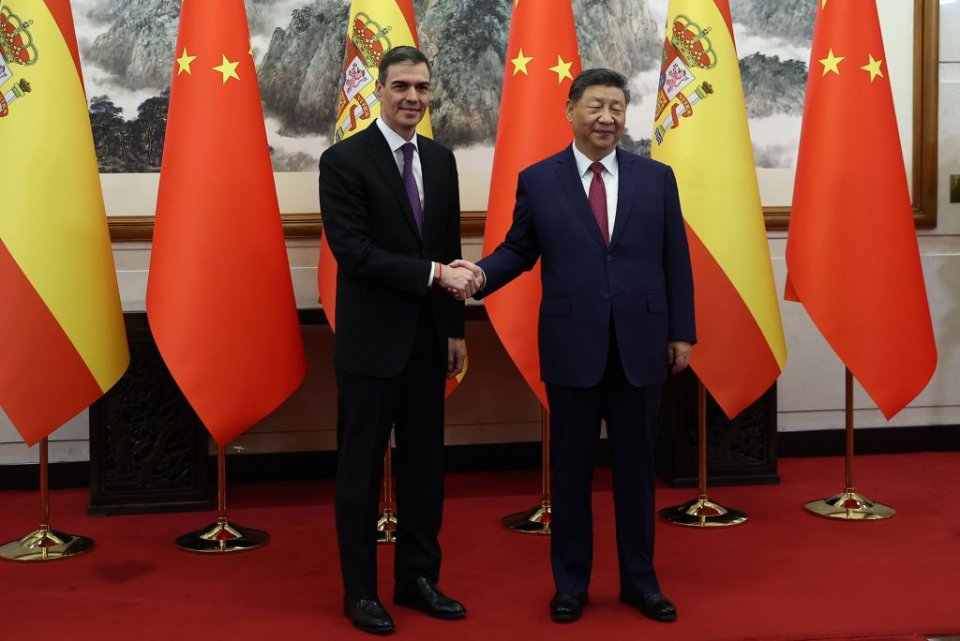
During his previous visit to Beijing in April 2025 (main image), Sánchez stressed that trade tensions should not hinder cooperation between the European Union and China after meeting President Xi Jinping.
Xi, for his part, called on Sánchez and the EU to work together to resist ‘unilateral bullying’, in reference to the trade tariffs imposed by the Trump administration.
Enjoying the news from Spain in English? Add us as a preferred news source in Google.
Subscribe to the Weekly Newsletter from Spain in English.

Click here to get your business activity or services listed on our DIRECTORY.