
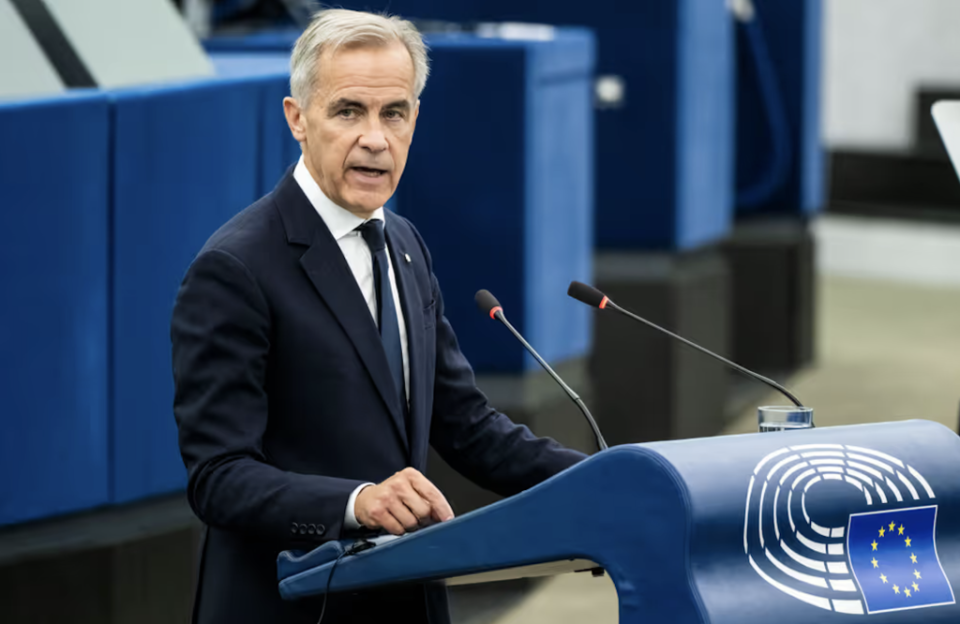
Canadian Prime Minister Mark Carney has called for a far-reaching new alliance between Canada and the European Union, insisting that neither Washington nor any other government would dictate who his country could build international partnerships with, after US President Donald Trump threatened fresh tariffs over the rapidly deepening relationship.
Addressing the European Parliament in Strasbourg on Thursday, Carney said Canada welcomed an unprecedented proposal from European Commission President Ursula von der Leyen for it to become the EU’s first ‘associate member’.
‘Canada and Europe are each strong. Europe and Canada are stronger together,’ Carney told MEPs in a speech that received a standing ovation.
His intervention came a day after von der Leyen used her annual State of the Union address to propose opening the door to an entirely new form of relationship with Canada — one that could encompass trade, defence, technology, energy, critical minerals and the Arctic. ALSO READ: Von der Leyen proposes new EU migration emergency framework after Ceuta crisis.
The proposal has already provoked an angry response from Trump, who described the idea as ‘laughable’ and suggested Washington could impose ‘very serious tariffs’ on the EU or restrict trade with Europe if he regarded the arrangement as hostile to the United States.
Carney, however, rejected the suggestion that Washington should have any say over the countries with which Canada chooses to cooperate.
‘No one is going to dictate our culture, or with whom we can strike agreements internationally,’ he told reporters following his address.
At the same time, the Canadian leader stressed that closer EU-Canada relations were intended as a positive partnership rather than an alliance directed against the United States or any other country.
‘A beacon for other democracies’
Carney framed the proposed relationship as part of a wider response by democratic countries to an increasingly unstable international order, characterised by trade disputes, geopolitical rivalry and growing pressure on established alliances.
‘We are not fair-weather allies. We do not pursue zero-sum deals. Our commitment to the rule of law, and our unyielding defence of human dignity, individual freedom, and democracy share the same deep roots, the same unwavering dedication,’ he said.
‘Today, our societies are being shaken by new storms: the upheaval caused by climate change, the erosion of democratic norms, the weaponisation of trade.’
Carney argued that Canada and Europe should not seek self-sufficiency but instead build what he called ‘collective resilience’, reducing their vulnerability to outside economic or political pressure.
‘We do not seek power to dominate others,’ he said. ‘On the contrary, we are pursuing resilience so that no one can control our open markets, impair our sovereignty, threaten our territorial integrity, or undermine our freedoms, our democracies, our rule of law.’
A stronger relationship between Canada and Europe, he suggested, could ‘create a beacon for other democracies’.
The speech echoed Carney’s intervention at the World Economic Forum in Davos earlier this year, when he called for democratic ‘middle powers’ to cooperate more closely in a world increasingly dominated by competition between major powers.
Trump threatens Europe with new tariffs
Trump’s reaction demonstrated the diplomatic risks surrounding the European initiative.
Speaking after von der Leyen unveiled the proposal on Wednesday, the US president suggested that making Canada an associate member could amount to a ‘hostile act’. ALSO READ: From trade threats to praise: Trump changes tune as NATO agrees new defence commitments.
He warned that if he considered the move hostile, the United States could impose ‘very serious tariffs’ or ‘stop trading with Europe’ in some areas.
The dispute comes as Canada and the United States are already embroiled in an escalating trade confrontation, while relations between Washington and Brussels have also been strained by tariffs and other geopolitical disputes.
Von der Leyen had explicitly attempted to head off such an interpretation when announcing her proposal.
‘This is a partnership not against anyone else, but for our common strength,’ she told the European Parliament.
Carney adopted much the same position on Thursday, describing the closer relationship as a positive initiative rather than a reaction against Washington. ALSO READ: Trump says he has ordered a cutoff of US trade with ‘terrible ally’ Spain over NATO dispute.
What would ‘associate membership’ actually mean?
Despite the dramatic terminology, precisely what Canadian ‘associate membership’ of the EU would involve remains unclear.
No such formal status currently exists in the EU treaties, and Canada is not seeking conventional membership of the 27-nation bloc.
The concept of an associate status had previously been floated by German Chancellor Friedrich Merz in relation to Ukraine, as a possible arrangement short of full EU membership. Under that concept, Ukraine might have gained access to parts of the EU budget and participated in summits and some European institutions without acquiring the full voting rights of a member state.
There is no indication that exactly the same model would apply to Canada, however, and any eventual arrangement would have to win the necessary backing from EU governments.
Carney played down the importance of what the relationship was ultimately called.
‘What matters is the substance — what are we actually building together?’ he said.
Canada, he stressed, is neither seeking nor currently in a position to become a full EU member, while any eventual agreement would also be subject to debate and approval in the Canadian parliament.
There are also signs of caution among some European capitals about creating a new formal category of membership. Nevertheless, there appears to be broad interest within the bloc in expanding practical cooperation with Canada, irrespective of the terminology eventually used.
Defence, energy, AI and critical minerals
Carney set out an ambitious range of areas in which the two sides could deepen their relationship.
Canada could help Europe secure supplies of critical raw materials and provide liquefied natural gas and hydrogen ‘at large scale’, while cooperation could extend across defence production, artificial intelligence, computing capacity, space technology and payment systems. ALSO READ: Europe must take defence into its own hands amid US NATO threats, says Spain’s foreign minister.
He also advocated moving towards ‘seamless digital trade’ in non-agricultural goods and a broad range of services.
Another proposal would make it easier for young Canadians and Europeans to live, work and study on either side of the Atlantic, potentially including Canadian participation in the EU’s Erasmus+ education and exchange programme.
Von der Leyen had outlined similarly ambitious plans on Wednesday, proposing what she called an ‘Alliance for the Future’ between the two sides.
Her plans include a technology alliance, greater integration between Canadian and European defence industries and closer cooperation over energy, critical minerals, batteries, artificial intelligence, quantum technology, cybersecurity and economic security. She also wants cooperation in the Arctic to become a flagship element of the relationship. ALSO READ: Calls for an AI slowdown: conscience, politics, or cold feet?
The two sides already have substantial economic ties through the Comprehensive Economic and Trade Agreement (CETA), which provisionally came into force in 2017 and removed almost all tariffs between Canada and the EU. Trade has increased significantly since the agreement was introduced.
Canada has also moved closer to the EU on defence, this year becoming the first non-EU country to join the bloc’s SAFE defence-loan programme.
The next major opportunity to turn the political declarations into concrete proposals will come at an EU-Canada summit due to be held in Montreal next month.
For Carney, however, the broader purpose of the emerging partnership goes beyond individual trade or defence agreements.
‘We are not fair-weather allies,’ he told European lawmakers.
And despite the increasingly explicit warnings from Washington, his message in Strasbourg was that Canada intends to continue choosing its own international partnerships — with Europe now at the centre of that strategy.
Enjoying the news from Spain in English? Add us as a preferred news source in Google.
Subscribe to the Weekly Newsletter from Spain in English.
Canada’s Prime Minister Mark Carney wants the EU and Canada to strengthen their partnership in response to today’s geopolitical challenges. pic.twitter.com/jtrkR5gwte
— European Parliament (@Europarl_EN) September 17, 2026
The alliance between Canada and Europe is not defined by what we oppose. It is about what we are for: freedom, solidarity, prosperity, sustainability. An alliance strong enough so that no one can dictate our choices.
— Mark Carney (@MarkJCarney) September 17, 2026
Europe and Canada are each strong. Europe and Canada are even… pic.twitter.com/RW85Z0EauJ
— Pedro Sánchez (@sanchezcastejon) September 17, 2026

Click here to get your business activity or services listed on our DIRECTORY.