
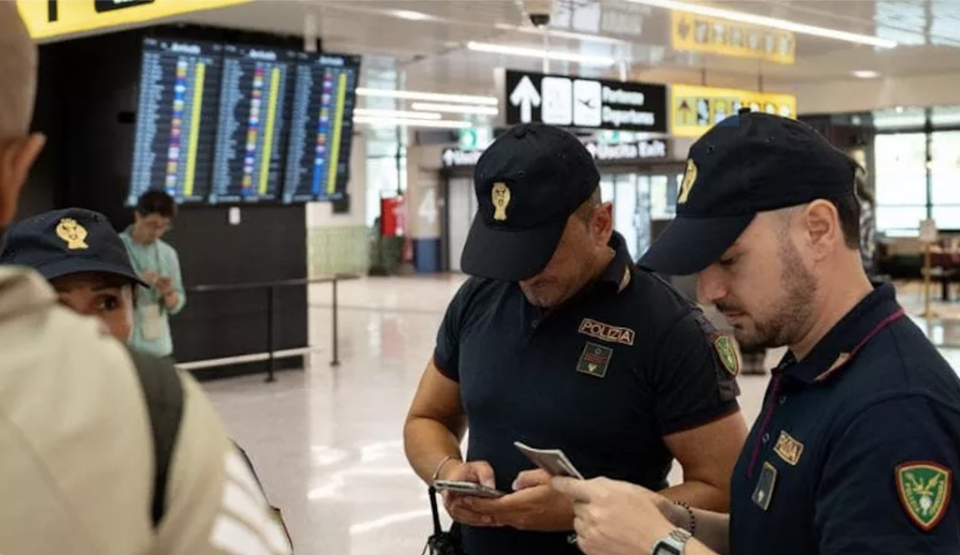
Spain and Italy agreed on Thursday to end the reciprocal border checks introduced after the summer migration crisis in Ceuta, bringing an almost three-month confrontation over travel between the two countries towards a close.
The agreement followed a telephone conversation between Spanish Interior Minister Fernando Grande-Marlaska and his Italian counterpart, Matteo Piantedosi. Their discussions came after Spanish Prime Minister Pedro Sánchez and Italian Prime Minister Giorgia Meloni met on the sidelines of the European Council. ALSO READ: Spain and Italy plan joint end to border checks imposed after Ceuta crisis.
Both governments confirmed that the temporary controls would not be extended. The agreement covers checks on passengers travelling between the countries by air and sea.
‘The decision, reached after a careful assessment of the situation, will be accompanied by enhanced information-sharing measures to ensure the full security of the common Schengen area,’ the Italian Interior Ministry said.
The announcement means the restrictions will be allowed to expire, rather than renewed again. The European Commission’s published register lists Spain’s current controls as running until 22 October and Italy’s until 23 October.
How the dispute began
Italy announced its decision to restore border checks on 31 July, following the arrival of nearly 80,000 people in Ceuta over 30 and 31 July from Morocco. ALSO READ: Ceuta crisis sparks emergency EU meeting requests as Sánchez rejects Schengen criticism.
Meloni’s right-wing government described the intervention as an ‘extraordinary measure’ intended to ‘safeguard national security and prevent possible repercussions’. Rome’s stated concern was that migrants who had entered the Spanish enclave could subsequently travel onwards to Italy.
The Italian controls took effect on 1 August. Spain responded by introducing equivalent checks on arrivals from Italy, rejecting Rome’s justification and describing its measures as ‘unjust, contrary to European Union interests, and discriminatory to the population of Spain’. ALSO READ: Spain imposes reciprocal border checks on Italy as Schengen dispute escalates.
Successive extensions kept the restrictions in place through the summer and into October, turning the initial security decision into a prolonged diplomatic disagreement. ALSO READ: Italy and Spain extend tit-for-tat border controls for another 15 days over Ceuta migrant crisis.
The argument became particularly public in September. When Italy decided on 15 September to retain the checks for a second time, Spanish Foreign Minister José Manuel Albares called the decision a ‘disgrace’ and an ‘absurd measure’.
His Italian counterpart, Antonio Tajani, had meanwhile described Spain’s decision to impose reciprocal controls as ‘unnecessarily aggressive’.
Existing checks on departures from Ceuta
A central issue in the dispute was the system already governing travel from Spain’s North African enclaves.
Ceuta and Melilla operate under special Schengen arrangements, with document checks on passengers leaving by sea or air for mainland Spain. Arrival in either enclave therefore does not provide unchecked access to the mainland.
As the Spanish Foreign Ministry explains on its website: ‘Nobody travels from Ceuta or Melilla to the mainland without identifying themselves to the National Police at the port or airport.’
The distinction is relevant to Italy’s stated concern about onward travel: passengers departing the enclaves already have to pass through identity controls before reaching mainland Spain.
Schengen normally allows travel between participating countries without routine internal border checks. Its rules nevertheless permit governments to restore controls temporarily in response to serious threats to public policy or internal security, subject to requirements including necessity and proportionality.
More than 180,000 travellers checked
Italy released figures on 31 August showing the scale of its first month of inspections.
According to the Italian authorities, more than 180,000 travellers arriving from Spain had been checked. Entry was refused to 31 people, including eight Moroccan nationals, and six others were arrested.
Thursday’s agreement replaces further extensions of those passenger controls with a commitment to closer information-sharing, ending the immediate dispute while maintaining cooperation over security within the Schengen area.
Enjoying the news from Spain in English? Add us as a preferred news source in Google.
Subscribe to the Weekly Newsletter from Spain in English.

Click here to get your business activity or services listed on our DIRECTORY.