
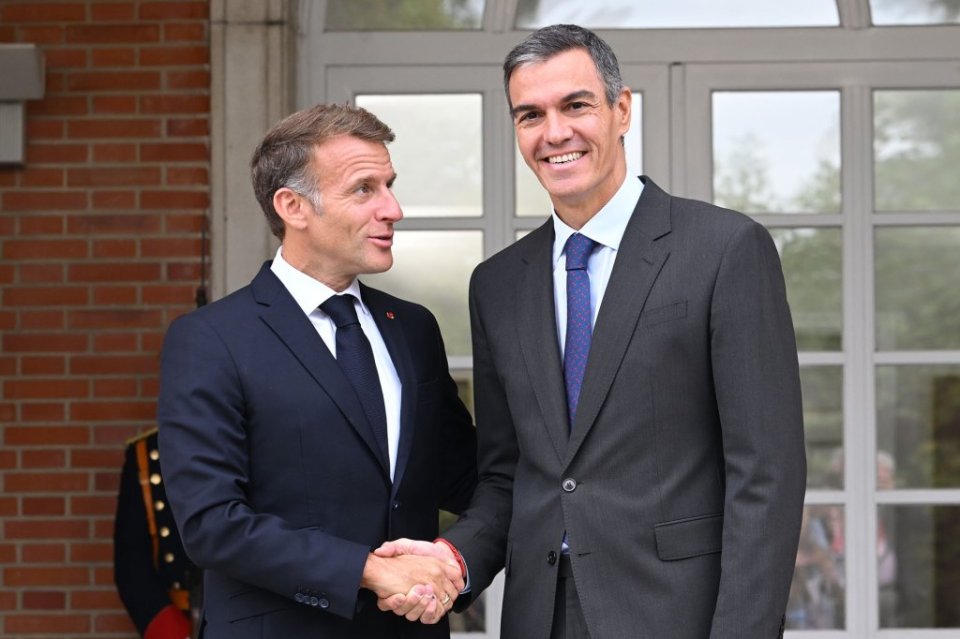
Spanish Prime Minister Pedro Sánchez has publicly apologised to French President Emmanuel Macron after the Spain’s Senate House again rejected a friendship treaty between their countries, while both leaders insisted they remained committed to securing its approval.
The parliamentary defeat overshadowed Macron’s two-day state visit to Madrid, the first by a French president since Nicolas Sarkozy visited in 2009. Speaking alongside Sánchez at La Moncloa on Wednesday, Macron played down the implications for bilateral relations, describing the rejection as ‘more a setback than a drama.
Sánchez said he expected Spain’s parliament to approve the Treaty of Friendship and Cooperation before the end of the year. Signed in Barcelona in January 2023, the agreement has already completed the French ratification process, but remains blocked in Spain despite receiving approval from Congress.
‘I can only apologise publicly for this negative vote,’ Sánchez said of Tuesday’s decision in the upper house.
Senate rejection despite constitutional ruling
The right-wing opposition People’s Party (PP), led by Alberto Núñez Feijóo, used its absolute majority in the Senate to oppose the treaty, with the far-right Vox group also voting against it. The agreement was rejected by 142 votes to 106. UPN abstained and the BNG did not vote; the other groups participating supported approval.
The vote came a week after Spain’s Constitutional Court unanimously ruled that the treaty was compatible with the Constitution.
The PP’s challenge had centred on a provision allowing French ministers to participate in meetings of the Spanish government, and Spanish ministers to do the same in France. Following an exchange of letters between the two countries clarifying its interpretation, the court concluded that such participation would occur in a separate meeting on the margins of the Council of Ministers.
Nevertheless, the PP maintained its opposition. During the Senate debate, it questioned the extent of the commitments contained in the treaty and renewed its objections to the arrangements for ministerial participation.
Sánchez criticised both the rejection and the decision to convene an extraordinary Senate session to vote against the agreement. He accused the PP of failing to act as a party with a sense of responsibility towards the state, stressing that even the Constitutional Court’s conservative judges had supported the ruling.
The prime minister argued that the agreement concerned the long-term relationship between two nations, rather than the governments currently in office.
‘I don’t know what strategy for good neighbourly relations the PP and Vox have,’ he said. ‘It is not a treaty between the government of the president of the French Republic and that of the wicked President Sánchez; it is a treaty between France and Spain.’
Shared commitment to Europe
Despite the dispute, both leaders emphasised the importance of strengthening cooperation between Spain and France and their shared ambition for the European Union.
Sánchez described the countries as feeling like brothers and sharing a common future, both within Europe and in their bilateral relationship. He called for ambition in confronting a political current seeking to persuade Europeans to abandon their values.
‘Spain and France represent that European resistance to those enemies of the continent and of the European model,’ he said.
Macron also underlined the importance of the relationship, highlighting the commercial ties between the two countries and expressing confidence that the treaty would ultimately be approved. At Tuesday’s gala dinner hosted by King Felipe VI and Queen Letizia, he had already declared: ‘We will achieve it.’
Sánchez said the desire to build a ‘more united and solid’ Europe had featured in his discussions with the French president.
Ceuta and European border cooperation
The meeting at La Moncloa also covered the migration situation in Ceuta following the large-scale arrivals recorded in the Spanish autonomous city at the end of July.
Macron expressed France’s solidarity with Spain and advocated using the available mechanisms for cooperation with countries of origin and transit to manage returns within the European framework.
He also called for firm protection of Europe’s common borders, alongside solidarity between member states and respect for EU values. Sánchez thanked him for France’s position, recalling that Macron had already conveyed his support during the Ceuta crisis.
The talks concluded a state visit that began on Tuesday, when Macron was welcomed with full military honours by the king. During his stay, the French president also joined writer Javier Cercas for a discussion with students, offering an optimistic defence of the European Union.
Enjoying the news from Spain in English? Add us as a preferred news source in Google.
Subscribe to the Weekly Newsletter from Spain in English.
¡Gracias, España, por recibirnos con tanta cercanía, reflejo de la relación que une a nuestros países! Tienen en Francia, con nosotros, amigos seguros, y por mucho tiempo. pic.twitter.com/Ggf3rhfdjN
— Emmanuel Macron (@EmmanuelMacron) September 30, 2026
Cuando España y Francia están unidas, Europa avanza. pic.twitter.com/ChrZciu3WZ
— Pedro Sánchez (@sanchezcastejon) September 30, 2026

Click here to get your business activity or services listed on our DIRECTORY.