
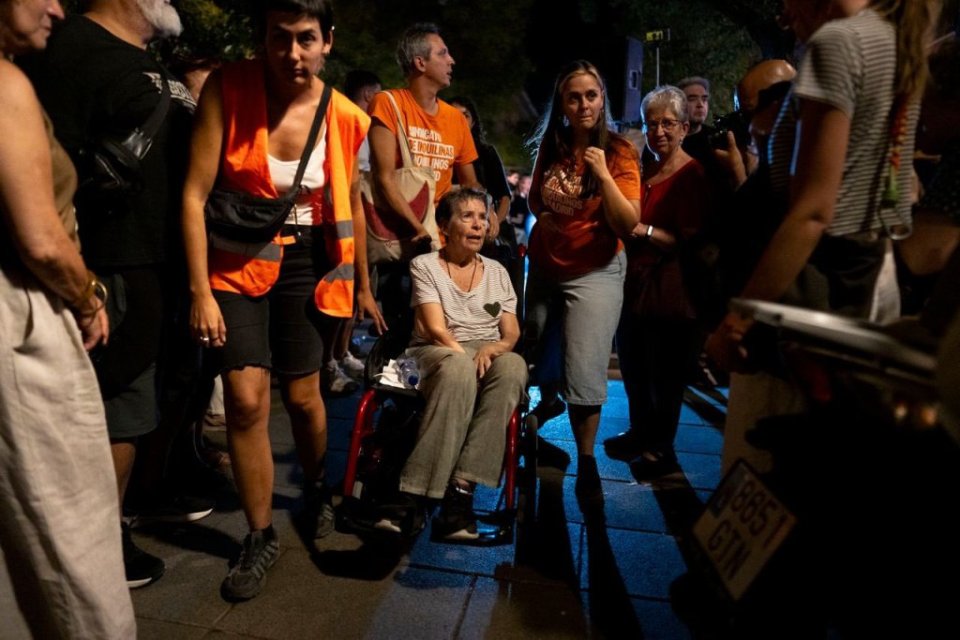
Spain’s government is working to approve a new housing decree at next Tuesday’s cabinet meeting, including measures designed to prevent vulnerable people being evicted when no suitable alternative accommodation is available, following the controversial eviction of an 87-year-old woman from her Madrid home.
The removal of María del Carmen ‘Maricarmen’ Abascal (main image) from the apartment where she had lived for more than 70 years has intensified pressure on Pedro Sánchez’s coalition government to agree new protections for tenants. ALSO READ: 87-year-old woman evicted from Madrid home after 70 years despite mass protests and offer to pay her rent.
Government sources have described Wednesday’s eviction as a ‘turning point’ that should encourage political parties to reconsider their positions on housing legislation.
Housing Minister Isabel Rodríguez said the government was working towards taking the Royal Decree-law to the Council of Ministers on Tuesday, but stressed that cabinet approval alone would not be enough.
The decree would subsequently need sufficient support in the Spanish Congress to remain in force.
‘The government can approve it tomorrow, but without the support of the groups it will not become law,’ Rodríguez told RTVE.
She said there appeared to be considerably greater agreement among the Spanish public over the need for action on housing than among political parties, but suggested that Maricarmen’s eviction may have begun to narrow some of those political differences.
‘I see much more social consensus than political consensus,’ she said, calling for parties to reach an agreement.
Rodríguez added that Wednesday’s events appeared to have ‘stirred the conscience’ of political groups whose positions had previously been further apart. ALSO READ: Spanish government delays major housing decree until autumn amid political deadlock.
Eviction becomes catalyst for government action
Maricarmen, who has a recognised disability and uses a wheelchair, was evicted on Wednesday from her apartment in Madrid’s Retiro district after a lengthy legal dispute with property investment company Urbagestión Desarrollo e Inversión.
She had lived in the property since 1956 and was paying around €500 a month under a longstanding rent-controlled tenancy.
Hundreds of people gathered outside the building in an attempt to prevent the eviction, with police eventually clearing protesters from the entrance and inside the property.
Maricarmen was removed on a stretcher and taken by ambulance to hospital.
Her case has subsequently become a focal point in Spain’s continuing debate over housing costs and tenant protections.
Prime Minister Pedro Sánchez, speaking in New York, described what had happened as a ‘social tragedy’, while political responsibility for the eviction has become the subject of bitter exchanges between the national government and Madrid’s regional authorities.
Isabel Díaz Ayuso, president of the Madrid region, rejected criticism from Sánchez and pointed out that the eviction had been ordered by a judge and carried out by National Police, which comes under the national government. ALSO READ: Opposition steps up pressure on Ayuso government over €6.3 million penthouse purchase.
She also argued that Sánchez and his parliamentary allies had had years in which to change legislation governing such cases.
The controversy has now shifted towards whether Spain’s divided parliament can agree measures intended to prevent similar evictions.
Moratorium where no alternative home is available
Among the provisions expected to form part of the government’s proposed decree is an anti-eviction moratorium protecting people who cannot be provided with suitable alternative accommodation.
The precise final text remains under negotiation.
The government needs to consider not only what can secure agreement between the socialist PSOE and its junior coalition partner Sumar, but also whether the measures can obtain sufficient votes in Congress.
Government sources have appealed to parliamentary parties to compromise, arguing that all sides will have to make concessions if an agreement is to be reached.
They have also directly challenged the right-wing opposition People’s Party (PP) to consider at least abstaining when the decree reaches Congress, arguing that even if the measures differ from those the PP itself would introduce, they could prevent cases similar to Maricarmen’s.
The PP, however, has so far distanced itself from negotiations.
Government negotiating with Junts and Podemos
Attention is therefore focusing particularly on the Catalan pro-independence party, Junts per Catalunya (JxCat), and far-left Podemos group, whose votes could prove crucial to the decree’s survival in Congress.
The government has confirmed contacts with both parties. ALSO READ: Catalan pro-independence party Junts to withdraw backing for Spanish government.
JxCat says it presented Sánchez with its own proposed housing decree two weeks ago, incorporating measures it had previously put before Congress.
The Catalan party said the PSOE was now examining those proposals after what it described as months of government inaction and that it was awaiting a response.
Negotiations continued on Friday.
Culture Minister Ernest Urtasun, of Sumar, said the government was prepared to consider tax incentives proposed by JxCat for landlords affected by extensions to rental contracts.
He said the government had been willing from the outset to discuss such tax reductions and stressed the urgency of reaching an agreement.
Asked whether conditions existed for an agreed Royal Decree-law to go before the cabinet on Tuesday, Urtasun said the government’s political willingness was there and that negotiations would continue until the last moment.
Among the issues he said should be addressed are protection against evictions, regulation of temporary rentals and measures intended to prevent tenants facing substantial increases when their contracts come up for renewal.
Podemos has also said it is prepared to negotiate, but has placed conditions on its support.
The party has objected to including changes to Spain’s land law within the housing decree, saying an agreement could be close if that proposed reform is removed.
Sumar also demands expropriation of Maricarmen’s former home
The negotiations have also exposed differences within Sánchez’s coalition government over how far the response to Maricarmen’s eviction should go.
Sumar is demanding not only the wider housing decree but the compulsory purchase of Maricarmen’s former apartment.
Second Deputy Prime Minister and Labour Minister Yolanda Díaz has called for both measures to be considered at Tuesday’s Cabinet meeting.
‘The Council of Ministers next Tuesday must approve the expropriation of Maricarmen’s home and a package to freeze rents, as we have called for from Sumar,’ Díaz said.
Sumar has formally presented the proposal to the socialist side of the coalition.
The PSOE-led side of the government has not confirmed that the proposed expropriation will be included on Tuesday’s agenda.
Urtasun reiterated Sumar’s demand on Friday, arguing that compulsory purchase could provide a specific solution to Maricarmen’s case.
Spanish law permits compulsory acquisition of private property in certain circumstances subject to legal requirements and compensation, although no decision to pursue that course in this case has yet been announced.
Housing crisis returns to centre of political debate
The latest attempt to reach an agreement follows previous parliamentary failures over housing measures.
An earlier government decree containing tenant protections was rejected by Congress, demonstrating the difficulty Sánchez’s minority government faces in assembling parliamentary majorities for legislation.
The political arithmetic means that cabinet approval of the latest proposal would be only the first hurdle.
The government must construct a text capable of satisfying parties with significantly different approaches to housing policy, ranging from demands for stronger rent and eviction protections to proposals for incentives and greater safeguards for property owners.
Maricarmen’s eviction has given those negotiations a new urgency.
Whether that public and political reaction is sufficient to produce an agreement will now become clearer ahead of Tuesday’s Council of Ministers meeting.
Enjoying the news from Spain in English? Add us as a preferred news source in Google.
Subscribe to the Weekly Newsletter from Spain in English.
Primeras declaraciones de Maricarmen desde el hospital. Está aún muy débil y conmocionada pero todavía le quedan fuerzas para agradecer todo el apoyo recibido estos años y animarnos a seguir luchando por lo que es nuestro.
— Sindicato de Inquilinas e Inquilinos de Madrid (@InquilinatoMad) September 25, 2026
NO FALTES EL SÁBADO 26 A LAS 18:30H pic.twitter.com/jE58tQBMDh
Sumar quiere expropiar a Urbagestión el piso para que Maricarmen vuelva allí.
— La Hora de La 1 (@LaHoraTVE) September 24, 2026
Verónica Martínez: “Es viable jurídicamente. El Art. 33.3 de la Constitución lo prevé, la ley de expropiación también (…) Tenemos que meterlo en el real decreto ley del martes” #LaHora24S pic.twitter.com/ROtVwwrkn7

Click here to get your business activity or services listed on our DIRECTORY.