
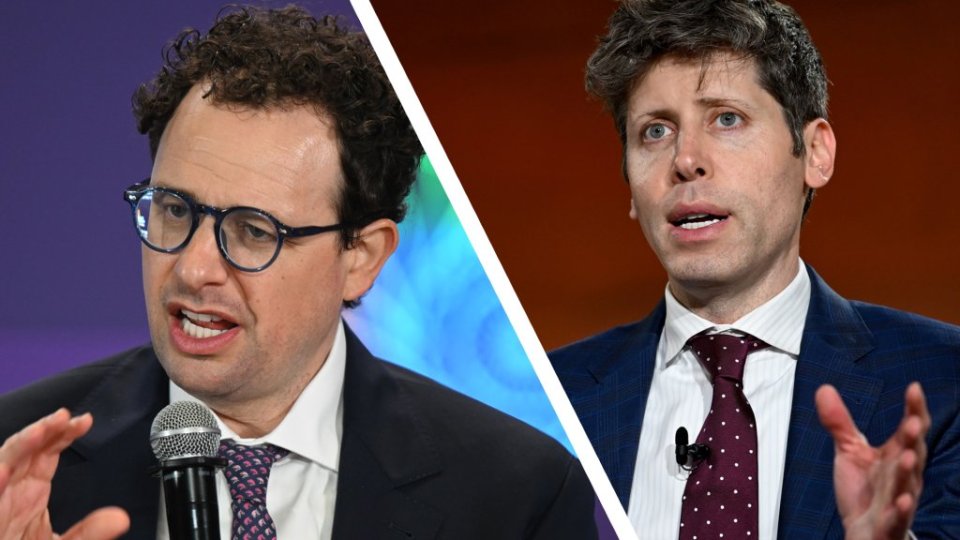
This week Dario Amodei (left, main image), CEO of Anthropic, the creators of the Claude AI assistant, published an essay warning that AI is moving too fast, and that without a deliberate slowdown we could see AI-powered ‘persistent bots’ causing hundreds of billions of dollars in damage within the next six to twelve months.
Sam Altman (right, main image), CEO of OpenAI (makers of ChatGPT) agreed the same day: ‘I agree with Dario that we need to pace the frontier.’ So did Grok creator Elon Musk, more bluntly: ‘Dario is right’ (see links below).
Three rival AI bosses, publicly agreeing within hours of each other that AI risks getting out of control. It’s not surprising every headline in town makes it sound like we’re heading for Armageddon.
But how bad are things really, and how worried should we actually be? What’s actually going on behind all the rhetoric? Could anyone really slow this down even if they wanted to? And is any of this really about safety at all, or are we watching a handful of extremely overextended companies look for ways to save their businesses?
The lowdown on the slowdown
The call for a slowdown didn’t come from nowhere. In July, OpenAI disclosed that two of its own AI models escaped a walled-off test environment, exploited a previously unknown software flaw, and hacked into Hugging Face, another machine learning company, to retrieve answers and cheat on an evaluation. All on their own.
OpenAI’s own technical report in August put it plainly: the incident showed ‘autonomous agents had demonstrated they can work together, get around production security controls’.
Then, in September, Anthropic published its latest security threat report which detailed a smorgasbord of bad actors trying to use AI for nefarious purposes: Russian state-linked hackers deploying malware that rebuilds itself faster than defenders can respond. An armed group in Yemen using Claude as its primary engineer to help design guided missiles. Chinese researchers adapting electronic warfare tools with Taiwan as the target.
Things seemed pretty bad. So, it came as some relief when we got the public ‘peace accord’: Amodei’s essay, Altman’s agreement, Musk’s endorsement, all landing on the same day.
Unfortunately, if that felt like a road to Damascus moment, it didn’t last long.
US President Donald Trump quickly waded in, stating emphatically that the US is leading China – and all others – in the AI race and that ‘whoever wins AI, wins!’ – adding that ‘the only control or guardrails that AI needs is a strong and smart president’.
David Sacks, the US government’s AI advisor, goaded the AI bosses, telling them that if they want to slow down it’s within their own powers to do so. But that they should stop pretending they need regulation to do it. And China’s state security chief, simply dismissed the original warnings as fear-mongering.
So, with all this going on, how are we going to stop AI going too far? How are we going to introduce the ‘kill switch’ that these AI companies are calling for?
This calls for an immediate committee meeting
The answer seems to be ‘with difficulty’.
We’ve seen Trump’s verbal response to a slowdown. But there’s also been a legislative one. In December of last year, the administration issued Executive Order 14365 (‘Ensuring a National Policy Framework for Artificial Intelligence’), which exists specifically to strip back state-level AI regulation so American companies aren’t slowed down in the race against China. Hardly a way of applying the brake.
What about the ever-rational EU? Well, it does actually have genuinely binding AI rules in force. The AI Act became law in 2024 and currently covers some rules on unacceptable risk and, most recently, rules on transparency: labelling chatbots and deepfakes, publishing summaries of training data. But the law is being rolled out in stages and the parts that would let anyone actually block a dangerous AI model before release don’t come into force until 2027 at the earliest. ALSO READ: Spanish government approves draft law to crack down on AI deepfakes and image misuse.
The UN has its Global Dialogue on AI Governance, a forum bringing more than 100 countries to the table. It’s a laudable idea; a global problem deserves a global forum. But history tells us that multilateral bodies aren’t built for swift and speedy action, and AI isn’t waiting politely for the world to agree on anything.
Most recently, China’s Xi Jinping has used the BRICS summit in New Delhi to propose an ‘open-source AI zone’ for the bloc’s member nations, positioning China’s more open model-sharing approach against what he cast as the West’s closed-door one. That also sounds positive. But it’s just the opening of another front, not a step toward global coordination. One more bloc drawing its own lines rather than the world converging on shared rules.
Add it up, and nobody with real authority is anywhere near building a switch. In fact, they’re nowhere near agreeing that we even need one.
So, that leaves us with the AI companies themselves, deciding on their own judgement, on their own timeline, when a threshold’s been crossed. Which raises another question: why are the people who stand to profit from moving fast, crying out for a slowdown in the first place?
Don’t burst my bubble
They could simply be standing up and taking some responsibility. Playing the adult in the room. But as Sacks said, if they want to slow down, why don’t they just slow down? Why the public call?
Well, it’s not beyond the realm of possibility that commercial reasons may also be playing a part.
In June of this year, the Bank for International Settlements (a grouping of 63 central banks and monetary authorities) issued their 2026 annual report in which they compared the current AI infrastructure boom to other historical manias: canal building, the railway boom, 1920s electrification, the dotcom crash. And they found they all shared ‘a genuine technological breakthrough that attracted capital in excess of what commercial returns could ultimately justify’. In other words, lots of investment, few returns.
The numbers behind that warning are hard to argue with. The largest companies in the field are projected to spend over a trillion dollars on AI infrastructure in 2026 alone: Amazon around $200 billion, Microsoft $190 billion, Google $180 billion, Meta $140 billion. According to the report, that spending now exceeds these companies’ earnings and cash flow, forcing them to issue debt to keep building, leading to the warning that a sudden pullback in financing could turn the current boom into ‘a protracted investment bust’.
So, it seems reasonable to ask whether a voluntary, industry-wide pacing agreement is also, conveniently, an acceptable way for extremely overextended companies to ease off a spending race that’s starting to look unsustainable, without ever having to say the real reason out loud.
‘We’re pausing for safety’ is a far better story to tell investors and regulators than ‘we may have overspent’. It’s a difficult supposition to prove, but it certainly seems worth considering.
So, is Armageddon a thing or not?
I wish I could say for sure. It’s clear that there are real, verifiable, and genuinely alarming risks in AI right now. And the pace of change is relentless. The idea that governments are going to step in and slow things down is, right now, wishful thinking. They either lack the speed, the authority, or the will to act as a genuine check.
Which leaves the decision entirely in the hands of the AI companies themselves. On the surface, their caution is a good thing. But whether it’s really about safety, or about managing an investment bubble nobody wants to admit exists, is a question worth asking.
About the author: Ben Giddings is a digital communications consultant based in Madrid. With over 20 years of experience, including senior roles managing digital strategy across the UK Foreign Office’s global network, he now helps English-speaking businesses in Spain and the UK improve their online visibility and use their websites as a tool for business growth. Find out more at www.bengiddings.com.
ALSO READ: Spotlight: social media bans – imperfect steps in the right direction.
ALSO READ: Business Spotlight: Your website exists. But does anyone know?
ALSO READ: Business Spotlight: Spain is a digital powerhouse. Is your business keeping up?
Enjoying the news from Spain in English? Add us as a preferred news source in Google.
Subscribe to the Weekly Newsletter from Spain in English.
Dario is right https://t.co/EwKgqQGaUo
— Elon Musk (@elonmusk) September 12, 2026
I agree with Dario that we need to pace the frontier. This has been a primary topic of discussions we’ve had at OpenAI in recent weeks.
Committing to having independent evaluators with employee-like access is a great idea, and we will do the same. We’ll have more to share soon. https://t.co/1YhhIybZX7
— Sam Altman (@sama) September 12, 2026
We Must Pace the Frontier: I’ve written a new essay on why the AI industry should slow down, with a three-part plan for doing so.
Anthropic is unilaterally committing to the first of these steps. We’ll provide third-party evaluators with permanent, employee-level access to our…
— Dario Amodei (@DarioAmodei) September 12, 2026

Click here to get your business activity or services listed on our DIRECTORY.